
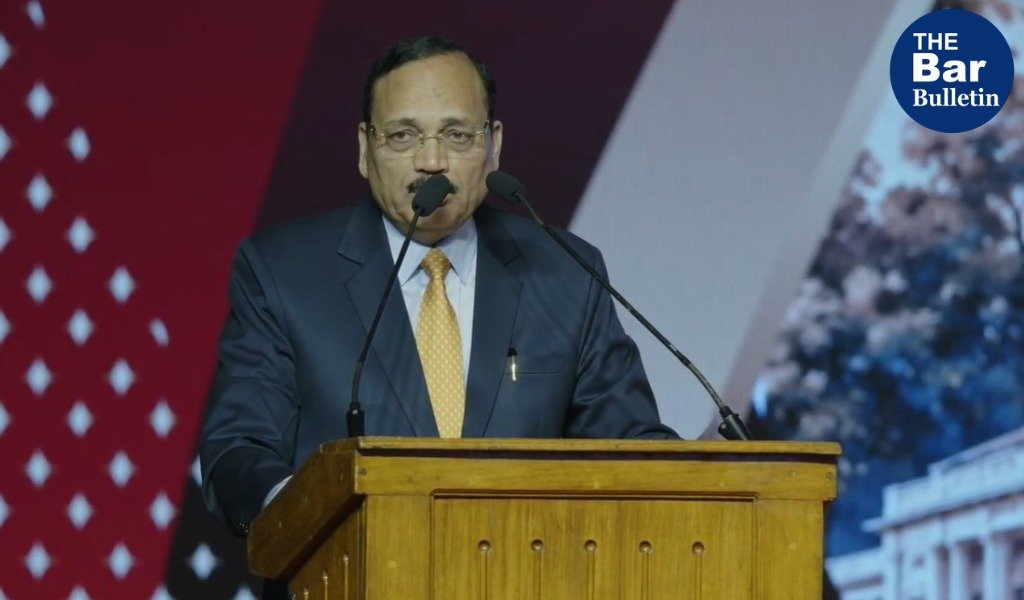

Chief Justice of India Surya Kant on Sunday emphasised that High Courts must continue to function as the natural and effective first forum for constitutional remedies, observing that litigants increasingly approaching the Supreme Court for directions seeking urgent listing or early hearing of matters pending before High Courts calls for introspection into the responsiveness of judicial processes.
Addressing the inaugural ceremony of the Platinum Jubilee celebrations marking 70 years of the Kerala High Court, the CJI said that constitutional justice in India does not begin and end in New Delhi, and the country’s 25 High Courts have an equally significant responsibility to protect fundamental rights and uphold the rule of law.
“
“We often speak of the Supreme Court as the ultimate guardian of the Constitution. But lest we forget, Constitutional Justice in India does not begin and end in New Delhi. Its strength lies in a robust network of 25 Constitutional High Courts spread across the country, each entrusted with the duty of protecting rights and upholding the rule of law,” he said.
Highlighting the proximity of High Courts to the people and their grievances, the CJI said that they are better placed to understand the local circumstances and human dimensions of disputes.
Emphasising the importance of Article 226 of the Constitution, the CJI said that its breadth is one of the greatest strengths of India’s judicial architecture. While Article 32 provides access to the Supreme Court for enforcement of fundamental rights, Article 226 empowers High Courts to issue writs and directions for enforcement of both fundamental rights and other legal rights.
The CJI then turned to the growing tendency of litigants to approach the Supreme Court seeking directions for urgent listing or early hearing of matters pending before High Courts. While acknowledging the pressures under which High Courts function, he said the increasing frequency of such requests raised questions about whether their processes could be made more responsive.
“
“I am deeply conscious of the enormous pressures under which our High Courts function. I know that Judges work beyond regular court hours; urgent matters are accommodated despite heavy boards, and that considerable effort goes into balancing competing demands on judicial time. These efforts deserve our sincere recognition.At the same time, we are witnessing a growing tendency of litigants approaching the Supreme Court requesting directions for urgent listing or early hearing of matters pending before the High Courts. The Supreme Court has consistently respected the institutional autonomy of High Courts, including their authority to regulate their own rosters. That position is rooted in respect for the constitutional status of these institutions. Yet the frequency of such requests invites us to consider whether there is room to improve the responsiveness of our processes.”
The CJI posed a series of questions on how High Courts could improve their listing mechanisms and ensure timely access to justice.
“
“We must ask ourselves: Can urgent matters be identified more effectively? Can listing procedures be made more transparent and predictable? Can technology assist in prioritising cases where delay may cause irreversible prejudice? And can we ensure that a litigant’s access to timely justice does not depend upon their ability to travel to the national capital? These are not questions of institutional criticism, but of collective responsibility. Judicial independence and judicial efficiency are not competing virtues. On the contrary, timely and effective functioning reinforces public confidence in the independence of our courts,” he said.
The CJI also highlighted the Kerala High Court’s judicial legacy, tracing its origins to the judicial institutions of Travancore and Cochin, including the Travancore High Court established in 1887 and the Travancore-Cochin High Court in 1949. He noted that the present High Court, established in 1956, inherited a judicial tradition extending beyond its 70-year institutional history.
He recalled that Justice Anna Chandy became India’s first woman High Court judge and that Justice M. Fathima Beevi went on to become the first woman judge of the Supreme Court. He also referred to the Kerala High Court’s 1999 decision prohibiting smoking in public places, observing that it was the first Constitutional Court in India and across the world to do so.
Referring to the Court’s technological initiatives, he mentioned the fully paperless functioning of the Kalpetta Judicial District in Wayanad, which he virtually inaugurated in January this year, describing it as the first district judiciary in the country to achieve the transformation.
Concluding his address, the CJI said that the Supreme Court and High Courts must function as constitutional partners rather than competing destinations for justice. Drawing an analogy from Kerala’s backwaters, he said that constitutional courts must retain their individual authority while working in harmony towards a shared purpose.
“
“Countless streams and waterways, each following its own course, ultimately sustain one interconnected ecosystem. Our constitutional courts, too, must retain their individual authority while working in harmony towards a shared purpose,” he said.
He expressed hope that the Kerala High Court would continue to remain accessible to the vulnerable, attentive to the urgency of human suffering and committed to constitutional values as it enters its eighth decade.
Also Read: ‘The credibility of Arbitration, Particularly in India, is at Stake’: Justice DK Singh