
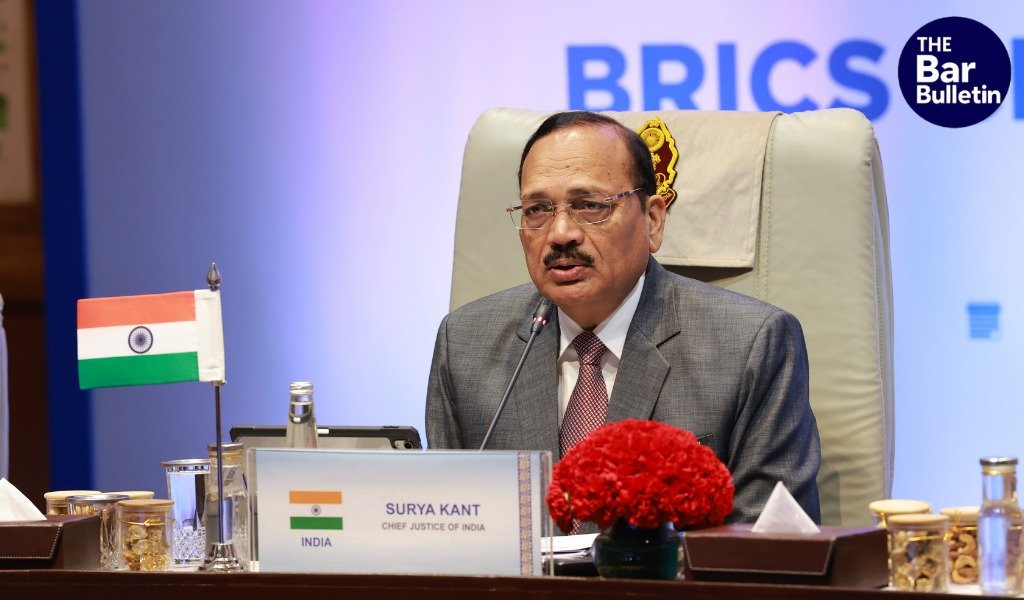

Chief Justice of India Surya Kant has highlighted the role that Chief Justices and judges can play in building confidence in mediation for resolving cross-border commercial disputes. He said that by supporting mediators who understand both commerce and culture, the judiciary can help ensure that “disputes do not become barriers to trade.”
He was addressing the BRICS Chief Justices’ Forum on “Mediation as a Strategic Mechanism for Resolving International Commercial Disputes in a Globalised Economy.”
He emphasised the need for dispute-resolution systems to evolve alongside increasingly interconnected global commerce. He noted that commercial relationships today can involve parties, assets and governing laws spread across multiple countries, making cross-border disputes difficult to fit within a single legal system.
The CJI said mediation assumes particular importance because commercial parties may wish to preserve their relationship even when they are in dispute. Explaining the distinction between adjudication and mediation, he said:
“
“The conventional methods of adjudication always ask: Who is legally right? Mediation simply asks: What arrangement will allow the parties to move forward? That difference can determine whether a commercial relationship survives a dispute or is lost because of it. Mediation, therefore, at its core, is a process of reason and reconciliation. It does not replace litigation or arbitration. It offers another way to resolve disputes when the parties are willing to find common ground. This is why mediation has strategic value. It can lead to solutions that a judgment or award may not provide: renegotiated obligations, restructured transactions and phased performance. In a globalised economy, where commercial relationships are often long and complex, this flexibility can be critical. The right approach is therefore to use mediation, courts and arbitration together, with each serving the needs of the dispute before it.”
Turning to India’s experience, the CJI pointed to the country’s recent efforts to institutionalise mediation, including the Mediation for the Nation initiative. He said 1,05,000 cases were settled through mediation during 2024, while 1,10,000 cases were amicably settled during the four-month campaign in 2025. He also referred to the recently concluded Samadhan Samaroh, where 1,712 cases were settled, describing these initiatives as evidence of mediation’s potential to deliver settlements at scale.
The CJI also referred to the constitution of the Mediation Council of India on August 27, 2026, saying it would contribute to building a structured and credible mediation system through professional standards, quality and accountability among mediators and mediation service providers.
On the role of the judiciary, he stressed that judges need not themselves mediate disputes but can play an important role in creating confidence in the process.
“
“Our judiciaries need not mediate disputes themselves. We can encourage appropriate referrals and ensure that mediated settlements are effectively enforceable. Parties will use mediation fully only when they know that seeking settlement does not mean giving up their legal rights. The role of the judiciary is to create the conditions in which parties can approach mediation with confidence.”
The CJI called for stronger cooperation among BRICS Members and Partner Countries as cross-border commerce expands. He suggested greater collaboration between mediation institutions, professional training, multilingual capacity and dialogue among judges, mediators, lawyers and businesses.
He concluded by emphasising that mediation can help ensure that commercial disputes do not become barriers to trade and cooperation:
“
“As Chief Justices and Judges, we can help build confidence in this process. By encouraging cooperation between our legal and mediation institutions and supporting mediators, who understand both commerce and culture, we can help ensure disputes do not become barriers to trade. Let us strengthen mediation so that dialogue can prevail, commerce can continue, and trust can grow across our BRICS Members and Partner Countries.