
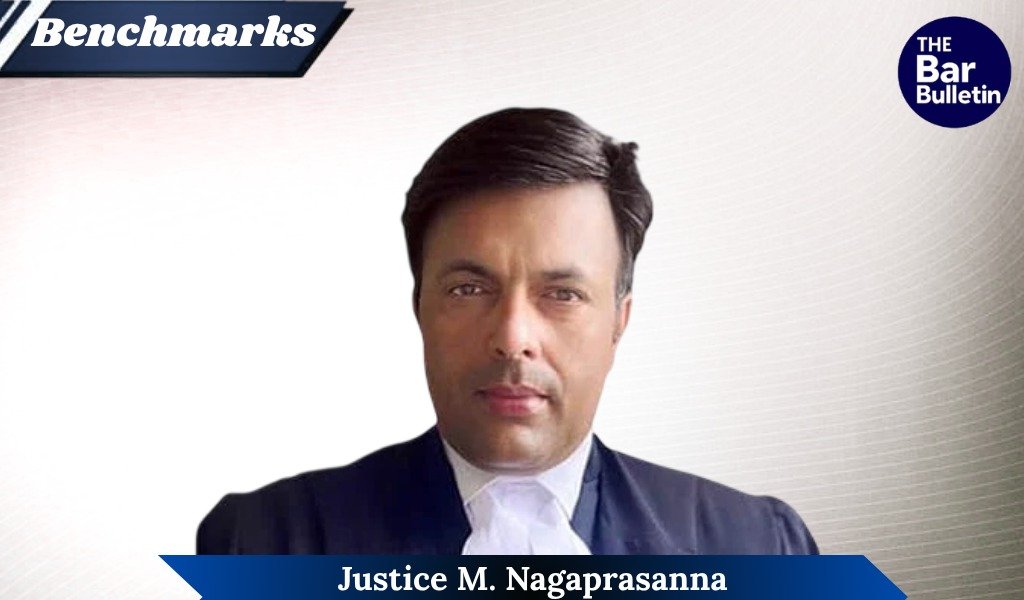

Justice M. Nagaprasanna is a prominent judge of the Karnataka High Court, widely recognized for his fast-paced disposition of cases, work ethic, and legal philosophy centred on constitutional rights, personal liberty, and socio-economic justice. Justice Nagaprasanna’s jurisprudence is characterized by a strong rejection of bureaucratic delay, protection of women and child rights, and a strict interpretation of statutory powers v. executive overreach
Early Life and Career
Born on 23-03-1971, Justice Nagaprasanna developed an early interest in the legal profession and pursued his legal education at B.M.S. College of Law, Bengaluru. Prior to his elevation to the bench, he practiced extensively before the Karnataka High Court and various Tribunals. His practice spanned a wide spectrum of law, with a strong focus on Constitutional Law, Service Law, Labor Matters, and Criminal Law. Over years of practice, he established himself as a distinguished advocate known for thorough preparation and mastery over administrative jurisprudence. A little over a year after being designated Senior Advocate, he was elevated directly to the bench of the High Court.
Judicial Career
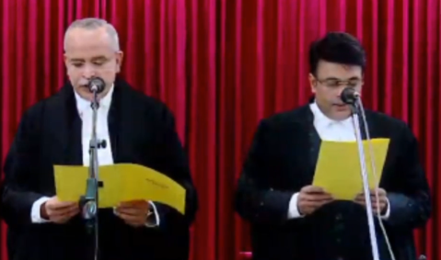
Justice Nagaprasanna was appointed as an Additional Judge of the Karnataka High Court on 26-11-2019. He was sworn in as a Permanent Judge of the High Court on 08-09-2021.
As a sitting judge, Justice Nagaprasanna has presided over both a single-judge roster, hearing criminal petitions, writ petitions under Articles 226 and 227, bail applications and service-law matters and, at times, division-bench sittings. He is also the Administrative Judge of the Court of Small Causes in Bengaluru. He is known for a heavy and fast-moving docket. Justice Nagaprasanna has also earned a reputation for extraordinary efficiency by disposing of dozens of matters, including criminal petitions under Section 482 Cr.P.C., in a single sitting day.
Notable Rulings
● Nasir Pasha (Ali) v. Union of India [2022 Supreme(Kar) 1607]
Sitting as a single judge, Justice Nagaprasanna dismissed a petition by the PFI’s Karnataka state president challenging the Union Government’s September 2022 notification declaring the PFI and its affiliates an “unlawful association” under the Unlawful Activities (Prevention) Act, with immediate effect. He held that the government was empowered under the proviso to Section 3(3) of the UAPA to bring such a notification into force immediately, and that the restriction fell within the “reasonable restrictions” permissible on the right to form associations under Article 19(1)(c), read with Article 19(4), of the Constitution. Solicitor General Tushar Mehta appeared for the Union in the matter.
● SIT, CID, Bengaluru v. Prajwal Revanna [2025:KHC:89451813]
Justice Nagaprasanna flatly rejected three out of four bail petitions and when Prajwal Revanna’s defence team filed an application under Section 207 of the CrPC demanding cloned copies of the entire FSL digital data, he declined the request, famously observing that “the law cannot be bent for Prajwal Revanna” ruling that providing entire unedited mobile contents would severely violate the privacy of other unrelated individuals and victims.
● Shri Ranveer Singh v. State of Karnataka & Anr. [2026:KHC:15324]
Justice M. Nagaprasanna presided over this matter as a single-judge bench, admonishing the actor’s mimicry as reckless while ultimately quashing the FIR upon receiving an unconditional affidavit of remorse. To enforce accountability, he made the legal relief conditional on the actor performing spiritual atonement through a personal visit to the Shri Chamundeshwari Temple within four weeks.
● Sri K. Madal Virupakshappa v. State of Karnataka by Karnataka Lokayukta Police & Anr. [2023 Supreme(Kar) 578]
Justice M. Nagaprasanna presided as the single-judge bench that quashed the Prevention of Corruption Act case against former MLA K. Madal Virupakshappa. He ruled that a paternal relationship alone does not establish criminal liability without evidence of a direct bribe demand or acceptance, concluding that the prosecution amounted to an abuse of the judicial process.
● Sri H. Siddaraju v. Union of India [2023 SCC OnLine Kar 16]
Justice Nagaprasanna held that requiring a surrogate mother to be genetically related to the couple in altruistic (non-commercial) surrogacy “defeats both altruism and logic”. He created a judicial mechanism by introducing a triple test including genetic test, physical tests, or economic test while ordering the State Surrogacy Board to process the petitioner’s eligibility certificate based on these tests rather than rejecting them outright.
● Hrishikesh Sahoo v. State of Karnataka [2022:KHC:9691]
Justice M. Nagaprasanna played a transformative role in Indian jurisprudence by delivering a landmark single-bench verdict in this case, where he refused to quash rape charges framed against a husband by a lower court. By declaring that “rape is a rape” regardless of marital status, he boldly challenged the immunity granted under the colonial-era Marital Rape Exception (Exception 2 to Section 375 of the IPC). His judgment powerfully upheld a married woman’s fundamental rights to dignity, bodily integrity, and sexual autonomy under the Constitution, ruling that marriage cannot be used as a license for marital cruelty or male privilege.
● Kavitha M. v. Raghu & Ors. [2023:KHC:10373]
Dismayed by a case that had languished for 52 months (over 4 years) without resolution, Justice Nagaprasanna declared that “Section 12 is the salt of the statute; if by delay the salt would lose its savour; the statute would lose its flavour.” He emphasized that women seeking shelter or maintenance are victims facing immediacy, meaning law courts must act swiftly under the doctrine of actus curiae neminem gravabit (an act of the court shall prejudice no man). Consequently, he invoked structural timelines to make statutory relief meaningful and not merely illusory while establishing a strict procedural timeline for Magistrates handling applications under the Protection of Women from Domestic Violence Act, 2005.
● Pandurangabhat & Ors. v. State by Malebennur Police & Anr. [2023:KHC:41804]
Justice Nagaprasanna held that a temple is a public place and denying entry based on caste attracts the Scheduled Castes and Scheduled Tribes (Prevention of Atrocities) Act, 1989. While dismissing the petition, Justice Nagaprasanna stated that a deity in a temple cannot be claimed by a few, and that worship must be open to all human beings without regressive bigotry.
● People for Ethical Treatment of Animals v. State of Karnataka [2026:KHC:31535]
Justice Nagaprasanna allowed a petition by PETA and set aside an order, directing the release of nine rescued dogs to a man accused of brutally assaulting and sexually abusing them, holding that the Magistrate’s decision reflected a grave failure of judicial sensitivity and was wholly inconsistent with the object of animal welfare laws.
● XXXX v. Registrar General, High Court of Karnataka & Ors. [2026:KHC:30294]
Presiding as the Single Judge, Justice Nagaprasanna allowed the writ petition of an Iranian national who was fully acquitted of criminal charges in 2019. He famously observed that “a final acquittal must receive equal recognition in the digital sphere” and directed Google, Indian Kanoon, and the High Court Registry to completely mask her name from online judicial records to remove the digital stigma.
● Thomas Jadan v. State of Karnataka [2026:KHC:37991]
Justice M. Nagaprasanna quashed an FIR registered against a 21-year-old student over a single Instagram message sent to his classmate, holding that an isolated compliment, though inappropriate or indiscreet, does not by itself constitute offences of voyeurism, stalking or insulting the modesty of a woman under the Bharatiya Nyaya Sanhita (BNS).
Exceptional Judicial Efficiency and Speed
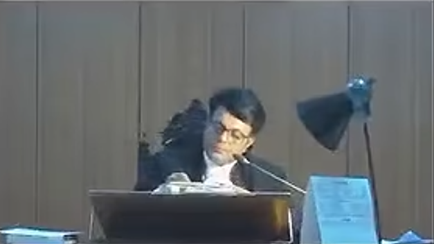
Justice Nagaprasanna is nationally recognized for his astonishing work ethic and focus on clearing the judicial backlog. He has repeatedly set records by listing and hearing over 500 cases in a single day. Most recently, on 02-09-2026, Court No. 14 of the Karnataka High Court witnessed an unusually demanding sitting with a cause list running to nearly 300 matters in the morning session alone.
With more than 250 matters awaiting across multiple lists, the day’s total reportedly went beyond 700 matters. The Court sat almost continuously from 10:00 AM until approximately 8:00 PM disposing of matters through admissions, directions for emergent notice, dismissals, interim stays, and various other orders. By ensuring that litigants and advocates are heard while approaching each matter with commitment and discipline, Justice Nagaprasanna embodies the enormous responsibility shouldered by constitutional courts.