
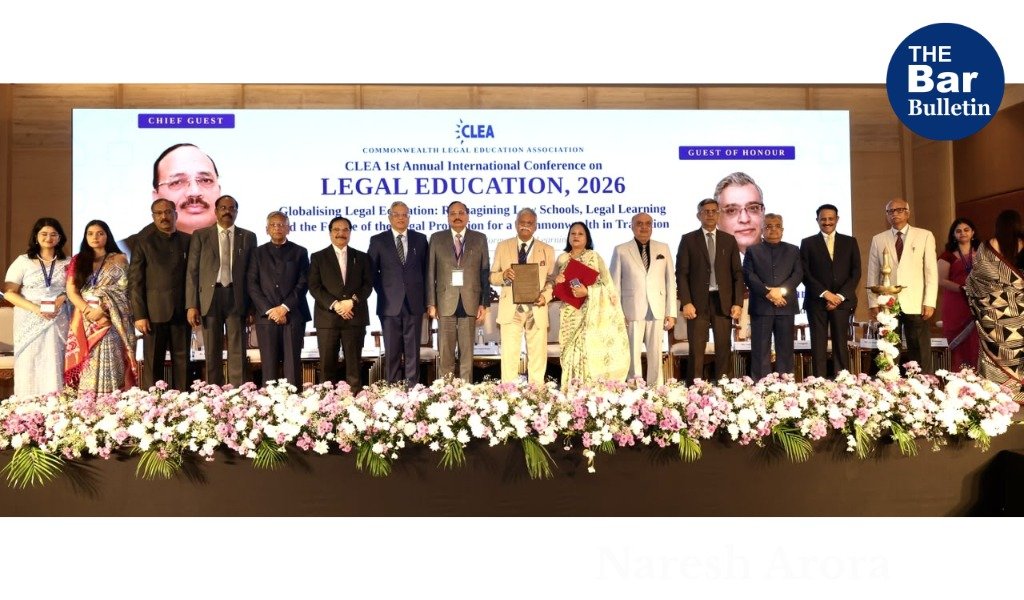

Chief Justice of India Surya Kant, while delivering the inaugural address at the Commonwealth Legal Education Association’s (CLEA) first Annual International Conference on Legal Education in Hyderabad on November 21, called for law schools to adopt a more practical and technology-aware approach to legal education. He cautioned against both the blanket prohibition of artificial intelligence tools and their uncritical use, stressing that technology must assist students without replacing their own reasoning and understanding of the law.
The CJI emphasised that generative AI should be regulated rather than banned in academic work, while students must remain accountable for the reasoning and research they submit. He also called for clinical legal education to be integrated into core law subjects, common citation standards across Commonwealth jurisdictions, and a minimum period of compulsory legal aid work for students to graduate.
On the use of AI-detection software, CJI Surya Kant cautioned that such tools could wrongly flag students, particularly those who use English as a second or third language. Referring to a 2023 study that found widely used detectors had incorrectly identified more than three in every five essays written by non-native English speakers as machine-generated, he stressed that institutions must not rely solely on automated assessments to establish academic misconduct. He stated:
“
“Such software is, however, far from reliable: a study published in 2023 found that seven widely used detectors, though almost flawless with essays written by schoolchildren in the United States, wrongly flagged more than three in every five essays by non-native speakers of English as machine-generated. In a Commonwealth where so many students write in English as a second or third language, an honest student could thus be branded a cheat on the strength of a number that no one can explain, and that student cannot meaningfully challenge. No student should therefore be held guilty of misconduct on the word of a machine alone.”
The CJI proposed that law schools clearly communicate which uses of AI are permitted, which require disclosure and which amount to handing over the very reasoning that an assessment is intended to test. Assessments, he suggested, could include oral explanations, defence of cited authorities and exercises requiring students to identify errors in AI-generated answers.
On legal research, CJI Surya Kant stressed that AI-generated answers cannot be treated as authoritative without verification. Researchers must check every authority against its primary source, disclose material AI assistance and remain accountable for published work. He also urged CLEA to develop model guidelines on disclosure of AI assistance in legal research, which law schools and journals across the Commonwealth could adapt.
The address also advocated integrating clinical learning into core subjects such as Evidence, Criminal Procedure, Family Law and Constitutional Law, instead of confining practical training to separate courses. It suggested exercises such as drafting and negotiating agreements in Contract Law, tracing remedies for denied entitlements in Constitutional Law and conducting mediation exercises in Family Law.
On legal aid, the CJI proposed making a minimum period of legal aid work compulsory for every law student as a condition for graduation, with additional academic credits for students who undertake work beyond the prescribed requirement. He cautioned that the mere existence of a legal aid clinic does not establish its effectiveness, and called for clinics to undertake regular work involving students, panel advocates and para-legal volunteers. He observed:
“
“A clinic may have a room, a coordinator, and a calendar of awareness camps, and still offer little real help, which is why a clinic’s existence must never be mistaken for its effectiveness. The Authority’s own scheme points the way, envisaging panel lawyers and para-legal volunteers working alongside students, and clinics that reach out to villages and settlements. However, I believe that a clinic’s work should also not pause with the semester, and students who serve in it during their breaks should receive certificates for the work they actually do. I would further suggest that a minimum period of legal aid work be made compulsory for every student to graduate, with additional credits for those who go beyond it.”
The CJI also called for a common minimum citation framework across Commonwealth jurisdictions, centred on neutral citations and accessible legal sources, including translated judgments and customary sources that are often underrepresented in law reports.
The conference was held under the theme “Globalising Legal Education: Reimagining Law Schools, Legal Learning and the Future of the Legal Profession for a Commonwealth in Transition” at Novotel, Hyderabad.