
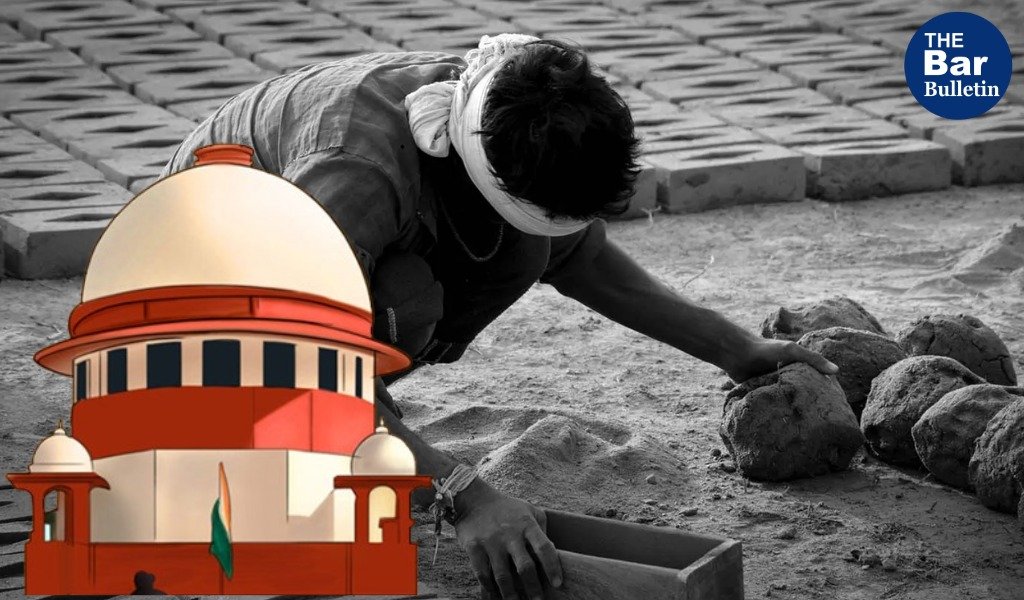

The Supreme Court has directed the Union Government and all States and Union Territories to ensure uniform implementation of the rehabilitation framework for bonded labourers, including disbursement of immediate financial assistance ordinarily within seven days of issuance of a release certificate. The Court also directed authorities to complete the identification and verification of complaints concerning bonded labour ordinarily within 24 hours and issue release certificates within 24 hours of determining that a person has been subjected to bonded labour.
A Bench of Justice Vikram Nath and Justice Aparesh Kumar Singh issued the directions while hearing petitions concerning deficiencies in the identification, rescue, release and rehabilitation of bonded labourers across the country.
The proceedings arose from a petition filed by bonded labour survivor Surendra Manjhi, who was rescued along with other labourers from a Shahjahanpur brick kiln in Uttar Pradesh on February 28, 2019. The labourers had allegedly been brought from Bihar on the pretext of repayment of a bonded debt. Despite their rescue, several did not receive rehabilitation assistance promptly. Manjhi received Rs. 20,000 only in 2022, while 17 of the 42 rescued labourers were still awaiting assistance. A connected petition by the National Campaign Committee for the Eradication of Bonded Labour raised wider concerns over the implementation of the bonded labour rehabilitation framework.
The Court observed that the principal concern was not the absence of a statutory framework but the difficulties encountered in its effective implementation. It emphasised that the State’s obligation does not end with rescuing a bonded labourer, but extends to ensuring timely financial assistance and meaningful rehabilitation. The Bench observed:
“
“A person released from bonded labour is often left without an independent source of livelihood and remains vulnerable to further exploitation. Financial assistance intended to address immediate needs loses much of its purpose when its disbursement is delayed for months or years. The circumstances of the first petitioner illustrate this difficulty. Although rescued in 2019, he received immediate financial assistance only in 2022. It was also submitted on the last hearing of this matter that 17 labourers who were rescued alongside him had still not received their financial assistance. These circumstances demonstrate that rehabilitation delayed may, in substance, amount to rehabilitation denied.”
The Court further directed the Union Government to ensure uniform implementation of the revised Standard Operating Procedure (SOP) dated May 14, 2026, across the country. States and Union Territories have been given six months to implement the SOP and comply with the directions.
The Union Government has also been directed to issue supplementary guidelines, in consultation with the National Human Rights Commission (NHRC), within three months.
The Court directed that individual rehabilitation plans be prepared and implemented within 90 days of rescue, clarifying that financial assistance cannot be withheld merely because an investigation or criminal proceedings are pending. It also asked the Union Government to consider revisions to the Rehabilitation Scheme within three months, including enhanced assistance and interim subsistence support. For inter-State rescues, it directed States to ensure timely transfer of release certificates, designate nodal officers and establish coordination mechanisms within six months.
Specifically concerning the 17 labourers rescued alongside the petitioner, the Court directed Uttar Pradesh and Bihar to jointly verify their pending financial assistance within one month. Any outstanding assistance found payable must be disbursed as expeditiously as possible, preferably within three months and in any event within six months.
The Court also directed States and Union Territories to ensure that Vigilance Committees are duly constituted and functioning at district and sub-divisional levels. The Union Government must ensure effective operation of the NAVJIVAN Portal for recording and monitoring the identification, rescue, release and rehabilitation of bonded labourers.
Further, State-level Monitoring Committees have been directed to review implementation every month, while grievances concerning non-issuance of release certificates, delayed financial assistance and rehabilitation benefits must ordinarily be resolved within 30 days. The Court also emphasised the need for special safeguards in cases involving children, including access to education, medical care, counselling and other rehabilitative measures.
The Union Government has been directed to file a compliance affidavit within four months, while all States and Union Territories must file their respective compliance affidavits within two weeks after completing the six-month implementation period. Keeping the matters pending for continued monitoring, the Bench directed that they be listed after seven months for consideration of compliance reports and further directions.
