
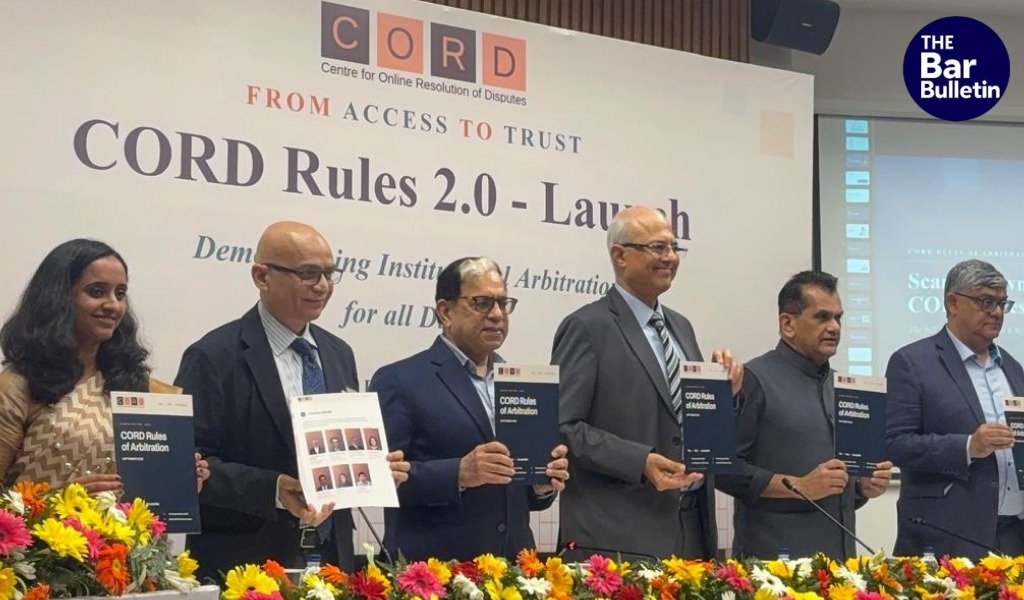

CORD launched its Rules 2.0 in New Delhi on Friday with a call to make institutional arbitration more accessible, affordable, efficient and technology-driven, particularly for the large segment of medium-value and high-volume disputes that remains outside the traditional arbitration ecosystem.
The launch, themed “From Access to Trust: Democratising Institutional Arbitration for All Disputes,” brought together senior members of the judiciary, arbitration practitioners, government representatives and corporate counsel. The event featured addresses by Justice (Retd.) A.K. Sikri, former Judge of the Supreme Court; Justice Manmohan, Judge of the Supreme Court; and former NITI Aayog CEO Amitabh Kant, followed by a roundtable discussion involving leading stakeholders from the arbitration and corporate sectors.
Justice Sikri, who had chaired the committee that prepared the 2020 report ‘Designing the Future of Dispute Resolution’, traced the evolution of India’s ODR movement from the COVID-19 period to the present. He said the objective had never been to create a pandemic-specific mechanism, but to establish a long-term dispute-resolution system in which proceedings could begin online and digital processes could become the default.
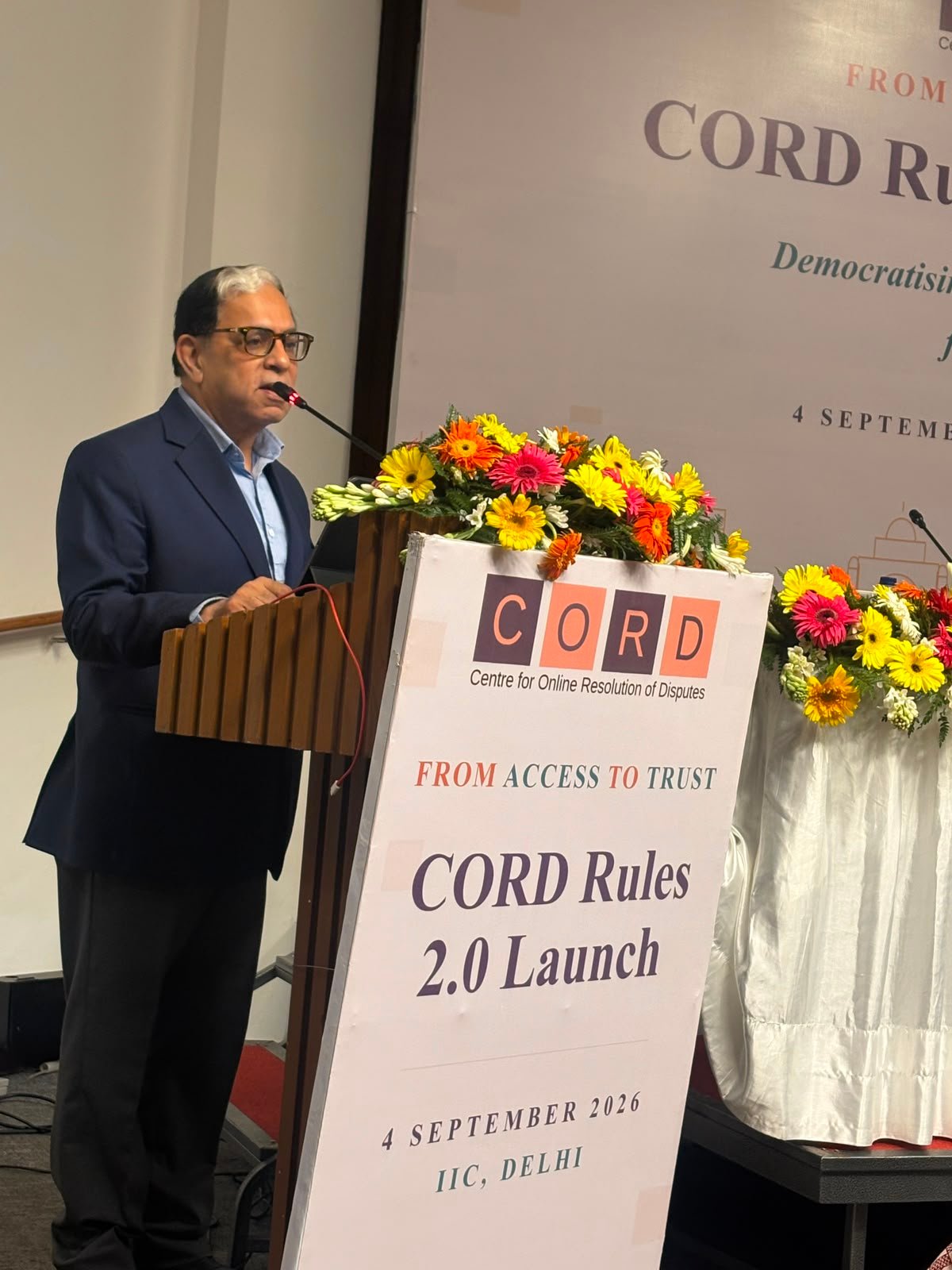
He explained that the report had envisaged a phased adoption of ODR, beginning with government departments, followed by regulators and eventually the private sector. Justice Sikri pointed to subsequent developments involving digital payment disputes, securities-market disputes and MSME payment disputes as evidence that the vision was increasingly becoming reality.
He also highlighted the growing use of technology in arbitration, including transcription and translation services, and noted the legal recognition of online mediation under the Mediation Act, 2023. According to Justice Sikri, the next phase of ODR would require greater scale while maintaining confidence and accessibility.
Justice Manmohan: Arbitration Must Be Taken Beyond the ‘Elitist’ Segment
Delivering the keynote address, Justice Manmohan said arbitration had traditionally been perceived as a mechanism for large corporations and high-value disputes, while India’s courts continued to face overwhelming litigation volumes.
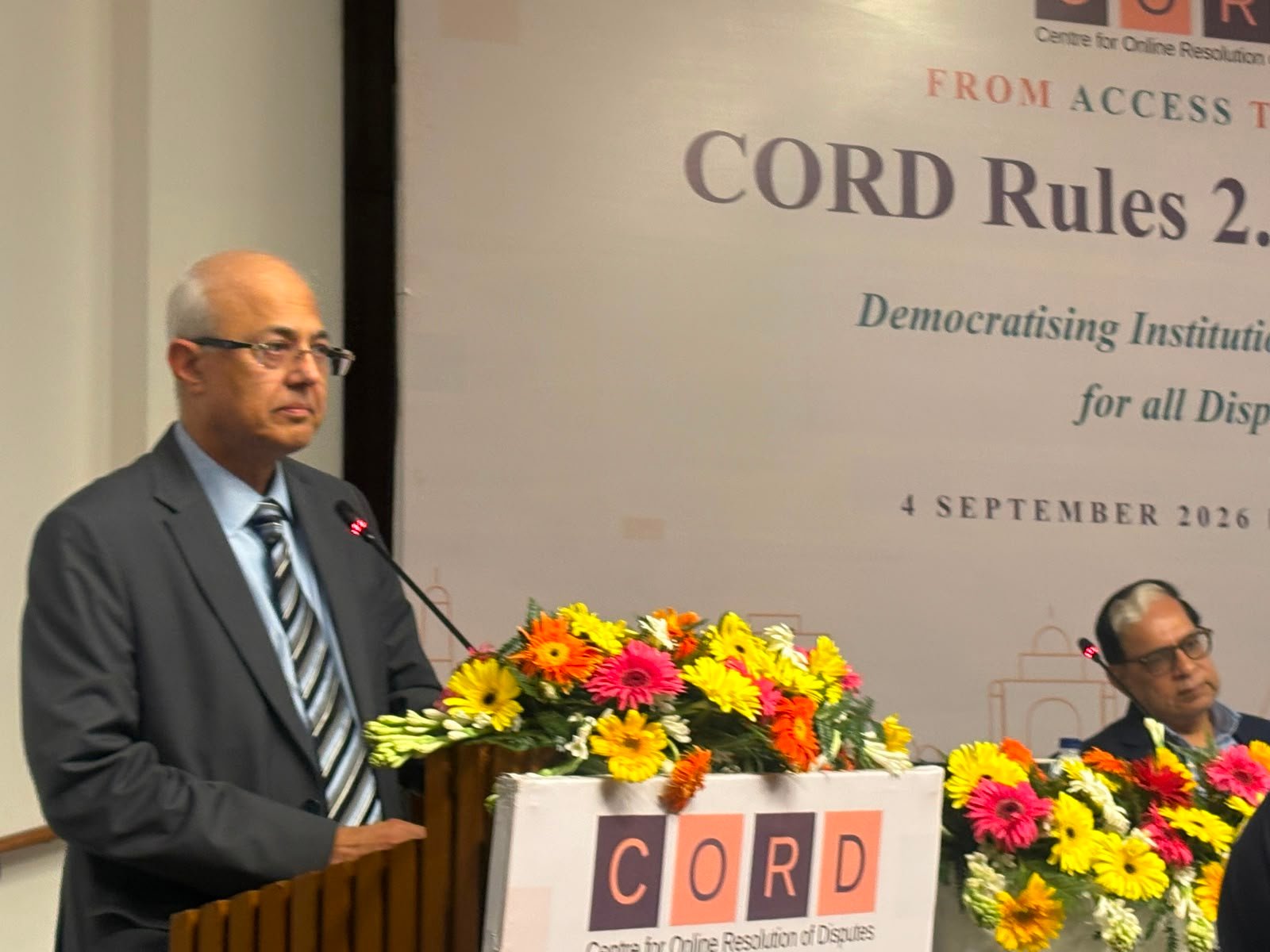
He identified a significant mid-value segment, particularly disputes below ₹5 crore, that had remained underserved by the arbitration ecosystem. He said CORD’s focus on this segment could help democratise institutional arbitration and make it available to a much wider range of businesses and commercial disputes.
Justice Manmohan emphasised the advantages of institutional arbitration, including established rules, administrative support, monitoring of timelines and mechanisms for ensuring procedural quality. He also suggested that industry-specific institutional arbitration could be developed for different commercial communities and sectors.
He highlighted CORD’s proposed emphasis on lower costs, faster resolution and technology. Among the technological features he referred to were real-time transcription and translation, which could make proceedings more accessible in India’s multilingual environment.
Justice Manmohan also discussed CORD’s proposed framework for responsible AI use in arbitration, under which different applications are categorised into green, amber and red zones depending on whether disclosure is required or use is prohibited. He stressed that AI cannot replace human oversight in substantive adjudicatory decision-making or assessment of evidence.
On institutional trust, he pointed to safeguards including arbitrator appointments, external audit, appellate mechanisms and measures addressing delay as important features for building confidence in the process.
Amitabh Kant: Dispute Resolution Should Be India’s Next Digital Frontier
Former NITI Aayog CEO Amitabh Kant praised the evolution of India’s ODR ecosystem and the role played by the 2020 report in bringing together government departments, regulators and other stakeholders around a common policy framework.
Kant said the report had correctly envisaged ODR as being broader than merely online arbitration or online mediation, encompassing dispute avoidance, dispute containment and dispute resolution.
He highlighted the subsequent adoption of ODR mechanisms across sectors, including digital payments, securities and MSMEs, and said India’s experience demonstrated that disputes could be resolved with greater speed, convenience and enforceability.
Kant said the launch of CORD Rules 2.0 represented a transition “from mere advocacy to institutional accountability”, and called for the next phase of ODR to be designed for scale without compromising trust.
He emphasised the need to deploy AI with transparency, accountability and human oversight, while developing multilingual and mobile-first systems to ensure that technology expands access rather than deepens the digital divide.
Drawing on India’s experience with digital public infrastructure in identity, payments and public services, Kant described dispute resolution as the next major frontier for technology-driven democratisation of access.
PANEL DISCUSSION
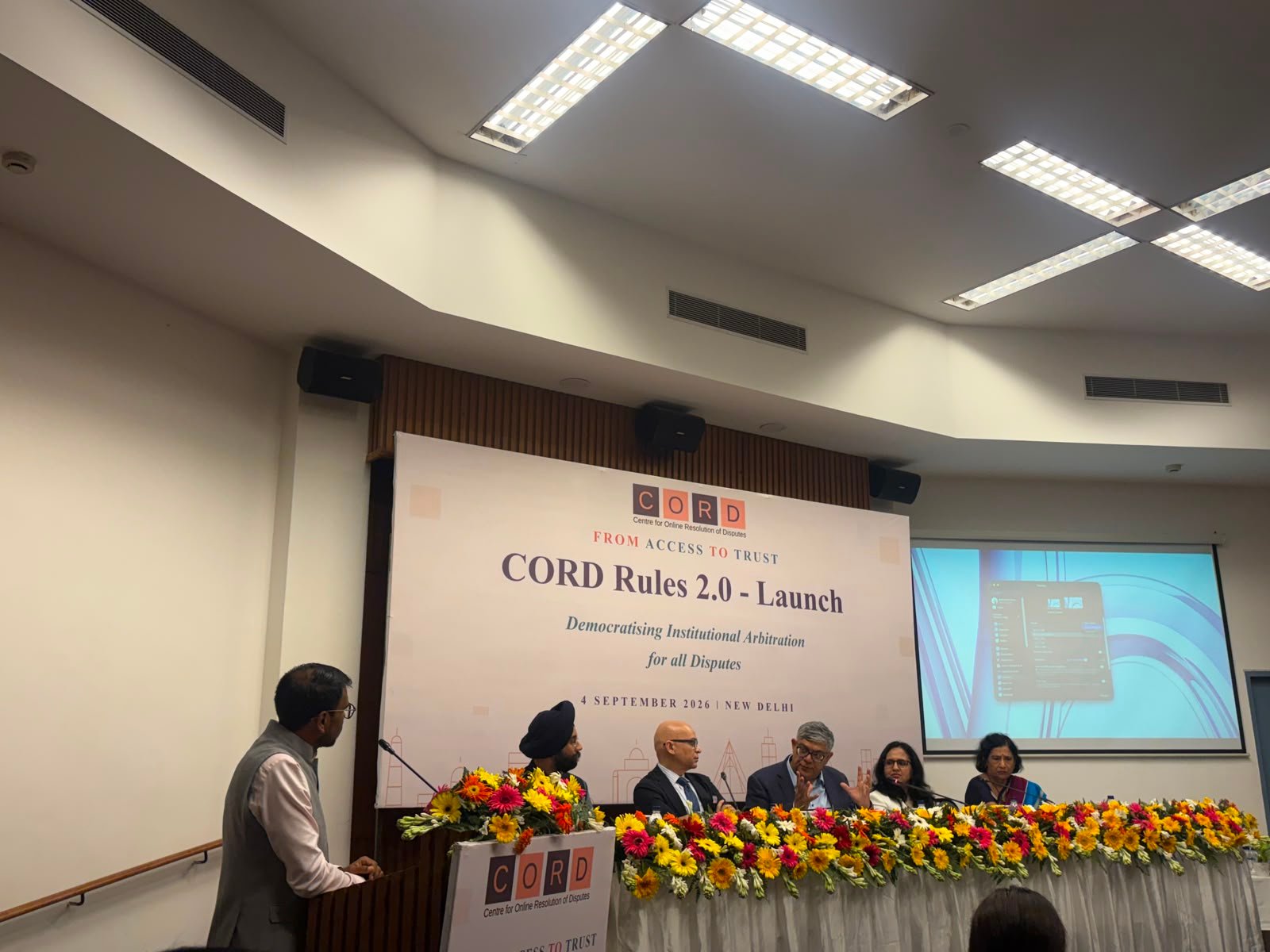
The launch of CORD Rules 2.0 in Delhi was followed by a roundtable discussion moderated by Vikas Mahendra on the future of arbitration and dispute resolution, where senior members of the arbitration bar, in-house legal community and government highlighted persistent concerns around cost, delay, enforceability and confidence in the arbitral process.
The discussion was led by Justice (Retd.) Rajiv Shakdher, former Chief Justice of the Himachal Pradesh High Court, with Avnit Singh Arora, Director, Department of Legal Affairs; Vijaya Sampath, former Group General Counsel, Bharti Airtel; Gourab Banerji, President, Arbitration Bar of India; and Jyothi V.K., General Counsel, Aditya Birla Fashion as panellists.
Opening the discussion, Vijaya Sampath spoke candidly about the practical difficulties faced by users of arbitration. She pointed to the failure of the statutory 180-day timeline to reflect ground realities, with arbitrations often taking three to four years before reaching an award, followed by challenges before courts that can prolong disputes for several more years. She also highlighted the difficulties surrounding enforcement, noting that even after obtaining an award, parties may have to return to civil courts for enforcement.
Jyothi V.K. emphasised a changing corporate approach towards dispute resolution. She said companies increasingly recognise vendors and other counterparties as stakeholders in their success and therefore cannot rely on jurisdiction clauses merely as a deterrent to litigation. Instead, businesses need transparent and effective mechanisms for resolving disputes. She also pointed to the limitations of mediation where finality and enforceability remain concerns, while suggesting that structured dispute-resolution mechanisms built into commercial relationships could help prevent disputes from escalating.
The discussion then turned to the Government’s approach towards arbitration. Avnit Singh Arora explained that the Government’s experience as a user of arbitration had contributed to the concerns reflected in its 2024 policy approach, including questions around arbitrator accountability. At the same time, he noted that the Government’s framework promotes institutional arbitration and mediation, rather than imposing an absolute bar on arbitration. He stressed that greater confidence in arbitration among government users would ultimately depend upon the credibility and performance of the arbitral ecosystem.
Justice Rajiv Shakdher addressed the role of courts and arbitrators, observing that courts and the arbitral system have broadly aligned objectives in seeking to minimise unnecessary intervention. He noted, however, that once an award reaches court, the adversarial nature of proceedings can lead parties to seek grounds for interference. He also emphasised the importance of institutional support for arbitrators, particularly in complex matters involving extensive records, as such support can contribute to both speed and quality.
Gourab Banerji called for greater self-reflection within the arbitration community, observing that the arbitration bar and arbitrators may sometimes operate within an ‘echo chamber’ disconnected from the concerns of users. Referring to survey findings discussed during the session, he highlighted high and unpredictable costs, delay, accountability and quality as significant concerns.
He identified three areas requiring attention in relation to arbitrators competence, incentives and accountability. He stressed the need for better training for arbitrators transitioning from judicial office and suggested that institutional oversight may be necessary because self-regulation alone may not always be sufficient. He also pointed to the emergence of younger lawyers pursuing arbitration as a full-time professional career and the need to build a larger pool of capable arbitration practitioners.
The panellists also discussed the need to develop a full-time professional arbitration bar, with the view that institutional arbitration could provide the training, administrative infrastructure and steady flow of work necessary to build such a specialised ecosystem.
On the question of rebuilding trust, the discussion focused on time and cost control, transparency and accountability. Justice Shakdher spoke in favour of developing a stronger pool of full-time arbitrators who could independently conduct proceedings and prepare awards, while Avnit Singh Arora referred to the possibility of market-driven mechanisms for evaluating arbitral institutions and arbitrators.
The discussion also explored the potential use of technology in improving transparency and efficiency. Jyothi V.K. suggested that institutions could go beyond dispute resolution and provide preventive litigation support, including tools that help businesses and their vendors understand the implications of contractual provisions before disputes arise.