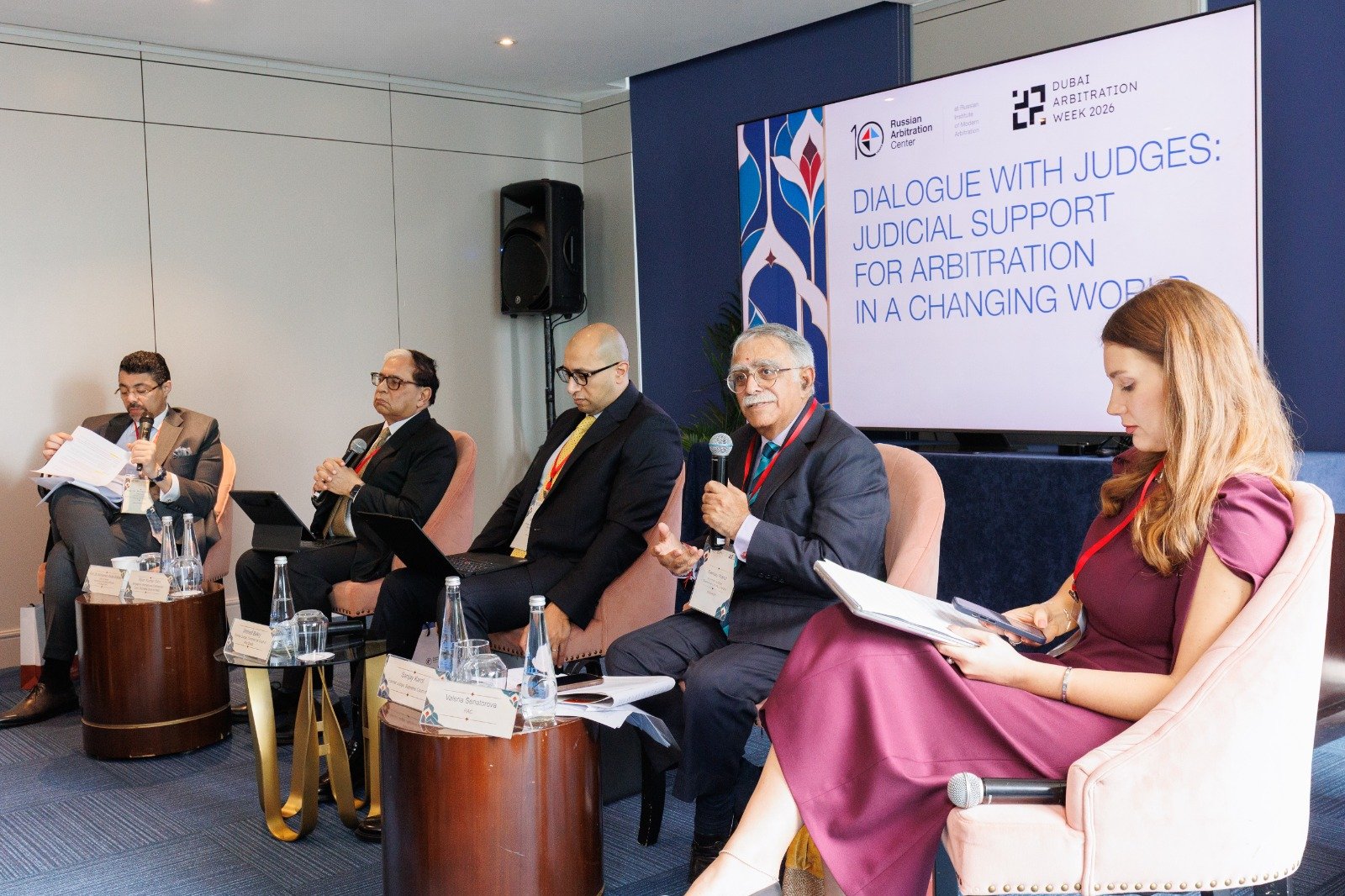

Courts play a crucial role in making jurisdictions arbitration-friendly, but their approach must be guided by restraint, predictability and respect for party autonomy, Justice Arjan Kumar Sikri, Judge of the Singapore International Commercial Court, said during a panel discussion at Dubai Arbitration Week.
Speaking at the session titled “Dialogue with Judges: Judicial Support for Arbitration in a Changing World”, hosted by the Russian Arbitration Centre (RAC) on November 11, Justice Sikri emphasised that predictability in the enforcement of arbitral awards is particularly important for an arbitration-friendly jurisdiction. He said courts should support, not supervise arbitration and exercise restraint so that parties can realise the financial outcome of their disputes. Ultimately, he observed, parties want to see the colour of money.
The discussion, moderated by Mohamed Abdel Wahab of Zulficar & Partners, brought together international judges to examine the role of courts in supporting arbitration, the impact of geopolitical developments and sanctions, the emergence of international commercial courts, and the growing use of artificial intelligence in adjudication.
Judicial approach and arbitration-friendly jurisdictions
Justice Ahmed Bakry, an Egyptian judge and former judge of the Abu Dhabi courts, said that having specialised courts for arbitration matters was not merely about the “sign on the door but about the judge sitting behind it”. He observed that judges dealing with arbitration matters should ideally have experience as arbitrators and understand the practical challenges faced by tribunals and parties.
He also stressed the need for judges to adapt legal precedents to changing commercial realities. Justice Sikri, meanwhile, said that judges contribute more to the success of an arbitration jurisdiction than its legislation or arbitral institutions, adding that courts must adhere to the intention of the relevant legislation.
Justice Sanjay Karol, former Judge of the Supreme Court of India, agreed that judges play a defining role in determining whether a jurisdiction is arbitration-friendly. Abdel Wahab added that courts must guard against decisions that fail to satisfy requirements fundamental to arbitration, without assuming a supervisory role over the merits of arbitral decision-making.
International comity, sanctions and public policy
The panel also discussed whether international comity continues to have a meaningful role amid increasing geopolitical divisions. Justice Sikri said the principle should be retained, particularly where proceedings have already commenced before an arbitral tribunal or a foreign court. Courts should avoid encouraging parallel proceedings that could result in conflicting judgments.
Justice Bakry, however, referred to differing approaches adopted by arbitral tribunals and courts, observing that some had questioned whether comity had a place in international arbitration or constituted a principle of international law.
On sanctions, Justice Sikri observed that their application could also involve considerations of international comity. Referring to the potential enforcement in India of a foreign award involving findings based on US or European sanctions against a Russian party, he said Indian courts would not necessarily adopt findings founded on foreign sanctions regimes, particularly where such sanctions were imposed for political reasons and were not applicable under Indian public policy.
He cautioned against parties invoking public policy as a means of obtaining a second bite at the cherry after an adverse arbitral award. Describing public policy as an “unruly horse”, he emphasised the need for courts to approach such objections carefully.
International commercial courts and the future of arbitration
Discussing the emergence of international commercial courts, Justice Sikri observed that such courts were “mushrooming”, with around 15 now in operation following the establishment of the Singapore International Commercial Court more than a decade ago.
He clarified that this did not mean international arbitration was losing its relevance, although he acknowledged the need for reforms. Arbitration, he said, was not speedy and not cost effective, and parties often felt that proceedings could have been conducted in a more meaningful manner.
He also raised concerns about high-stakes investment treaty disputes involving awards against States that could represent a significant proportion of their GDP. In his view, international commercial courts could be better placed to address certain sovereign issues that, according to him, had not been satisfactorily dealt with in some ICSID awards. The availability of an appeal against a decision was another factor distinguishing international commercial courts from arbitration.
Justice Karol similarly rejected the suggestion that international arbitration was losing its purpose, but cautioned that it cannot be an elitist club and must be immediately efficacious for all users.
Artificial intelligence in judicial decision-making
The panel also examined the growing use of artificial intelligence by judges and arbitrators. Justice Bakry said the Abu Dhabi Judicial Department was encouraging judges to use AI and shared that he found it useful for organising procedural histories and summarising evidence and pleadings. However, he cautioned that decision-makers must remain alert to whether they are controlling the technology or allowing it to lead the decision-making process.
Justice Sikri described AI as a “good facilitator” that could assist decision-makers in several ways, while stressing that the central challenge was ensuring that human decision-makers remained in control.
Abdel Wahab questioned whether even AI-generated summaries could influence the eventual outcome, since the summaries themselves inform the decision-making process and could potentially contaminate it. He also raised concerns about practitioners developing AI tools trained to think like them, asking whether such tools could eventually become a digital twin.
He further cautioned that younger lawyers increasingly treating AI as their primary source of information could affect their ability to independently assess and challenge its output, raising concerns about the development of their professional.