
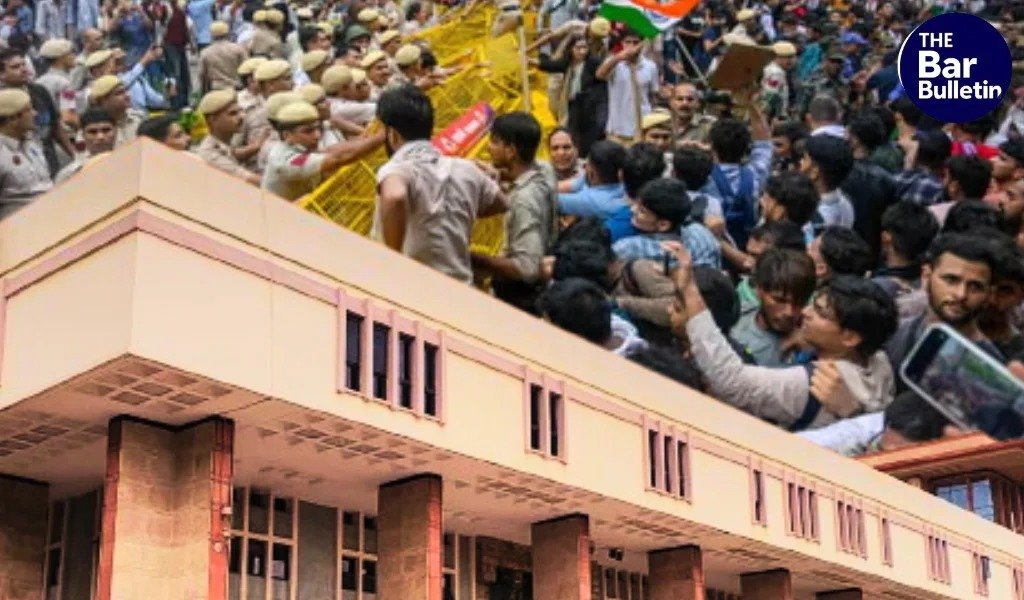

The Delhi High Court on Tuesday directed the respondents to take instructions on petitions filed by traders seeking implementation of Supreme Court judgments and the standard operating procedure (SOP) governing protests, amid claims that demonstrations and road blockages in Delhi have caused significant business losses.
The petitions contend that the alleged failure to implement the existing directions has adversely affected traders and petty vendors. During the hearing, counsel appearing for the traders submitted that business worth approximately ₹2,000 crore had been affected over the preceding days, particularly during the festive season. Senior Advocate Sacchin Puri Submitted:
“
“In the last few days, ₹2,000 crore business has vanished. These are festival seasons, my Lords. We get the business only during this period, my Lords, which endures for our benefit for the entire period. This October till February is the best time for business in Delhi. And that is being jeopardised because of this. Kindly see my prayer is to follow these directions of the Supreme Court, which is binding, which has not been overturned.”
Counsel referred to Supreme Court decisions concerning the regulation of demonstrations, including Amit Sahni v. Commissioner of Police, (2020) 10 SCC 573 and Mazdoor Kisan Shakti Sangathan v. Union of India, (2018) 17 SCC 324. He argued that the existing judgments required authorities to balance the right to peaceful protest with the rights of commuters, residents and businesses.
Referring to the Supreme Court’s observations in the Shaheen Bagh matter, Mr Puri submitted that the right to protest could not be exercised in a manner that indefinitely obstructed public roads and public spaces.
“
“The Supreme Court has given clear-cut directions, my Lord, that there is no right to protest which is a fundamental right but it cannot impede others’ rights. Streets are being blocked. The markets are being shut down,” he submitted.
He also referred to the Supreme Court’s observations that the right to peaceful protest must be balanced against other competing rights and that public spaces could not be occupied indefinitely. He then read from the Supreme Court’s judgment concerning demonstrations at Jantar Mantar, which emphasised the need to balance the interests of local residents with those of protesters. He pointed out that the judgment had directed the authorities to formulate a mechanism for the limited use of the area for peaceful demonstrations.
The petitions also seek implementation of the SOP formulated after the Supreme Court’s directions. Counsel submitted that the authorities had designated certain areas for protests but that the implementation of the relevant directions remained a concern.
The Bench of Acting Chief Justice Nitin Wasudeo Sambre and Justice Sanjay Sharma asked counsel to clarify the precise issues raised in the petitions and sought copies of the petitions and pleadings pending before the Supreme Court. The Court observed that it did not want to examine matters that were already pending consideration before the apex court.
Counsel submitted that the present petitions concerned the implementation of existing judgments and the SOP, rather than the issues directly under consideration in the Supreme Court proceedings.
The Bench indicated that the overlap between the proceedings would have to be examined before the matter could be taken further. It asked the petitioners to produce copies of the pleadings pending before the Supreme Court.
The Court agreed to consider the issue after receiving the respondents’ instructions and directed the petitioners to produce copies of the relevant petitions and pleadings pending before the Supreme Court.
The matter will be taken up on Friday.