
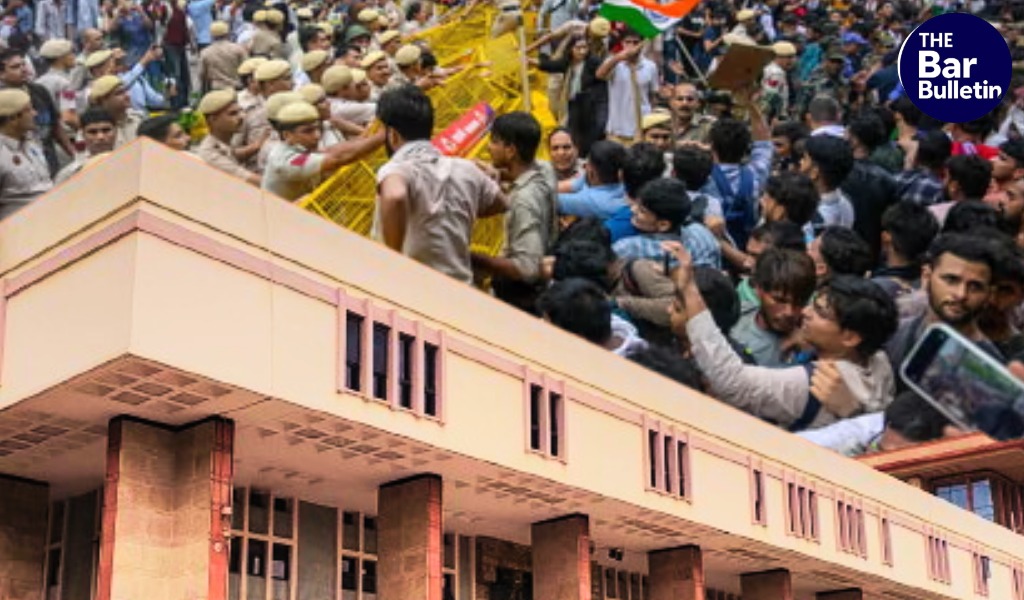

The Delhi High Court on Friday dismissed a public interest litigation seeking directions to initiate criminal action against persons allegedly involved in arson, lawlessness, attacks on police personnel and destruction of public property during the Jantar Mantar protests, holding that the Supreme Court has already laid down a comprehensive legal framework governing such situations.
The petition sought directions to initiate action against those allegedly responsible for arson, physical attacks on police personnel, anarchy and damage to public property. The Court observed that it disposed of a similar petition seeking NIA probe into student protest and it will pass a similar order in this one. The Bench further observed that the issues raised by the petitioner were already covered by binding Supreme Court precedents. Addressing the petitioner, the Court observed:
“
“Your prayer is to initiate criminal action against the persons indulging in arson, lawlessness, anarchy, physical attack on police staff, damaging public property, etc. All these issues have already been taken care of by the Hon’ble Supreme Court while pronouncing that judgment in the damage to public property… Those mechanisms in terms of the mandate of the Supreme Court are already in place. Please approach the authorities and they will act.”
The Bench of Chief Justice Devendra Kumar Upadhyaya and Justice Tejas Karia further noted that the Supreme Court’s decisions in In Re: Destruction of Public & Private Properties v. State of Andhra Pradesh, (2009) 5 SCC 212 & Kodungallur Film Society v. Union of India is (2018) 10 SCC 713, already prescribe the mechanism for recovery of compensation and action in cases involving destruction of public property during protests. Referring to the framework operating in Delhi, the Court said:
The Court also declined to examine the factual allegations surrounding the protest, observing that the present proceedings were confined to the petitioner’s prayer for criminal action and not the broader events of the protest. Finding no occasion to issue any further directions, the High Court disposed of the PIL while permitting the petitioner to pursue his grievance before the competent authorities.
Dictating the operative portion of the order, the Bench observed:
“
“We are of the opinion that in view of the law laid down by the Hon’ble Supreme Court… we permit the petitioner to represent his cause to the authorities concerned. In case the petitioner represents his cause as observed above to the authorities concerned, the same shall be attended to and an appropriate decision, as warranted in law, shall also be taken.”