
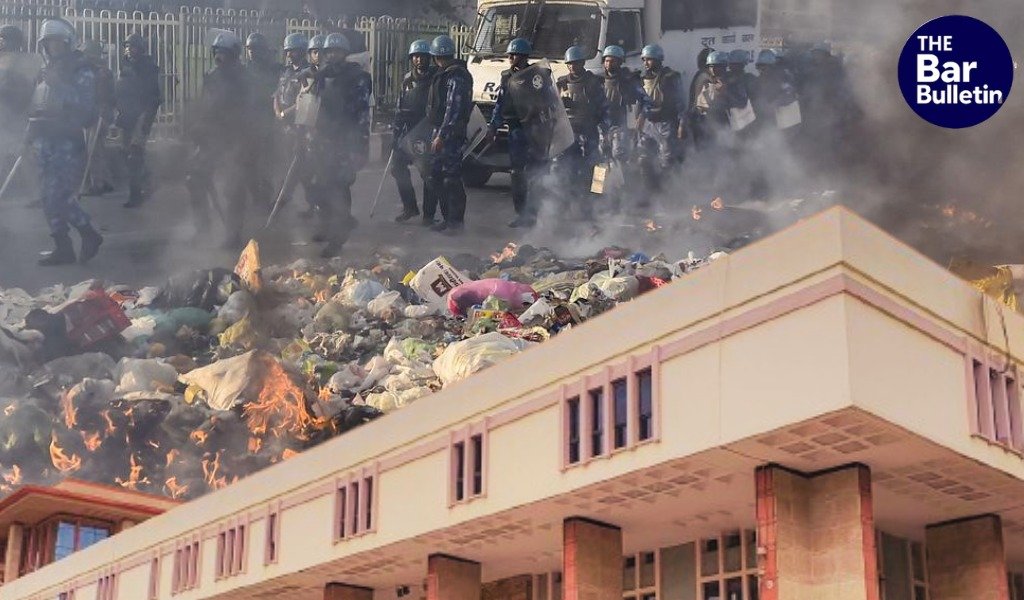

In a batch of seven petitions filed before the Delhi High Court arising from the outbreak of violence in the North-East District of Delhi in February 2020 after the enactment of Citizenship Amendment Act, 2019 (CAA) and proposal of the National Register of Citizens (NRC), a Division Bench of Justice Vivek Chaudhary and Justice Manoj Jain found no exceptional circumstance warranting exercise of the extraordinary jurisdiction of the Court and dismissed the petitions.
The petitioners confined their prayers for reliefs concerning registration of criminal cases against persons alleged to have delivered inflammatory speeches, transfer of investigation to an independent agency or constitution of a Special Investigation Team (SIT) against the allegations of police inaction, complicity, and misconduct during the riots, as well as preservation of evidence along with compensation and rehabilitation of victims.
The CAA was passed by both Houses of Parliament and received the President’s assent on 12-12-2019. Protests were held at several places. The petitioners alleged that inflammatory statements were made by various political leaders and that the immediate trigger for the violence was the events of 23-02-2020, when women protesters assembled near Jaffrabad Metro Station and counter-mobilizations took place, leading to widespread communal violence. Homes, shops, vehicles and places of worship were damaged or destroyed, and families were forced to take shelter in relief camps. The petitioners claimed to have approached the competent police authorities, seeking registration of criminal cases under Sections 153A, 153B, 295A, 298, 504, 505, and allied provisions of the Indian Penal Code, 1860 (IPC).
Hence, the present petitions were filed in 2020, and significant developments had occurred during the pendency. One of the petitioners had preferred a complaint dated 29-01-2020 to the Police Commissioner and later filed an application under Section 156(3) of CrPC. The Magisterial court dismissed it for want of sanction under Section 197. This Court dismissed her challenge on 13-06-2022. The Supreme Court then disposed of her SLP by a judgment dated 29-04-2026. Meanwhile, 757 criminal cases were registered. As on 19-02-2026, 65 stood transferred to the crime branch and charge-sheets were filed in 369 cases, with 22 convictions, 108 acquittals and 16 orders of discharge. GNCTD had also appointed a retired Judge of this Court as Claim Commissioner to award compensation.
The Court stated that where proceedings are instituted in the nature of public interest litigation and the relief sought concerns criminal investigation or prosecution, the Court must be cautious in converting its extraordinary jurisdiction into a mechanism for supervising or controlling the ordinary criminal process. The petitioners submitted that the speeches had incited communal hatred and that the failure to initiate criminal proceedings reflected a selective and discriminatory approach.
It was stated that the record did indicate an element of political selectivity in the manner in which certain individuals and particular speeches had been targeted for action by respective petitioners. The Court referred to Lalita Kumari v. Government of Uttar Pradesh & Ors. (2014) 2 SCC 1, and Sakiri Vasu v. State of Uttar Pradesh & Ors. (2008) 2 SCC 409 to mention the well-settled legal principles governing the registration of FIRs where information discloses commission of a cognizable offence.
The Court stated that the issue projected in this matter substantially overlapped the one in Ashwini Kumar Upadhyay v. Union of India & Ors. 2026 SCOLR 5(1)[5], and said that
No subsequent developments had been brought to the Court’s notice that could warrant issuance of directions for registration of FIR. It was also noted that the completeness and authenticity of the speeches had not been established and that the context in which the statements were made was also disputed. Hence, the Court opined that no case was made out for issuance of a writ directing registration of criminal cases against any particular individual or for issuance of any further direction.
Regarding the prayer for transfer of investigation to an independent agency, the Court stated that the mere making of allegations against the police is not sufficient and that there must be material indicating that the existing investigation is so compromised, tainted or lacking in credibility that intervention of a constitutional court becomes necessary. It was noted that in several instances, the authenticity, completeness, context, or interpretation of the material itself was in question.
Noting the report of the Delhi Minorities Commission, the Court stated that it did not constitute and investigation into the entirety of the incidents and therefore, could not, by itself, be treated as a conclusive determination of the culpability of any individual police officer or establish that the investigations by the Delhi Police were tainted. The Court was unable to hold that the alleged instances of non-compliance with Sections 41B, 41C, 41D and 174 of the CrPC or the other procedural safeguards relied upon by the petitioners established a systemic violation of the statutory framework or of Articles 21 and 22 of the Constitution so as to warrant transfer of the entire investigation.
The Court stated that an allegation that police personnel committed misconduct in the course of the riots is not, by itself, an allegation that the subsequent investigation into the incidents was conducted improperly. It was said that allegations against some police personnel being engaged in the riots, even if assumed to be correct, cannot automatically lead to the conclusion that the entire investigative machinery of the Delhi Police is institutionally incapable of conducting a fair investigation. The Court held that no case was made out for an SIT, a court-monitored investigation or a roving disciplinary enquiry.
Regarding the prayer for preservation of evidence, the Court opined that in the given circumstances, no general direction for preservation of CCTV footage or other electronic records were called for. On the prayer for compensation and rehabilitation of victims, the Court agreed with the State that a specific mechanism had already been constituted for assessing claims arising from the riots, and the petitioners had not demonstrated any systematic failure of the institutional mechanism. Hence, the Court held that no further directions for compensation or rehabilitation were warranted.
Thus, the petitions were dismissed.
