
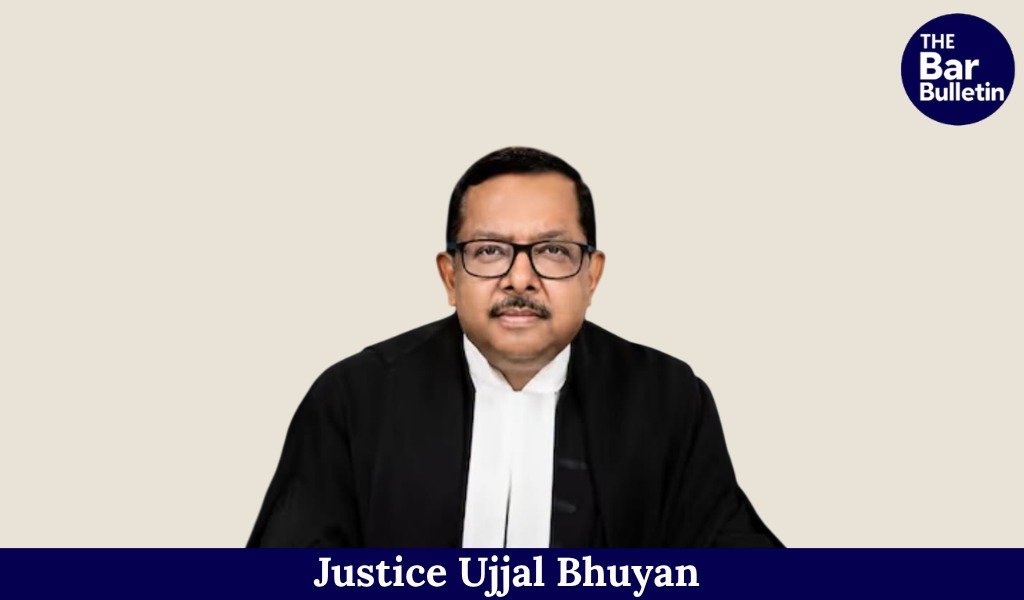
Justice Ujjal Bhuyan, Judge of the Supreme Court of India, has emphasised that the right to vote is not merely a statutory entitlement but a constitutional right that lies at the heart of India’s democratic system, asserting that “No one is above the Constitution.”
Delivering the valedictory address at the 19th NALSAR-Justice B.R. Sawhney Memorial Moot Court Competition 2026 in Hyderabad on October 4, Justice Bhuyan spoke on the evolution and constitutional significance of universal adult franchise in India.
Justice Bhuyan traced the journey towards universal adult suffrage from the freedom movement and the Constituent Assembly debates, noting that the adoption of universal adult franchise represented an “act of faith” by the founding fathers in the common citizen of India. He emphasised that irrespective of wealth, social position, education or occupation, every citizen’s vote carries equal value. Pasted text
Referring to Articles 325 and 326 of the Constitution, Justice Bhuyan said the right to vote or to be a voter cannot be treated as merely a statutory right arising from parliamentary legislation. According to him, it is a constitutional right forming a distinct part of democracy itself and is central to the electoral process. Pasted text
Justice Bhuyan further referred to the Supreme Court’s decisions in Kihoto Hollohan v. Zachillhu and PUCL v. Union of India, observing that democracy and free and fair elections are fundamental to the constitutional scheme and that the right to vote is central to citizens’ participation in governance. He also referred to Anoop Baranwal v. Union of India, where the Supreme Court held that the right of a citizen to be a voter and to vote is of the greatest importance and forms the foundation of free and fair elections. Pasted text
Addressing the safeguards surrounding electoral rolls, Justice Bhuyan referred to Section 22 of the Representation of the People Act, 1950 and the Supreme Court’s decision in Lal Babu Hussain v. Electoral Registration Officer, emphasising that, except in the case of a dead voter, a person whose name is already included in the electoral roll cannot be removed without notice and an opportunity of hearing. Pasted text
Justice Bhuyan cautioned against any process resulting in wholesale disenfranchisement of citizens, stating that such a process would strike at the constitutional order itself. He stressed that Article 326 cannot be diluted and that no authority has the power to do so.
Concluding his address, Justice Bhuyan underlined the continuing responsibility of each generation to preserve constitutional freedoms, recalling Nani Palkhivala’s observation that freedom cannot simply be inherited but must be defended by every generation.