
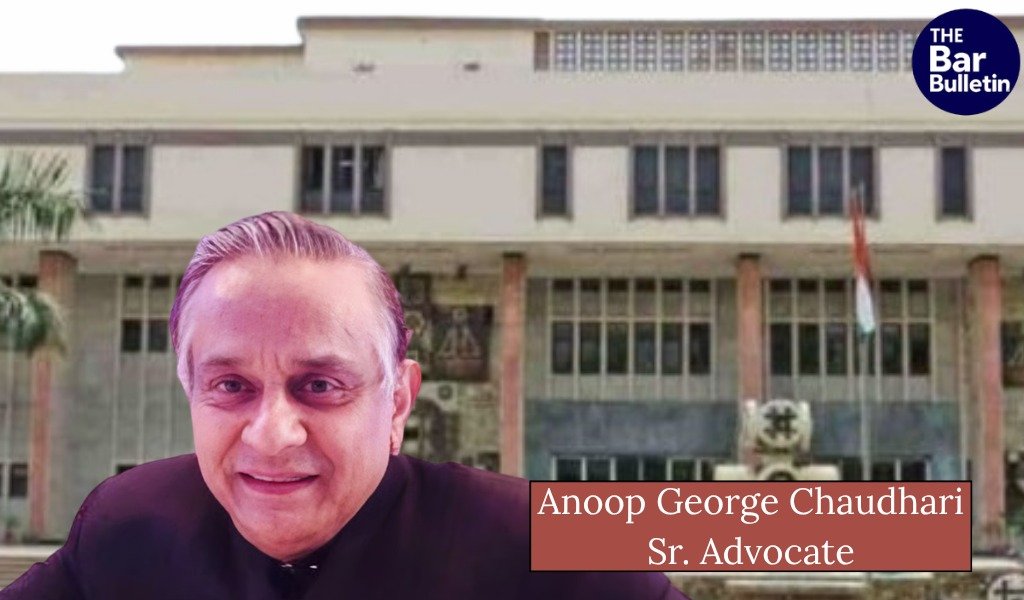

In a writ petition filed before the Delhi High Court by a senior advocate and the former Advocate General of the State of Madhya Pradesh, seeking directions upon the State to release his outstanding professional fee together with 24% interest p.a., regarding his appearances on behalf of the State before the Supreme Court and other conferences, a Single Judge Bench of Justice Sachin Datta held that the petitioner was entitled to appearance fees amounting to Rs. 78,65,000/-, together with interest at 9% per annum from the date of filing of the writ petition till payment, to be paid by the State within six weeks.
In 2019, a constitution bench of the Supreme Court finally heard the reference concerning interpretation of Section 24(2) of the Right to Fair Compensation and Transparency in Land Acquisition, Rehabilitation and Resettlement Act, 2013, in a batch of matters led by the Indore Development Authority matter, which arose out of a judgment by the Madhya Pradesh High Court, wherein the State of Madhya Pradesh was directly and vitally interested in the outcome thereof. A Housing Board Matter was also tagged with the aforesaid matters, in which the State was arrayed as one of the respondents. The petitioner averred that upon a personal request from the then Chief Secretary and the then Principal Secretary (Law), he agreed to appear for the State, and that the then Standing Counsel briefed him and handed over paper-books to him.
The Supreme Court’s record of proceedings reflected the petitioner’s appearance as Senior Advocate on fourteen dates of hearing between 16.10.2019 and 11.12.2019. On 01.12.2019, the petitioner raised 35 consolidated fee bills addressed to the standing counsel., aggregating Rs. 1,76,55,000/-, comprising appearance bills of Rs. 6,05,000/- each and conference bills of Rs. 1,65,000/- each. The standing counsel, by a letter dated 08-01-2020, informed the petitioner that the bills had been forwarded to the Principal Secretary (Law) and Principal Secretary (Revenue) for remittance of fees “as raised.” Despite this, the bills remained unpaid, prompting institution of the writ petition in November 2021.
The Indore Development Authority and the M.P. Housing Board filed replies denying that they had engaged the petitioner, asserting that the State alone was liable. In its counter-affidavit dated 16-05-2023, the State contended that the petitioner had been engaged by the IDA and the Housing Board rather than the State directly. The Advocate General was requested to look into the matter, and a report filed on 02-08-2024 stated that the Law Department had no record of the petitioner’s appointment or bills. Subsequently, the State filed an application seeking dismissal on grounds of non-maintainability, raised for the first time nearly four years after institution of the petition. Pursuant to the Court’s queries dated 13-03-2026, the State filed another application stating that it had been unable to conclusively ascertain the fees paid to the petitioner despite a ‘comprehensive and exhaustive exercise.’
After perusing various decisions, the Court found that the principle which emerges is not that the existence of a factual dispute ousts writ jurisdiction, but that the writ court will decline to embark upon an adjudication which genuinely requires trial. It was stated that the proposition that a writ court will not adjudicate disputed questions of fact is not intended to, and cannot, operate as a device by which a litigant, least of all, the State, may defeat the jurisdiction of the writ court by the simple expedient of raising disputes. The Court said that if the same is permitted, it would render the guarantee under Article 226 illusory at the option of the respondent. Considering the decisions relied on by the State, it was stated that the State could not invoke the contractual character of the claim for ousting writ jurisdiction, while simultaneously denying that any engagement ever existed.
The Court found that the material facts stood established by contemporaneous official records and admissions of the State’s own functionaries and that the petitioner’s appearance on fourteen dates recorded in the Supreme Court’s own order sheets, alongside the State’s standing counsel and Advocate-on-Record, to be beyond controversy, particularly since the State never sought review or correction of those records over six years. It was held that the State cannot retain the benefit of proceedings in which the petitioner represented it, while simultaneously disowning his very engagement.
It was held that the then Chief Secretary’s admission at the meeting dated 01-11-2025, that the petitioner had been engaged in the IDA matter and that his bills might be processed at prevailing rates, constituted acknowledgment of liability. The Court found the State’s shifting and mutually irreconcilable stands, denying engagement while also asserting only two effective appearances, to be untenable, and rejected the State’s assertion that the petitioner’s very engagement in the matter was disputed. The Court stated that the fact was that the State’s standing counsel briefed the petitioner, the State’s Advocate-on-Record gave his appearance to the Supreme Court on fourteen dates, and that the State’s standing counsel transferred his bills to the State for payment.
The Court said that the absence of a written appointment order in the State’s records was a reflection on the State’s own record keeping and internal processes, not a circumstance that could be put up against the counsel who was, in fact, engaged, briefed, and put up to argue before the constitution bench by the State’s own officers and standing counsel. The court refused to permit the State to convert its own administrative default into a defence and plead ‘disputed questions of fact’.
Regarding quantum, the Court stated that a public authority cannot dispute the only contemporaneous rate before the Court and then cite its own inability to retrieve the best evidence capable of contradicting the rate. Hence, it accepted the rate of Rs. 6,05,000/- per appearance as the same had never been disputed for years, while disallowing duplicated bills for the same date across the two connected matters and disallowing conference fees for want of corroboration. The Court held that the amount payable by the State of Madhya Pradesh was Rs. 78,65,000/- along with interest at 9% p.a. within six weeks.
The Court further stated that the designation of a Senior Advocate is a solemn judicial recognition of professional distinction conferred by the Court itself and also noted that the petitioner had held the constitutional office of Advocate General of the very State which now resisted his claim. It was stated that under the classical English tradition, the conception of the counsel’s office was so elevated that his fee was regarded as an honorarium rather than a contractual debt, and that the facts of the present case was a matter of institutional concern.
It was stated that if States are permitted to consume the services of seniormost members of the Bar in their hour of need and to consign their bills to a maze of departmental denials, the inevitable consequence, as cautioned by the Supreme Court, would be that talented members of the Bar would be discouraged from appearing for the State at all. The Court also deprecated the State’s conduct as inconsistent with the standard expected of a model litigant under Article 14. Lastly, the Court found it necessary to observe that the maintenance of great traditions of the Bar is an onerous obligation, cast in equal measure upon all who participate in the administration of justice.
