
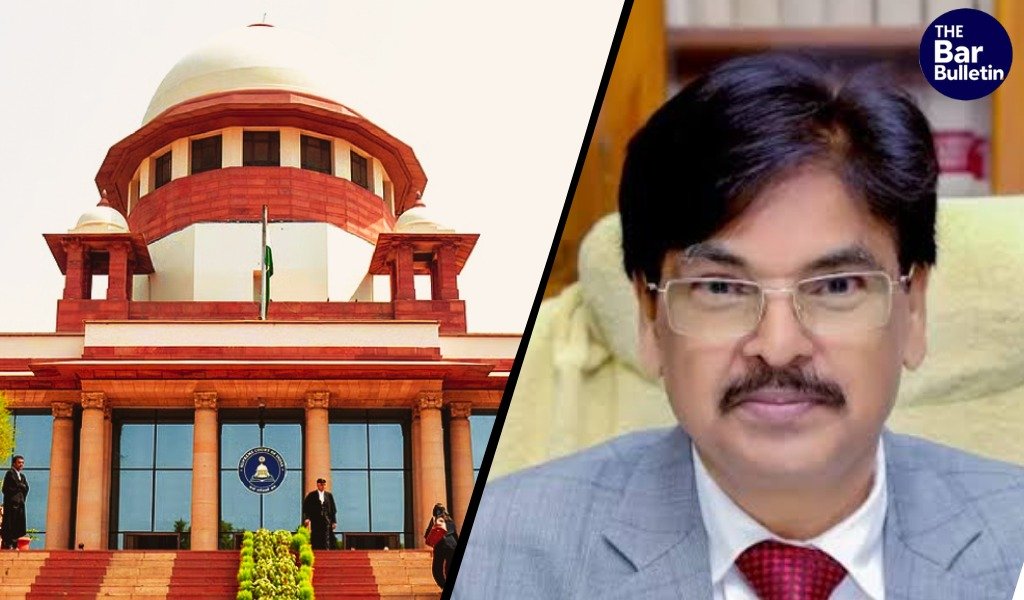

The Supreme Court on Wednesday directed a time-bound process for reconstitution of the State Bar Councils and consequential election of a new Bar Council of India (BCI), observing that the recently concluded State Bar Council elections have changed the position and must now be followed by the statutory process for constituting the BCI.
A Bench comprising Chief Justice of India Surya Kant, Justice Joymalya Bagchi and Justice V. Mohana was hearing petitions challenging the prolonged continuance of BCI Chairman Senior Advocate Manan Kumar Mishra.
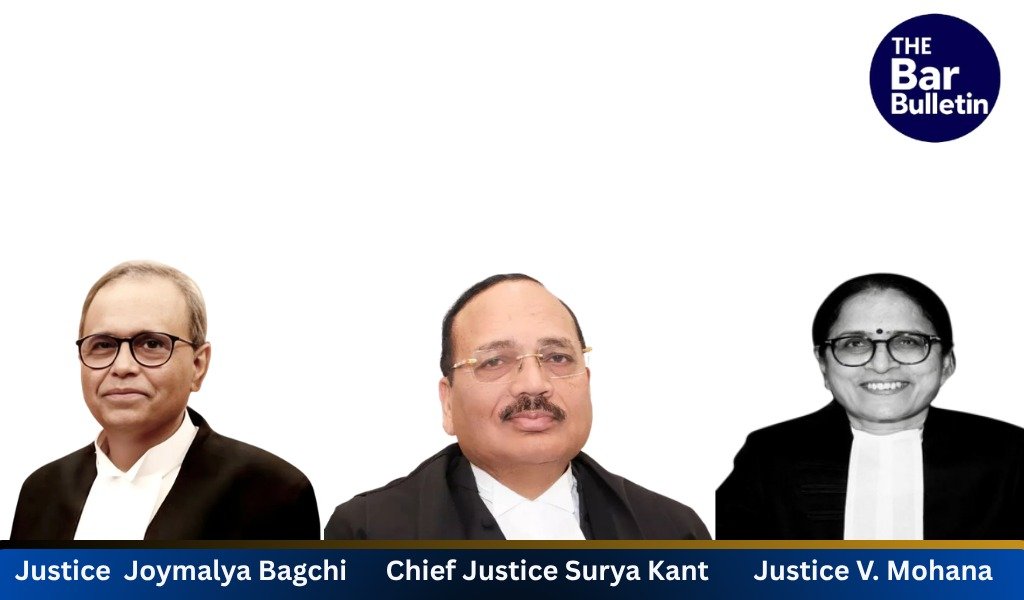
Appearing first for the petitioners, Senior Advocate Madhavi Divan argued that the petitioners were challenging the continuation of the BCI Chairman and Vice-Chairman and, in particular, the April 2025 notification which recorded their tenure up to 2030. Ms Divan pointed out that Rule 12(2) of the BCI Rules prescribes a two-year tenure for the Chairman and Vice-Chairman. She argued that the April 2025 notification, which purported to extend the tenure to five years, could not override the statutory framework.

Ms Divan also challenged the reliance on the proviso to Section 4(3) of the Advocates Act, under which BCI members continue until their successors are elected. She argued that a provision intended to prevent an administrative vacuum was being used to indefinitely prolong the tenure of office-bearers. She argued:
“
“The proviso to Section 4(3) has a wholesome purpose of avoiding an administrative vacuum. That was the purpose. Vacuum and nothing more. The question is whether Section 4(3), in the rule architecture where there is an independent rule prescribing a finite tenure, can be used to extend the finite tenure to another tenure. And there are certain provisions which may have a very salutary purpose at the time they are brought in, but by virtue of passage of time or open misuse in this manner they acquire unconstitutionality, which is what we are saying and this is what needs to be addressed.”
She submitted that the long delay in State Bar Council elections had earlier been justified on the ground of verification of advocates’ rolls and certificates, but that the Supreme Court had repeatedly made it clear that such an exercise could not become a means to indefinitely postpone elections.
Also Read: ‘Totally Uncalled For’: CJI Surya Kant Criticises BCI Action Against NALSAR Students
The Bench, however, focused on the fact that the State Bar Council elections have now actually taken place pursuant to the Supreme Court’s directions. The CJI observed that this was a significant intervening development. Once the newly elected State Bar Councils are constituted, Section 4(1)(c) of the Advocates Act requires them to elect one member from amongst themselves as their representative to the BCI.
The Bench observed during the hearing that the newly constituted State Bar Councils are “required and obligated” to elect their representatives to the BCI and that the process would ultimately result in the reconstitution of the BCI.
The Court also indicated that the April 2025 notification extending the tenure of the existing BCI office-bearers had to be viewed in light of the subsequent State Bar Council elections. The CJI observed that when the notification was issued, there were no elections taking place, whereas the situation had now materially changed. The Bench remarked:
“
“Once the elections are held, then a newly constituted State Bar Council is expected, is required and obligated to exercise their statutory prerogative under 4(1)(c) and elect their representative.”
On Manan Kumar Mishra’s present position, the court indicated that his continuation cannot be treated as a fresh democratic mandate extending up to 2030. Justice Joymalya Bagchi observed that, pending constitution of a newly elected BCI, the existing arrangement could continue only for day-to-day functioning, with the Chairman effectively functioning on a pro-tem basis until the fresh BCI election.
The Bench observed that this was not a situation where he is democratically elected and continues to be so, and that his continuation is co-terminus with the forthcoming election of the BCI constituted through the newly elected State Bar Councils. It remarked:
“
“You should also bear in mind that you are like a pro-tem chairman till a fresh election of the Bar Council of India, pursuant to the elections already conducted for the State Bar Council, takes place. So, it is not a situation where he is democratically elected and continues to be so. His tenure is now coterminous with the election, which is imminent, because the new State Bar Councils are about to be constituted and the election under Section 4(1)(c) is to be undertaken.”
___________________________________________________________________________
Senior Advocate Gopal Sankaranarayanan then raised a separate and substantial issue concerning the BCI-PEARL FIRST Trust, which was created in 2020 in place of the earlier BCI Trust. Mr Sankaranarayanan pointed out that the new Trust Deed contained a provision under which the managing trustees would continue in office irrespective of whether they continued as members of the BCI. He contrasted this with the 1974 Trust Deed, under which a trustee ceased to be a trustee upon ceasing to be a member of the BCI.
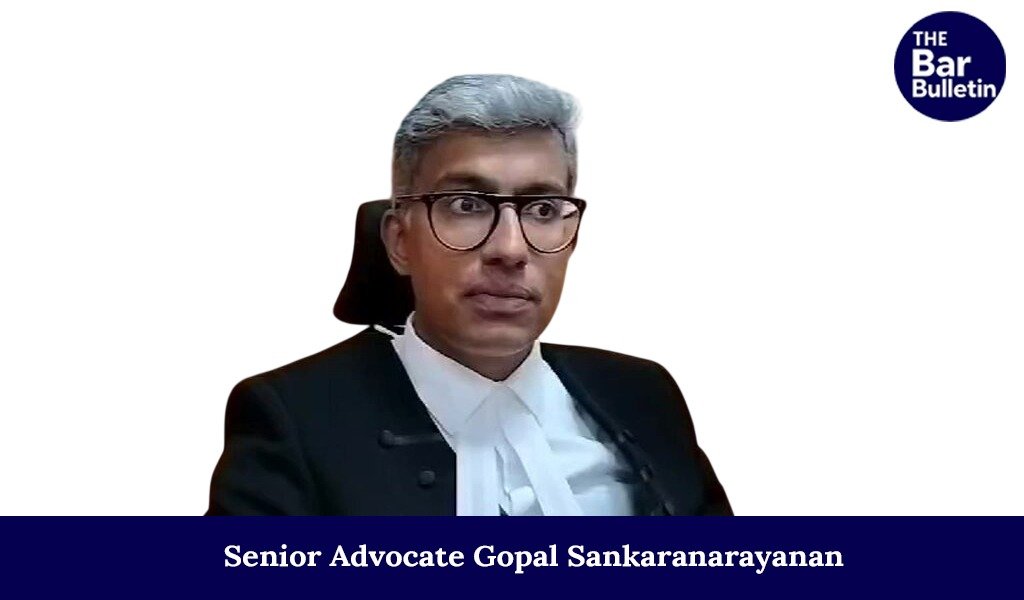
He argued that elected members of a statutory corporate body could not use their position to create a trust structure under which they could perpetuate control over assets even after their elected tenure ended. He submitted:
“
“Even if he is not elected, whether by virtue of his continuance, in view of the proviso of Section 4(3), can these members create a trust where the members themselves perpetuate their rights of trustees beyond their capacity and transfer the assets to themselves? If the Attorney General, the Chief Justice of India or the Chairman of the Bar Council of India is an ex-officio member’s perpetual trustee, it would be in consonance with Section 5. It should be the office, not the individual.”
Mr Sankaranarayanan also told the Court that the Trust had entered into arrangements with the Goa Government and established a university, while raising questions regarding the assets and finances transferred to the new Trust. He sought a high-level examination of what had happened to the BCI’s assets after the creation of the 2020 Trust.
He suggested the constitution of an interim committee, possibly involving the Attorney General, Solicitor General, senior lawyers and a woman member, to examine the affairs of the Trust and its financial management.
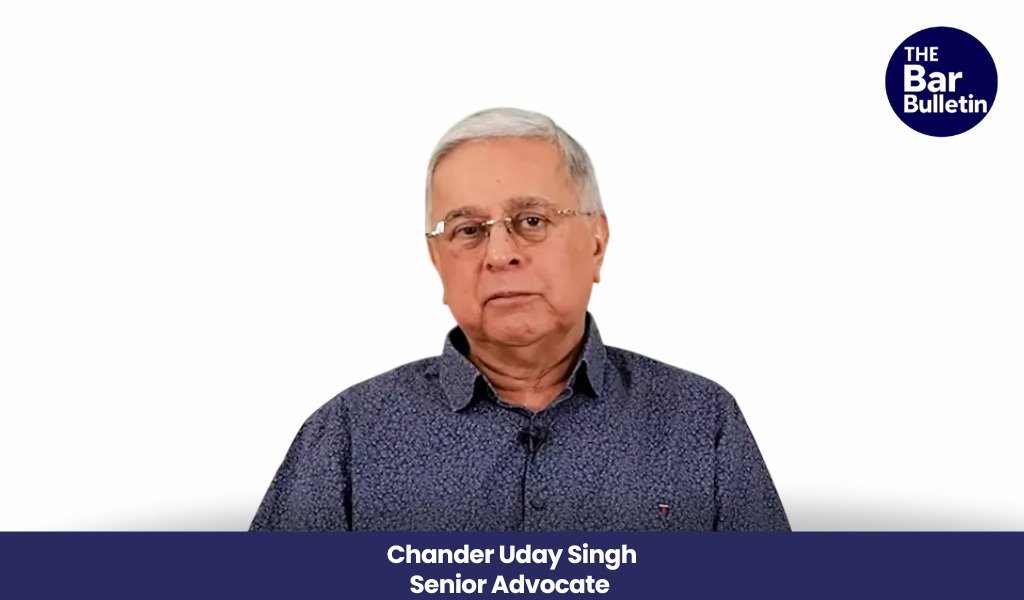
Senior Advocate Chander Uday Singh, appearing for the petitioner, supported the challenge to the provision allowing trustees to continue beyond their tenure as BCI members. Mr Singh pointed out the distinction between the 1974 and 2020 Trust Deeds, submitting that the earlier arrangement linked trusteeship to membership of the BCI, whereas the 2020 deed permitted named individuals to continue as managing trustees even after their BCI tenure came to an end.
The Bench also questioned whether an elected body could create a trust with permanent individual trustees, particularly when the trustees’ original authority flowed from their position within an elected statutory body. Justice Bagchi observed in substance that the office, rather than the individual, would have to be the basis for an ex-officio trusteeship.
Senior Advocate Sanjay Hegde also supported the concerns raised on behalf of the petitioners regarding the functioning of the BCI. The petitioners sought, among other things, interim safeguards and raised concerns regarding the continuation of existing office-bearers, financial management and the functioning of the BCI during the transition.
The Bench, however, indicated that many of these concerns could be addressed by ensuring that the newly elected State Bar Councils are constituted without delay and then exercise their power under Section 4(1)(c) to elect BCI representatives. The Court repeatedly returned to this statutory mechanism instead of immediately creating an alternative interim BCI structure.
BCI: Don’t Turn Hearing Into A ‘Wish List’; Agrees To AG-SG Involvement
Appearing for the BCI, Senior Advocate Maninder Singh supported the Court’s proposal for a time-bound completion of the electoral process but cautioned against combining the election issue with all the other allegations and concerns raised by the petitioners.
Senior Advocate Guru Krishnakumar, appearing for the BCI Chairman, also agreed to the time-bound electoral process but objected to what he described as broad allegations and insinuations against the institution.
He submitted that the Court could not become a forum for a “wish list” or indirect allegations against the BCI. The transcript records the submission that the matter concerned an institution and not individuals, and that the petitioners’ concerns should not become a basis for broad-based attacks.
The BCI, however, did not oppose the Court’s suggestion that the Attorney General and Solicitor General be actively associated with policy decisions during the interim period.
The Bench proposed that while the existing arrangement continued for day-to-day functioning, the AG and SG, both ex-officio members of the BCI—should be involved whenever a significant policy decision was taken. The Court said:
“
“Let every decision taken by the council be specifically participated in by the learned Attorney General and Solicitor General. So that we have an oversight of the highest law officers of the country.”
The BCI ultimately agreed to the arrangement, with counsel stating that there was no difficulty in involving the Attorney General and Solicitor General in such decisions.
The Court clarified that this did not mean that the AG or SG would run the day-to-day affairs of the BCI. Rather, their involvement would operate as an oversight mechanism for policy decisions until a newly elected BCI is constituted.
SC Sets Out Three-Stage Timeline
The Court noted that 30% representation for women in every State Bar Council had already been directed, with 20% to be directly elected and 10% to be co-opted. The Chief Justices of the respective High Courts had been directed to nominate two women members in consultation with the newly elected State Bar Council members.
● The Court has now requested the Chief Justices to complete the co-option exercise within two weeks.
● After that, the State Bar Councils are to notify their newly constituted composition within one week.
● Thereafter, each newly constituted State Bar Council will have to elect its Chairperson, Vice-Chairperson and other office-bearers, as well as one member to represent it on the BCI under Section 4(1)(c).
The State Bar Councils have been directed to complete these elections within three weeks from the date on which their composition is notified. Only after the compliance reports are received will the Supreme Court take up the issue of the constitution of the BCI under Section 4 of the Advocates Act.
The Bench indicated that the immediate priority was to ensure that the statutory electoral process, now set in motion after years of delay, reaches its logical conclusion. The Court observed that the recent State Bar Council elections had fundamentally altered the situation and that, once the newly elected bodies exercise their statutory power under Section 4(1)(c), the question of the BCI’s composition would follow. The order records:
“
“The core issue that arises for consideration in these matters pertains to constitution and composition of the State Bar Councils and Bar Council of India in accordance with the provisions of the Advocates Act, 1961 and the rules framed thereafter. Pursuant to the various orders passed by this Court, elections to the State Bar Councils have since been conducted. Through another order passed by this Court, it was directed that there shall be 30% representation for women members of the Bar in every State Bar Council. Out of that 30% representation, 20% were to be directly elected, whereas 10% were to be co-opted.”
When the issue of the manner and modalities of co-option arose, this Court, by order dated 4th August 2026, had directed that the Chief Justices of the jurisdictional High Courts shall, in consultation with the newly elected members of the respective State Bar Councils, formally nominate two women members, preferably from amongst the former women judges of the said High Court or senior women members of the Bar. It goes without saying that once the co-option exercise is completed, the composition of the State Bar Councils shall stand notified.”