
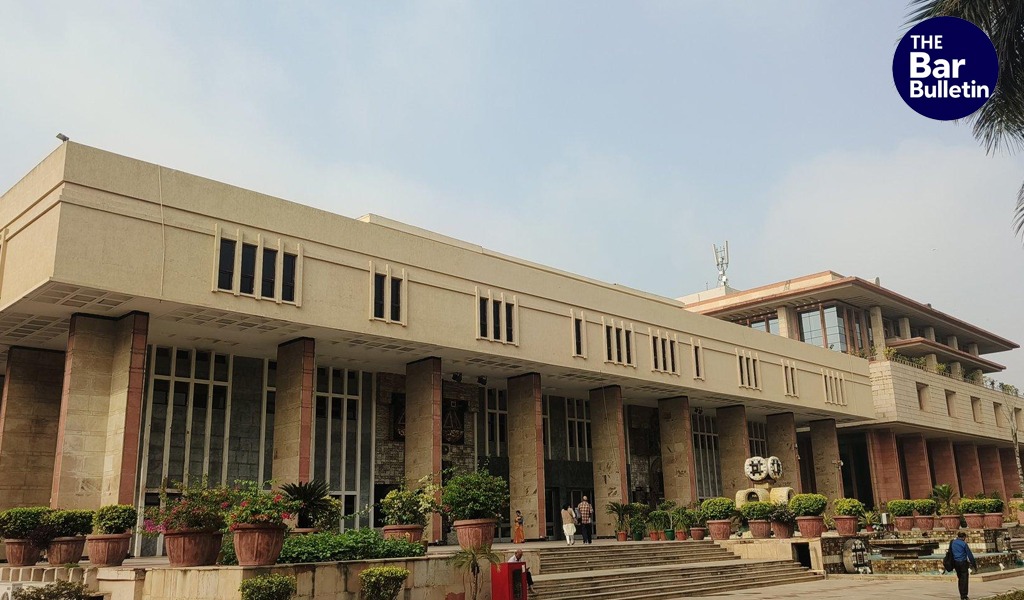

The Delhi High Court has held that interest earned during the pre-commencement period on funds deposited in bank will not be taxable as “income from other sources” if the funds are not surplus but are earmarked and inextricably linked with the setting up of the business, including for meeting committed liabilities toward plant and machinery, land, technical know-how and other project requirements.
Accordingly, referring to the decision in the case of CIT v. Bokaro Steel Ltd. [236 ITR 315 (SC)], the Court clarified that the funds earmarked to facilitate the balance payment for plant and machinery etc. for which advances were made by the assessee, as an inextricable link to the setting up of its business, goes to reduce the project cost or pre-operative expenses.
The Division Bench comprising Justice V. Kameswar Rao and Justice Vinod Kumar recounted the factual position that the appellant company had been incorporated in March 1992, had entered into the technical know-how agreement in May 1992, had paid USD 50,000 along with TDS in terms of that agreement, had raised unsecured loans of Rs.72,69,500 from its directors, and had partially invested the funds into fixed deposits from which the impugned interest accrued during AYs 1993-94 and 1994-95.
The Bench clarified that after meeting payments for technical know-how, land, advances for machinery, and raw materials, the remaining amount was deposited in the bank because those funds were not immediately required. It further noted that, admittedly, the business had not commenced during these years and the assessee had adjusted the interest income against pre-operative expenses.
The Bench then examined the profit and loss accounts for the relevant years, which showed interest on bank deposits on the credit side and transfer of the resultant balance to pre-operative expenses. It observed that the appellant had made payments for industrial land, technical know-how, raw material imports and tools, while in relation to certain purchases of machinery only advances were paid. Thus, the Bench found substance in the position that the deposits were maintained for meeting committed liabilities connected with setting up the project and not for deploying surplus capital to earn income.
If the deposits were required for meeting balance payments for plant and machinery and committed obligations under the know-how agreement, the funds on which interest accrued could not be treated as “income from other sources”, and the benefit under Section 35D would enure to the appellant because the funds were inextricably linked with the setting up of the business, concluded the Bench.
Briefly, the appellant company had been incorporated in 1992 for carrying on the business of manufacture and export of ecological brake-shoes for two-wheelers, cars and trucks. For AYs 1993-94 and 1994-95, it filed returns declaring “nil” income, and while computing income it adjusted interest earned during the relevant previous years against project expenses.
In 1992, the appellant entered into an agreement with CDB Holding Pte. Ltd., Singapore, for acquisition of technical know-how. Under that agreement, the appellant was required to pay USD 2,50,000, of which USD 50,000, equivalent to about Rs.20.27 lakhs, was paid during AY 1993-94, while the balance USD 2,00,000 was to be paid in five equal yearly instalments. During AY 1993-94, the appellant raised a loan of Rs. 72.69 lakhs from its directors. Out of this amount, payments aggregating to Rs. 23.17 lakhs and Rs. 20.27 lakhs, including payment for land, were made towards technical fee and other project expenses. The funds not immediately required were deposited in the bank, on which the appellant earned interest of Rs. 1.23 lakhs and Rs. 2.37 lakhs for AYs 1993-94 and 1994-95 respectively.
The appellant’s case was that total expenditure of Rs. 43.44 lakhs were incurred out of funds arranged from the directors, partly through share capital of Rs. 25 lakhs and partly through interest-free loans of Rs. 50.59 lakhs. In order to facilitate timely payment of committed obligations such as purchase of plant and machinery, construction of factory building and similar obligations, the appellant deposited the remaining funds of about Rs. 32 lakhs in the bank, and the interest earned thereon was adjusted against project expenditure, with the deficit transferred to pre-operative expenses and carried forward.
A notice under Section 148 of the Income-tax Act, was issued reopening the assessment for AY 1994-95 to tax the interest income as “income from other sources”. The Assessing Officer treated the amounts deposited in the bank as “surplus funds” and brought the interest to tax under that head. On appeal, the Commissioner of Income-tax (Appeals), held that this was not a case where surplus share capital money lay idle in the bank for the purpose of earning interest, and that the deposit of money by the appellant was directly linked to committed obligations for purchase of plant and machinery, construction of factory premises and payment of technology fees. The CIT(A) therefore concluded that any income earned on such deposit was incidental to acquisition of assets for setting up the plant and machinery and meeting other committed obligations.
On further appeal, the ITAT set aside the order of the CIT(A) and held that the interest received had been wrongly adjusted against project expenses and was liable to be taxed separately as “income from other sources.”
Case Relied On:
CIT v. Bokaro Steel Ltd. [236 ITR 315 (SC)]
Appearances:
Advocates Satyen Sethi and Arta Trana Panda, for the Appellant
Advocates Abhishek Maratha, Apoorv Aggarwal, Parth Samwal, Nupur Sharma, Gaurav Singh, Bhanukaran Singh Jodha, Muskan Goel, Himanshu Goel and Nischay Purohit, for the Respondent
