
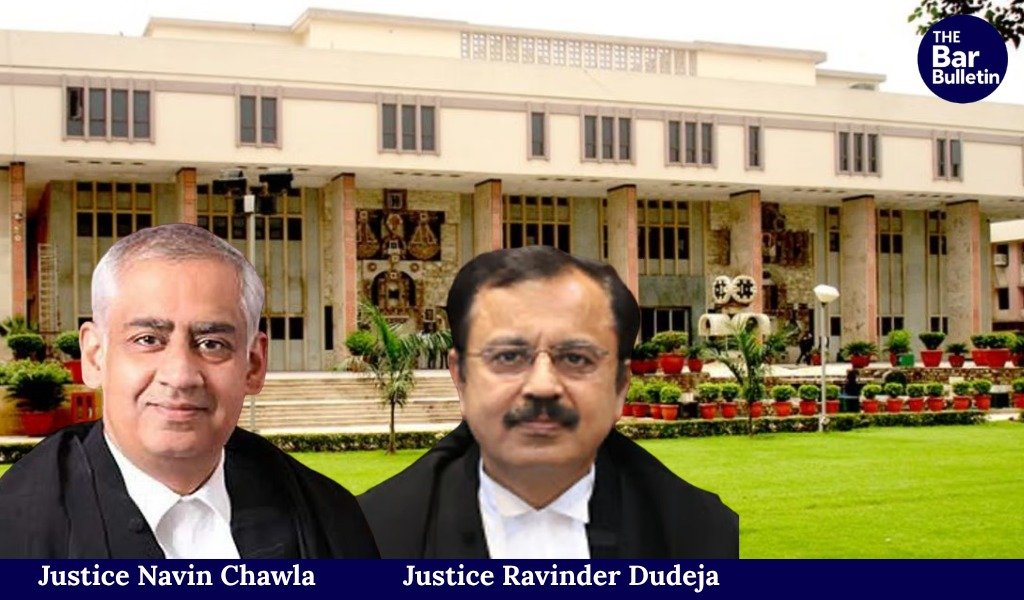

The Delhi High Court has clarified the stage at which a Magistrate takes cognizance of an offence in a private complaint under the Bharatiya Nagarik Suraksha Sanhita (BNSS), holding that the examination of the complainant and witnesses on oath, as well as an opportunity of hearing to the accused, must precede the formal act of taking cognizance.
A Division Bench of Justice Navin Chawla and Justice Ravinder Dudeja notedthat Section 223(1) of the BNSS has brought about a significant change from the corresponding provision under the Code of Criminal Procedure (CrPC). The judgment answered two questions referred to it concerning the stage of cognizance and the timing of notice to the accused.
Question 1: What is the stage at which a Magistrate can be said to have taken “cognizance” of an offence, in the context of a private complaint, under the provisions of BNSS, and whether the expression “while taking cognizance” as employed in Section 223(1) of the BNSS implies that the examination of the complainant and witnesses on oath is a step prior to taking of cognizance of offence?
Question 2: At what stage is the Magistrate required to issue notice to the accused in compliance with the first proviso to Section 223(1) of the BNSS – whether (a) upon perusal of the complaint but prior to recording of the statement of the complainant and witnesses, if any, or (b) after recording such statements but before a formal decision on taking cognizance?
The reference arose in a petition challenging an order of the Judicial Magistrate First Class directing issuance of notice under Section 223 of the BNSS before recording pre-summoning evidence in a private complaint. A connected petition concerned a similar direction to issue notice to the proposed accused upon receipt of a private complaint.
The Bench noted that under the CrPC, the settled position was that the Magistrate took cognizance under Section 190 and thereafter proceeded with the examination of the complainant and witnesses under Section 200. However, Section 223 of the BNSS uses the expression “while taking cognizance” and also introduces a new proviso stating that no cognizance can be taken without giving the accused an opportunity of being heard.
The Court held that the word “while” has a temporal meaning in the provision and therefore makes the examination of the complainant and witnesses part of the process of taking cognizance.
“
“Therefore, instead of the stage of the examination of the complainant and the witnesses present, being subsequent to the Magistrate taking cognizance, as was the position in the Cr. P.C., the legislature, by using the word ‘while’ has made the process of examination of the complainant and the witnesses a part of the process of the Magistrate taking cognizance of an offence on a complaint.”
The Bench further emphasised that Section 223(1) contains another significant departure from the CrPC by expressly prohibiting the Magistrate from taking cognizance without giving the accused an opportunity of being heard. The Court said that this hearing is now mandatory.
On the specific question of when notice must be issued, the Court rejected both the position that notice should necessarily be issued immediately upon presentation of the complaint and the suggestion that it could be deferred until after a formal decision to take cognizance.
The Bench held that the Magistrate must first examine the complainant and witnesses on oath, unless the examination is exempted under the statute. Thereafter, if the Magistrate forms a prima facie opinion that the complaint does not deserve dismissal under Section 226 but that cognizance may be warranted, notice must be issued to the accused and an opportunity of hearing must be provided.
Only after that hearing can the Magistrate formally decide to take cognizance. Thus, answering the first question, the Court held that examination of the complainant and witnesses and hearing of the accused are steps preceding the taking of cognizance.
On the second question, it held that notice to the accused is to be issued after examination and formation of the prima facie opinion, but before the formal decision to take cognizance.
The Court also clarified that the change in Section 223 was not merely a continuation of the CrPC procedure. It observed that the Single Judge’s reliance on earlier judgments explaining the CrPC position had overlooked the legislative change introduced by the BNSS.
The petitions have been directed to be listed before the Roster Bench on October 28, 2026, subject to the orders of the Chief Justice. A copy of the judgment was directed to be communicated to the Referral Court for necessary information.
