
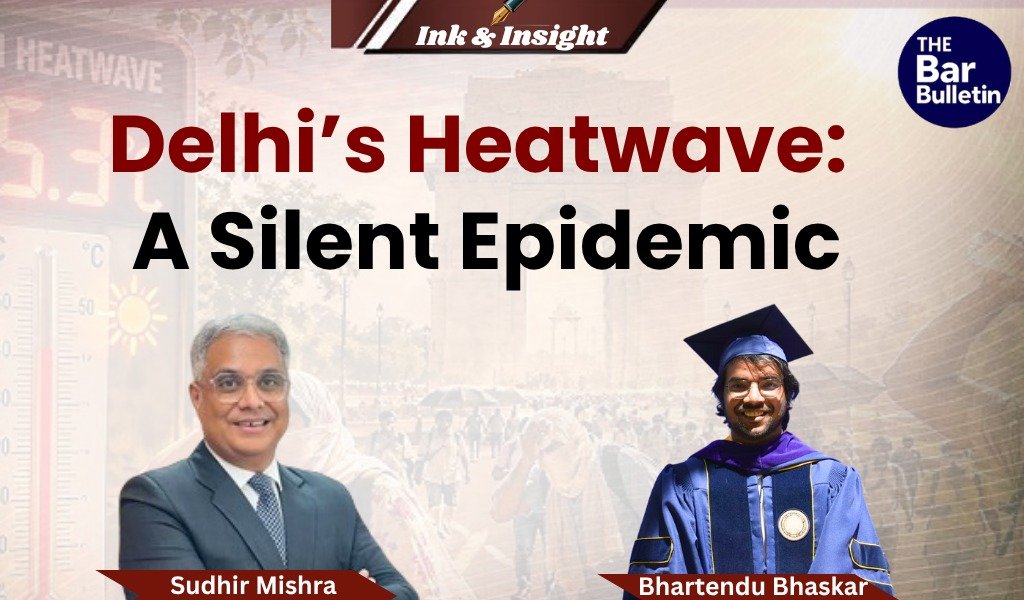

Are we to leave our successors a scorched planet of advancing deserts, impoverished landscapes, and an ailing environment?
When Nani Palkhivala posed this question in 1994, he was warning of a distant dystopia. Today, in Delhi, it is simply the daily weather report. Everyday life in Delhi can be drastically different for different people. The inequalities get a little more light every time a natural disaster happens – and the heatwaves are nothing less than a disaster. We often trade our green belts to flood the soil with heat-trapping asphalt. The small pockets of green in Delhi are covered in dust and poorly maintained. They say ‘rain falls on the just and the unjust alike’, but does it?
Walk from Malviya Nagar to a park in Sheikh Sarai, and the difference is abundantly clear. On an ordinary road, an old woman may stand with nothing overhead but the sun; a pregnant woman may ride a two-wheeler while sweat makes the handle difficult to grip; a child may walk home from school, wiping fresh sweat with every step. Meanwhile, the labourers who build high-rises equipped with air-conditioning will often never experience an air-conditioned life themselves. These are not merely unequal experiences of weather. They are unequal exposures to risk.
Air-conditioners, often sold as the solution, only deepen the urban heat problem. Every air-conditioner that cools a home rejects heat outdoors, reinforcing localised heat. AC ownership in India has increased threefold between 2010 and 2023, reaching about 24 units per 100 households[1], while variations in the heat index have been linked to as much as 67 per cent of Delhi’s daily peak electricity-demand variation[2].
These roads were once cooled by historical breezes from the Yamuna corridor when the ridges of Delhi functioned more like a green lung. Today that lung has been severely degraded. Hinch Lal Tiwari v. Kamala Devi, (2001) 6 SCC 496, treated community resources such as ponds as ecological assets that maintain ecological balance and support the quality of life protected by Article 21 – then why don’t we try and treat the winds and heat as community resources too. The loss, fragmentation or neglect of these assets should, therefore, be assessed not only as an aesthetic or planning concern but also as a heat-risk and public-health concern.
Sun-baked roads and pavements in Delhi can exceed 60°C during peak summer heat, far above ambient air temperature[3]. At such temperatures, surfaces can cause serious injuries, and extreme heat can deform footwear, yet the city still lacks adequate cooling infrastructure: too few shelters and water kiosks, and facilities that are often unusable when people need them most. In the Municipal Council, Ratlam v. Vardhichand, (1980) 4 SCC 162, the Supreme Court refused to allow a municipality to evade statutory and public-health obligations merely because compliance involved expenditure – where extreme heat makes such public spaces unsafe, the relevant question cannot be only whether the authority has a policy. It is whether the authority has discharged the positive duty to protect public health through workable measures.
Tin roofs create domestic ovens in which indoor night temperatures can remain dangerously high. Pregnant women face extreme thermal stress; older people may be unable to dissipate accumulated heat during humid nights; and gig workers, rickshaw pullers, construction workers and brick-kiln workers can spend hours without reliable shade, portable water or designated cooling breaks. The burden is not evenly distributed. Heat becomes most dangerous where people have the least ability to escape it. In M.K. Ranjitsinh v. Union of India, (2024) 5 SCC 338, the Supreme Court articulated that the right against the adverse effects of climate change is recognised through Articles 14 and 21. The Court explained that climate impacts can affect the right to health and that the inability of underserved communities to adapt or cope with those impacts can engage equality as well as life and health.
Construction workers sometimes use over-the-counter painkillers simply to keep working through heat-induced fevers, body aches and nausea. Consumer Education & Research Centre v. Union of India, (1995) 3 SCC 42, held that the right to health and medical care is a fundamental right under Article 21 and emphasised the State and employer’s responsibility to protect the health and strength of workers. A worker should not have to choose between starvation and fatal heat exposure. Bandhua Mukti Morcha v. Union of India, (1984) 3 SCC 161, likewise linked Article 21 with protection of workers’ health and strength and humane working conditions.
Taken together, these authorities support a legal duty to reduce avoidable occupational heat exposure rather than treating heat injury as a worker’s private medical misfortune. At the same time, heat-related deaths are difficult to count because extreme heat may exacerbate cardiovascular, respiratory or other pre-existing conditions without being recorded as the immediate cause. The legal and governance problem therefore begins before the death certificate: when a foreseeable environmental hazard is repeatedly known, measured and experienced, what duties arise to prevent the harm?
Frustrated by administrative apathy, the judiciary has been forced to intervene. In an order dated 31 May 2024 concerning Delhi’s forests and ecological administration, the High Court issued a stark warning regarding the capital’s survival.
“
“Judicial notice is taken of the fact that as recently as May 30, 2024, the official temperature recorded in Delhi was 52.3 degrees Celsius,” Justice Tushar Rao Gedela noted. “It is not far to see the day when this city may be only a barren desert, in case the present generation continues an apathetic view on deforestation.” [4]
This judicial alarm is echoing across jurisdictions. In Rajasthan, the High Court took suo motu cognizance of the 2024 heatwave[5], directing immediate, multi-pronged preventive measures. The court mandated the strict implementation of Heat Action Plans, the equipping of health facilities for heatstroke, and on-the-ground relief such as distributing ORS and advising rest during peak heat hours. Crucially, it called for compensation for victims and urged proactive climate legislation.
These aggressive judicial interventions are not overreactions; they are responses to a staggering public health and macroeconomic crisis. One review has reported a thermal mortality increase of roughly 4.1 to 5.8 per cent for each degree above 29°C[6], alongside substantial heat-related sleep loss[7]. While differing official estimates illustrate how under-recording obscures the true burden, the economic costs remain undeniable: heat-related productivity losses are projected to impose a major drag on India’s economy. Ultimately, this is not an inconvenience. It is an economic haemorrhage with a body count.
In our view, heat governance should link scientific heat thresholds to automatic legal action: scientific risk → administrative trigger → infrastructure duty → workplace duty → remedy. The Occupational Safety, Health and Working Conditions Code, 2020, which came into force nationally
on 21 November 2025, provides a broader framework for occupational safety and health. Within this framework, rules or sector-specific standards could require employers in high-risk sectors to monitor Wet Bulb Globe Temperature (WBGT) and other heat indicators, assess heat risks, maintain records, provide water and shaded rest areas, adjust working hours, increase rest breaks, and stop strenuous work when heat thresholds are exceeded. Workers could also be given a limited droit de retrait – the right to leave dangerous heat exposure once an objective threshold is crossed – without having to first prove an injury, along with protection against retaliation and loss of basic earnings when work is suspended for safety reasons.
Finally, the regime should provide compensation where preventable failures to meet mandated duties materially contribute to heat-related injury or death. The aim is to turn scientifically measured heat risk into automatic, reviewable legal duties covering administrative action, infrastructure, workplace safety, data collection and remedies. The question is no longer whether extreme heat is real but whether the State can treat foreseeable, measurable harm as nobody’s responsibility. It should not. If we fail to act, the scorched, impoverished dystopia we were warned about will simply become our permanent reality.
To her fair works did Nature link
The human soul that through me ran;
And much it grieved my heart to think
What man has made of man.
And much it grieved my heart to think
What man has made of man.
Lines Written in Early Spring
by William Wordsworth
*Mr. Sudhir Mishra, Founder and Managing Partner, Trust Legal.
**Mr. Bhartendu Bhaskar, Trainee Associate, Trust Legal
[1] Jayashree Nandi, AC Use Rising Sharply in India, Will Surpass All Other Home Appliances by 2050: Report, Hindustan Times (Oct. 25, 2023), https://www.hindustantimes.com/india-news/ac-use-rising-sharply-in-india-will-surpass-all-other-home-appliances-by-2050-report-101698169969128.ht
[2] Ctr. for Sci. & Env’t, How Delhi Is Losing Its Cool: Heat and Rising Demand for Cooling and Electricity Consumption (2024), https://www.cseindia.org/sharp-rise-in-summer-heat-and-humidity-in-delhi-jacks-up-cooling-demand-and-electricity-consumption-cse-12857.
[3] Preetha Banerjee, Unequal Human Cost of Extreme Heat: Experiences of Delhi’s Outdoor Workers, Down To Earth (June 11, 2024), https://www.downtoearth.org.in/climate-change/unequal-human-cost-of-extreme-heat-experiences-of-delhis-outdoor-workers.
[4] Neeraj Sharma v. Union of India, W.P. (C) No. 7253 of 2023, at 7 (Delhi High Ct. May 31, 2024).
[5] In re Save the Planet Earth and the Future Generations of this Universe, D.B. Civil Writ (PIL) Petition No. 9470/2024 (Raj. H.C. May 30, 2024) (India).
[6] Wong, Kaufui & Paddon, Andrew & Jimenez, Alfredo. (2013). Review of World Urban Heat Islands: Many Linked to Increased Mortality. Journal of Energy Resources Technology. 135. 022101-022112. 10.1115/1.4023176.
[7] Stuti Mishra, Climate Change Is Costing the World Nearly a Week of Sleep Every Year, The Independent (July 15, 2026), https://www.independent.co.uk/climate-change/news/heatwave-sleep-impact-night-temperatures-b3014428.html.