
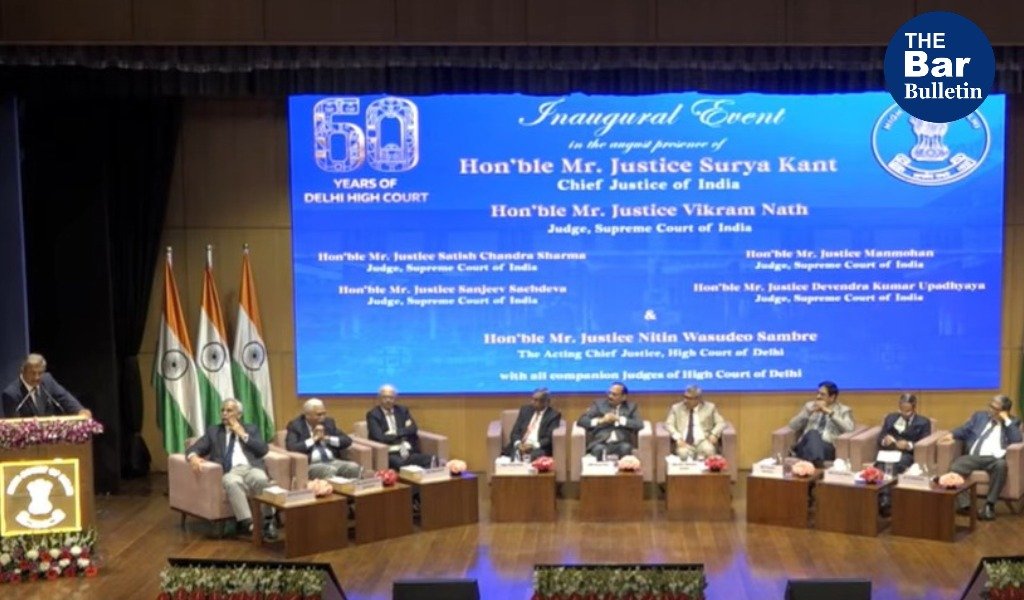
The Delhi High Court on October 30 celebrated 60 years of its establishment, marking its Diamond Jubilee. The special ceremony was attended by Chief Justice of India (CJI) Surya Kant, Supreme Court Judges Justice Vikram Nath, Justice Manmohan, Justice Sanjeev Sachdeva, and Justice DK Upadhyay, former Chief Justices of India and Delhi High Court, Acting Chief Justice of the Delhi High Court Justice Nitin Wasudev Sambre, along with other sitting and former judges of the Supreme Court and Delhi High Court, Additional Solicitor General Chetan Sharma, Delhi High Court Bar Association President Senior Advocate N. Hariharan, Vice-President Sachin Puri, Bar Council of Delhi Chairman Nitin Alawadhi, senior advocates, members of the Bar and Registry officials.
Acting Chief Justice Justice Nitin Wasudev Sambre, in his welcome address, reflected on the institution’s six-decade journey and acknowledged the contributions of former judges, members of the Bar and Registry staff in shaping its legacy.
He observed that 60 years represented not merely an institutional milestone but six decades of constitutional responsibility and public faith in justice. Highlighting the court’s adoption of digital integration, virtual hearings and paperless systems, he said technology and infrastructure must remain secondary to the judiciary’s commitment to its conscience.
“
“The true measure of judicial system is not just the volume of judgments delivered, but how swiftly, fairly and transparently the last person in the queue receives what is rightfully theirs,” he said.
He added that the institution must strive to make the distance between law and justice as short as humanly possible.
Delhi High Court Bar Association President Senior Advocate N. Hariharan, in his address, traced the court’s origins to October 31, 1966, when it was established with four judges, Chief Justice K.S. Hegde and Justices I.D. Dhruva, H.R. Khanna and S.K. Kapur. He recalled that the court initially functioned from a bungalow at 4 Maulana Azad Road before moving through Travancore House and Patiala House and eventually to its present premises on Shershah Road. For over four years, the court also held sittings at Ravenswood in Shimla.
Recalling the legacy of Justice H.R. Khanna, he referred to his historic dissent during the Emergency, when he held that life and liberty could not exist at the pleasure of the State, a position that cost him the office of Chief Justice of India.
He also highlighted the Delhi High Court’s initiatives in alternative dispute resolution, including the establishment of Samadhan in 2006 and the Delhi International Arbitration Centre in 2009. As a president of the bar, he added:
“
“Let me say as the president of this Bar, what we owe this court for the next 60 years. We owe it preparation, candour, and courtesy. We owe it our disagreement, when disagreement is due, because a Bar that only agrees is of little use to a court that must decide. And we owe the young lawyers who join us every year what our seniors gave us, patience, opportunity, and example. What we ask of the court is that what it has given at its best, the patient hearing, an open door, and the courage of Justice Khanna.”
Additional Solicitor General Chetan Sharma also congratulated the Delhi High Court on completing six decades, describing it as one of the country’s most distinguished judicial institutions. He observed that the court’s judgments had earned recognition not only across India but also in jurisdictions outside the country.
Referring to the institution’s reputation, he remarked that it was sometimes described as the “High Court of India” and even the “highest court of the High Courts of India.” He said:
“
“Delhi High Court has today spoken through its judgments in various fields. And it’s a cause célèbre for us, that the judgments are acknowledged not only all over India, with respect, but even in jurisdictions outside India. And that’s a big tribute to the excellence of this institution.”
Justice Vikram Nath, who presided over the function, reflected on the institutional legacy of the Delhi High Court and its contribution to the development of law in the country. Drawing from his experience of 17 years at the Bar and subsequent judicial service in the Allahabad and Gujarat High Courts, he spoke about how courtrooms, corridors and canteens gradually become a second home for members of the legal fraternity.
In a lighter moment, he praised the Delhi High Court’s canteens, observing that their food had earned a reputation among lawyers and visitors, sometimes even competing with well-known restaurants in Delhi.
He also acknowledged the quality of advocacy before the court and its contribution to strengthening alternative dispute resolution through the Delhi International Arbitration Centre and Samadhan.
“
“A well-prepared advocate can sometimes make even a judge reconsider an opinion, and that is something I have always appreciated about our profession,” he said.
Chief Justice of India Surya Kant, delivering the presidential address, highlighted the special relationship between the Supreme Court and the Delhi High Court, observing that the latter takes a disproportionate share of the Supreme Court’s burden compared to other High Courts.
He noted that the Delhi High Court, established in 1966 with just four judges, has evolved into an institution handling disputes of remarkable variety and complexity.
The CJI highlighted its contribution to civil and commercial jurisprudence, the establishment of India’s first High Court-annexed arbitration centre in 2009, its electronic filing initiatives and the specialised Intellectual Property Division, which has earned a formidable reputation nationally and internationally.
He also drew attention to emerging legal questions arising from artificial intelligence, including whether AI-generated works can claim copyright protection and how innovation can be accommodated without compromising individual rights. Emphasising the continuing relevance of constitutional principles in addressing technological developments, he said:
“
“When the law is silent, it is the Constitution that must guide us.”
He added that constitutional guarantees of dignity, liberty and equality must continue to guide the judiciary while addressing new challenges.
Justice Dinesh Mehta, Judge, High Court of Delhi, who delivered the vote of thanks, described the Diamond Jubilee as an opportunity not only to commemorate the institution’s achievements but also to acknowledge the responsibility of carrying forward its legacy. He observed that the completion of six decades brought with it greater institutional responsibilities and called for continued service with wisdom, maturity and compassion.
“
“The true celebration of 60 years would lie not merely in looking back with pride, but in looking forward with purpose,” he said.
The ceremony concluded with acknowledgements to the judges, members of the Bar, Registry officials, judicial officers and administrative staff who have contributed to the Delhi High Court’s journey over the past six decades.