
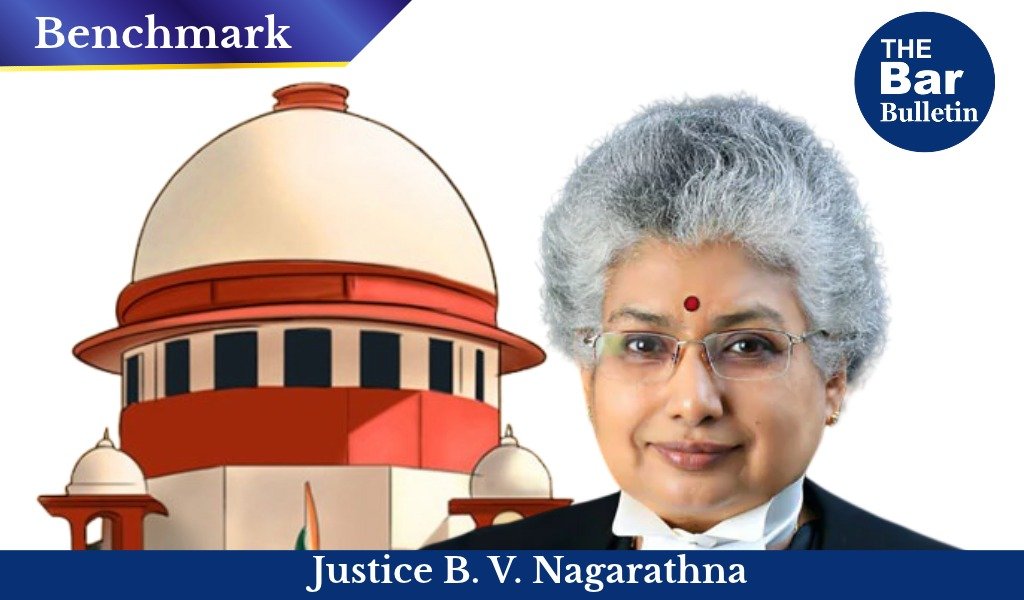

When the Supreme Court upheld the Union Government’s 2016 demonetisation exercise in January 2023, one judge disagreed. Justice Bangalore Venkataramiah Nagarathna, the lone dissenter on the five-judge Constitution Bench, held that the withdrawal of the ₹500 and ₹1,000 currency notes had been carried out through a legally impermissible process.
Her record of dissent continued in some of the Supreme Court’s most consequential constitutional cases. In Mineral Area Development Authority v. Steel Authority of India Ltd. (2024), she dissented from the nine-judge Bench’s ruling on States’ powers to tax mineral rights and mineral-bearing lands. Three months later, in State of Uttar Pradesh v. Lalta Prasad Vaish (2024), she again stood alone on a nine-judge Bench, holding that industrial alcohol was distinct from “intoxicating liquor” under Entry 8 of the State List and that the statutory framework governing industries controlled by the Union restricted the States’ legislative competence in the field.
In January 2026, Justice Nagarathna delivered another significant dissenting opinion in Centre for Public Interest Litigation v. Union of India, concerning Section 17A of the Prevention of Corruption Act, 1988. The provision requires prior approval before an inquiry or investigation can be initiated against a public servant for decisions or recommendations made in the discharge of official duties. Justice Nagarathna held the provision unconstitutional, reasoning that it could shield public servants from corruption investigations and resurrected a prior-approval regime that the Supreme Court had previously struck down.
Yet her judicial legacy is not confined to dissent. In the Bilkis Bano remission case in January 2024, she authored the judgment setting aside the Gujarat Government’s decision to remit the sentences of 11 convicts, holding that the State lacked the authority to grant the remission in the circumstances of the case.
These judgments, arising from distinct areas of constitutional law, have brought Justice Bangalore Venkataramiah Nagarathna into the centre of some of the Supreme Court’s most consequential debates. Her judicial record reflects a willingness to examine not merely the objectives of government action, but also the legal authority, statutory procedure and constitutional limits within which that action must be taken.
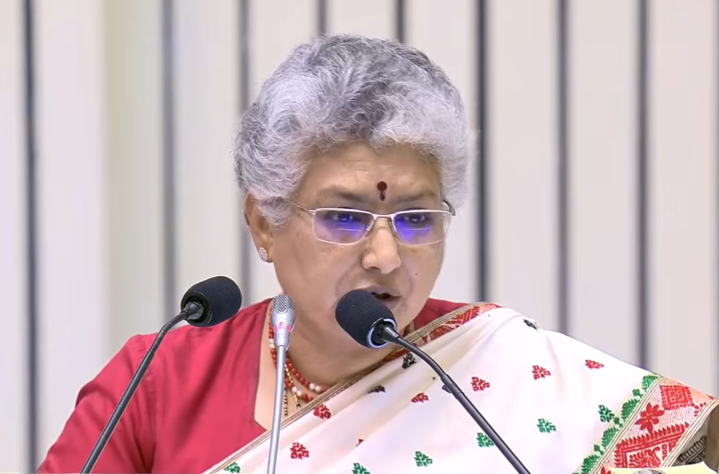
As she approaches the prospect of becoming India’s first woman Chief Justice of India in 2027, her career offers a compelling account of judicial independence, constitutional interpretation and the place of dissent in a democratic system.
From Bengaluru to the Supreme Court
Justice B. V. Nagarathna’s full name, Bangalore Venkataramiah Nagarathna, reflects her connection to Bengaluru, Karnataka. “Bangalore” is a place-name prefix associated with her name, while “Venkataramiah” is her father’s name, referring to former Chief Justice of India E. S. Venkataramiah. “Nagarathna” is her given name.
Born in Bengaluru on October 30, 1962, Justice Nagarathna pursued a Bachelor of Arts degree in History at Jesus and Mary College, University of Delhi, graduating in 1984. She subsequently obtained her LL.B. degree from the Campus Law Centre, University of Delhi, in July 1987.
She began practising law in 1987, initially with KESVY & Co., Advocates, before establishing an independent practice in July 1994. Her work covered a wide range of areas, including constitutional law, administrative law, commercial law and family law. She also represented the Karnataka State Legal Services Authority and the High Court Legal Services Committee, and served as an amicus curiae in certain matters.
Her professional journey unfolded in the Karnataka High Court, where she was appointed an Additional Judge on February 18, 2008, and became a permanent judge on February 17, 2010.
Her father, Justice E. S. Venkataramiah, served as Chief Justice of India in 1989. Yet Justice Nagarathna’s judicial career has developed through her own work on the Bench, including opinions that have placed her in disagreement with the majority in significant constitutional cases.
As a High Court judge, she also held administrative responsibilities, serving as President of the Karnataka Judicial Academy and the Bengaluru Mediation Centre. Her work extended to judicial administration, mediation, juvenile justice and the supervision of commercial courts in Karnataka.
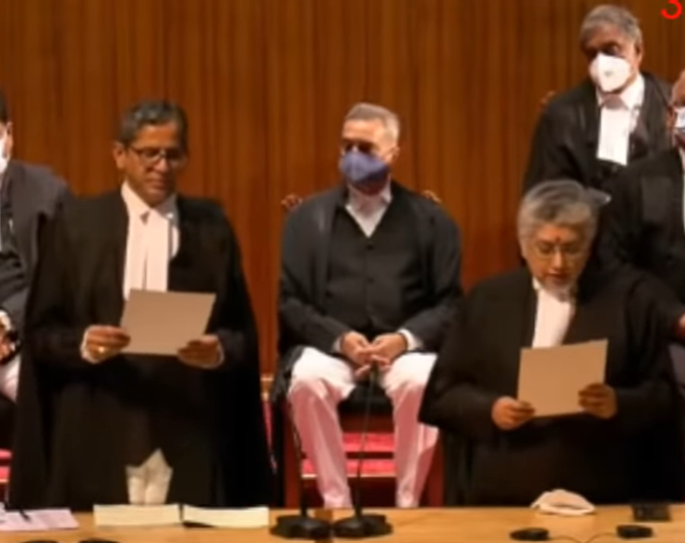
She was elevated to the Supreme Court of India on August 31, 2021, along with eight other judges. Her appointment was significant not only for her individual career but also for the possibility of a woman eventually occupying the country’s highest judicial office.
Landmark Judgements & Dissenting Opinions of Justice BV Nagarathna
1. Constitutionality of Section 17A of the PC Act: Dissent Against Prior Approval For Corruption Probes
Case: Centre for Public Interest Litigation v. Union of India, 2026 INSC 55
On January 13, 2026, the Supreme Court delivered a split verdict on the constitutional validity of Section 17A of the Prevention of Corruption Act, 1988, which mandates prior approval before conducting any inquiry or investigation against a public servant for decisions taken in the discharge of official duties.
While Justice K.V. Viswanathan held that Section 17A could be sustained only if the approval process is subjected to mandatory independent scrutiny through the Lokpal/Lokayukta or an equivalent independent mechanism, Justice B.V. Nagarathna dissented, holding that Section 17A is unconstitutional in its entirety as it forestalls inquiry and defeats the object of the anti-corruption law. She observed:
“The requirement of prior approval within the meaning of Section 17A of the Act is contrary to the object and purpose of the Act, inasmuch as it forestalls an enquiry and thereby in substance protects the corrupt rather than seeking to protect the honest and those with integrity, who really do not require any such protection.”
In view of the difference of opinion between the two Judges, the constitutional question remains unresolved, and the issue was directed to be placed before an appropriate Bench for authoritative determination.
2. Labour Law Dissent: Defending The Broad Definition Of ‘Industry’ And Workers’ Rights
Case: State of UP vs. Jai Bir Singh, 2026 INSC 897
Justice B.V. Nagarathna was part of the nine-judge Constitution Bench that reconsidered the scope of the term ‘industry’ under Section 2(j) of the Industrial Disputes Act, 1947, in Bangalore Water Supply and Sewerage Board v. A. Rajappa, 1978 AIR 548. In her separate dissenting opinion, she held that the expansive interpretation laid down by the Supreme Court in 1978 did not warrant reconsideration or modification.
The majority, by a 5:4 decision, held that the definition required modification, while Justice Nagarathna opined that the existing framework should continue. She emphasised that the definition must remain broad-based, particularly in the changing economic landscape where activities once performed by the State were increasingly being taken over by private entities. Narrowing the definition, she cautioned, could leave workers in such establishments without the protections of labour law.
She also rejected the argument that government welfare activities should be excluded merely because they are carried out by the State, stressing that the nature of the activity, rather than the identity of the entity undertaking it, must determine whether it qualifies as an industry. She observed:
“
“Because the government is doing these activities per se they cannot be excluded from the definition of industry. Hence, the test of who carries out the activity is not relevant. Rather, what is the nature of the activity and all other relevant factors of the activity have to be considered to determine whether the activity is an industrial activity or not.”
3. Demonetisation: A dissent on the limits of executive power
Case: Vivek Narayan Sharma v. Union of India, 2023 INSC 2
In January 2023, Justice B.V. Nagarathna authored the separate dissent in the Supreme Court’s 4:1 verdict upholding the Centre’s 2016 demonetisation of ₹500 and ₹1,000 currency notes. While agreeing that the measure was well-intentioned, she held that the manner in which it was implemented was unlawful, as the Central Government could not initiate demonetisation under Section 26(2) of the Reserve Bank of India Act, 1934, through an executive notification.
She held that the provision could be invoked only when the proposal originated from the RBI’s Central Board. If demonetisation was initiated by the Central Government, it had to be carried out through legislation or an ordinance, thereby ensuring parliamentary scrutiny of a measure with far-reaching consequences for citizens and the economy. She also found that the RBI had not independently applied its mind to the proposal.
Emphasising the need for legislative accountability when the executive exercises powers affecting the entire country, Justice Nagarathna observed:
“
“The powers of the Central Government being vast, the same have to be exercised only through a plenary legislation or a legislative process rather than by an executive act by the issuance of a notification in the Gazette of India. It is necessary that the Parliament which consists of the representatives of the People of this country, discusses the matter and thereafter approves and supports the implementation of the scheme of demonetisation.”
Although she declared the November 8, 2016 notification unlawful and the demonetisation exercise vitiated, she declined to disturb the actions already taken, directing that her declaration of law would operate prospectively.
4. Bilkis Bano remission case: Rule of law over arbitrary exercise of power
Case: Bilkis Yakub Rasool v. Union of India, 2024 INSC 24
On January 8, 2024, a Supreme Court Bench of Justice B. V. Nagarathna and Justice Ujjal Bhuyan set aside the remission granted by the Gujarat Government to 11 convicts in the Bilkis Bano gang rape and murder case. The Judgement, authored by Justice BV Nagarathna, held that the State lacked jurisdiction to grant the remission.
Emphasising that “rule of law must prevail”, the Court held that the convicts must return to prison, directing them to surrender within two weeks. The Court held that Gujarat was not the appropriate government to grant remission because the trial had been conducted in Maharashtra and the convictions had been delivered there. The remission orders were consequently held to be illegal.
The judgment made a strong statement about the judiciary’s responsibility when State action undermines the rule of law:
“
“Wherever and whenever the State fails to perform its duties, the Court would step in to ensure that the rule of law prevails over the abuse of the process of law…There can be no rule of law if there is no equality before the law; and rule of law and equality before the law would be empty words if their violation is not a matter of judicial scrutiny or judicial review and relief and all these features would lose their significance if the courts don’t step in to enforce the rule of law. Thus, the judiciary is the guardian of the rule of law and the central pillar of a democratic State. Therefore, the judiciary has to perform its duties and function effectively and remain true to the spirit with which they are sacredly entrusted to it.
In our view, this Court must be a beacon in upholding rule of law failing which it would give rise to an impression that this Court is not serious about rule of law and, therefore, all Courts in the country could apply it selectively and thereby lead to a situation where the judiciary is unmindful of rule of law. This would result in a dangerous state of affairs in our democracy and democratic polity.”
5. Azam Khan’s ‘Political Conspiracy’ Remark On Bulandshahr Gangrape: Hate speech and the constitutional responsibilities of public figures
Case: Kaushal Kishor v. State of Uttar Pradesh,2023 INSC 4
Justice B.V. Nagarathna also authored a separate opinion in this Constitution Bench case, differing from the majority on certain significant questions concerning the horizontal application of fundamental rights, the attribution of ministerial statements to the government and constitutional tort.
The five-judge Constitution Bench was considering a plea arising from the alleged gangrape of a woman and her minor daughter on National Highway 91 in Uttar Pradesh in July 2016, after then Cabinet Minister Azam Khan publicly termed the incident a “political conspiracy”, alleging that it was fabricated by the Opposition to malign the State Government ahead of elections. The petitioner challenged the Minister’s remarks and sought action against him, along with directions for a fair investigation and trial.
While the other four judges on the five-judge Bench held that a Minister’s statement, even if traceable to affairs of the State or made in defence of the government, could not be vicariously attributed to the government merely by invoking the principle of collective responsibility, Justice Nagarathna took a different view. She held that where a Minister makes a statement in an official capacity and the statement reflects the government’s position, the government could be held vicariously liable for it. She observed:
“
“Public functionaries and other persons of influence and celebrities, having regard to their reach, real or apparent authority and the impact they wield on the public or on a certain section thereof, owe a duty to the citizenry at large to be more responsible and restrained in their speech. They are required to understand and measure their words, having regard to the likely consequences thereof on public sentiment and behaviour, and also be aware of the example they are setting for fellow citizens to follo
33 While there are no infallible rules that can be formulated by the Court to define the precise threshold of acceptable speech, every citizen’s conscious attempt to abide by the Constitutional values, and to preserve in letter and spirit the culture contemplated under the Constitution will significantly contribute in eliminating instances of societal discord, friction and disharmony, on account of disparaging, vitriolic and derogatory speech, particularly when made by public functionaries and/or public figures.”
She also differed from the majority on the question of constitutional tort, holding that a Minister’s statement violating the constitutional rights of citizens could give rise to such a claim, subject to an appropriate legal framework governing the nature of the violation and the remedy.
At the same time, Justice Nagarathna agreed with the majority that the grounds for restricting freedom of speech under Article 19(2) are exhaustive and cannot be expanded by invoking other fundamental rights.
6. Mineral rights and taxation: Another dissent on legislative competence
Case: Mineral Area Development Authority v. Steel Authority of India, 2024 INSC 554
Justice B.V. Nagarathna authored the lone dissent in this nine-judge Constitution Bench case, which examined whether State legislatures have the power to tax mineral rights and mineral-bearing lands under the Seventh Schedule of the Constitution.
The central question was whether royalty paid by mining leaseholders under the Mines and Minerals (Development and Regulation) Act, 1957 (MMDR Act), constituted a tax and whether States could impose additional taxes on mineral rights. The majority, by an 8:1 verdict, held that royalty is not a tax and that States have legislative competence to tax mineral rights under Entry 50 of List II, subject to parliamentary limitations.
Justice Nagarathna disagreed. She held that royalty under the MMDR Act was in the nature of a tax or exaction and that Section 9 of the Act operated as a limitation on the States’ power under Entry 50. Consequently, States could not impose any additional tax, impost or fee on the exercise of mineral rights. She also held that Entry 49 of List II, concerning taxes on lands and buildings, did not extend to mineral-bearing lands.
Justice Nagarathna opined that the legislative and taxing powers of the States had to be understood within the constitutional framework governing mineral development. She held that Parliament’s authority to regulate mines and mineral development under Entry 54 of List I, read with Section 2 of the MMDR Act, had to be given effect while determining the extent of the States’ taxing powers.
Concluding that an earlier seven-judge decision in India Cement Ltd. v. State of Tamil Nadu had been correctly decided, she held that the contrary majority view in State of West Bengal v. Kesoram Industries Ltd. ought to be overruled. She summed up her disagreement with the majority:
“
“My short answer is that viewed from the statutory framework of the MMDR Act, 1957 passed by the Parliament on the strength of Entry 54 – List I of the Seventh Schedule of the Constitution of India and having regard to Section 2 of the said Act, royalty is in the nature of a ‘tax’ or an ‘exaction’. Further, Section 9 of the MMDR Act, 1957 is a limitation within the meaning of Entry 50 – List II of the Seventh Schedule of the Constitution and the States have no legislative competence to levy any other tax, impost or fee on the exercise of mineral rights.”
7. Industrial Alcohol And Federal Legislative Powers: Dissent On The Scope Of States’ Authority
Case: State of Uttar Pradesh v. M/S Lalta Prasad Vaish and Sons, 2024 INSC 812
Justice B.V. Nagarathna authored a separate opinion in this nine-judge Constitution Bench reference, which examined whether the expression “intoxicating liquor” under Entry 8 of List II of the Seventh Schedule includes industrial alcohol, and whether State legislatures can regulate its production and manufacture.
The majority, in an opinion authored by then Chief Justice D.Y. Chandrachud, held that Entry 8 covers both potable and non-potable alcohol, including industrial alcohol that could be misused to the detriment of public health. It overruled the seven-judge Bench ruling in Synthetics and Chemicals Ltd. v. State of Uttar Pradesh, (1990) 1 SCC 109 which had restricted the States’ regulatory authority over industrial alcohol.
Justice Nagarathna disagreed with the majority’s interpretation. She held that industrial alcohol, being part of the fermentation industry brought under Parliament’s control through the Industries (Development and Regulation) Act, 1951 (IDRA), fell outside the State’s legislative domain under Entry 8. She maintained that the earlier decision in Synthetics and Chemicals had been correctly decided and did not require overruling. Justice Nagarathna observed:
“
“State legislatures only have legislative competence over what is ‘intoxicating liquors’ as a beverage.”
She further held that Parliament’s control over the scheduled fermentation industry under Entry 52 of List I, read with the provisions of the IDRA, affected the States’ legislative powers over products of that industry under Entry 33 of List III.
The Sabarimala reference and the questions ahead
In October 2026, she was reported to be the first judge on the nine-member Constitution Bench hearing the long-pending Sabarimala reference to begin writing a judgment.
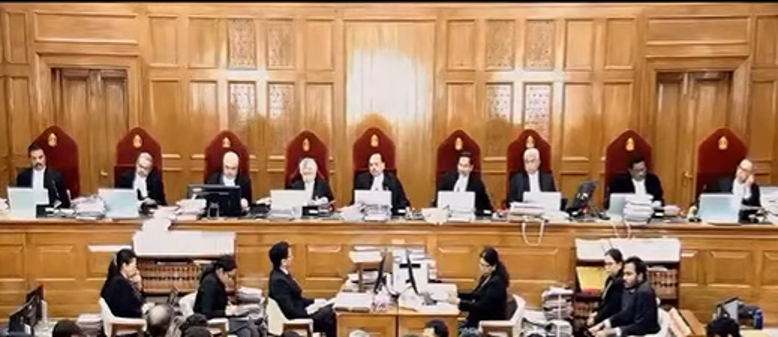
During the nine-judge Constitution Bench hearing, Justice B.V. Nagarathna repeatedly questioned the manner in which constitutional guarantees of equality and religious freedom were being interpreted in relation to each other. Her interventions touched upon the autonomy of religious denominations, the scope of judicial review and the relevance of the Essential Religious Practices doctrine.
During the May 13 hearing, Justice Nagarathna emphasised that constitutional guarantees of equality and religious freedom operate in distinct contexts. She explained that while Articles 25 to 28 specifically govern religious freedom, Article 25(2) allows the State to introduce social reform measures, including opening Hindu religious institutions to all sections and classes.
She also questioned the relevance of the Essential Religious Practices doctrine to the reference, asking Solicitor General Tushar Mehta: “In the context of Sabarimala, how does it arise₹” Pointing to the specific nature of the dispute, she noted that the issue was not access to a temple in general, but the exclusion of women between the ages of 10 and 50.
On the broader question of religious identity, Justice Nagarathna observed that temple-going and ritual observance were not prerequisites to being Hindu, describing Hinduism as “a way of life”. She also spoke of India’s civilisational character, noting that despite its many diversities, the relationship between people and religion remained a defining feature of Indian society.
“
“We are a civilisation, why are we a civilisation despite having so many pluralities and diversities. I said diversity is our strength. We are still a civilisation, despite you may call a sovereign, democratic republic. There is a constant. One of the constants in our Indian society is the relationship of human beings, man, woman and child with the religion.”
Upholding Constitutional Principles And Binding Precedents: Remarks on Denying Bail to Umar Khalid & Sharjeel Imam
Justice B.V. Nagarathna has consistently emphasised that constitutional principles and binding judicial precedents must guide the exercise of judicial power
While hearing Syed Iftikhar Andrabi v. National Investigation Agency, a UAPA and NDPS case, the Supreme Court Bench of Justice B.V. Nagarathna and Justice Ujjal Bhuyan made oral observations expressing reservations about the Court’s January 5, 2026 judgment denying bail to Umar Khalid and Sharjeel Imam in the Delhi riots conspiracy case.
The Bench orally observed that the earlier ruling appeared to depart from the principles laid down by a three-judge Bench in Union of India v. K.A. Najeeb, (2021) 3 SCC 713 on prolonged incarceration and the right to a speedy trial. It remarked:
“
“We have no manner of doubt in stating that even under the UAPA, bail is the rule and jail is the exception. Of course, in an appropriate case, bail can be denied having regard to the facts of that particular case.”
The observations were made during the hearing of Andrabi’s appeal, which the Supreme Court allowed, granting him bail.
The work beyond the courtroom
Justice Nagarathna’s responsibilities have also extended to institutional and administrative work within the judiciary.
She has contributed to Courts of India: Past to Present and chaired the committee responsible for its Kannada translation, released in April 2021. She has also held responsibilities relating to juvenile justice, family court matters and gender sensitisation within the Supreme Court.
Her engagement with institutional questions has also been reflected in her public addresses. At the National Law School of India University’s Pluralist Agreement and Constitutional Transformation Conference in Bengaluru in August 2024, she spoke on Home in the Nation: Indian Women’s Constitutional Imaginaries. Beyond the theme of women’s constitutional participation, she addressed the constitutional principles of fraternity and federalism, and expressed concern over the role played by Governors in matters concerning elected State governments.
At the Justice Sivasankar Natarajan Centenary Commemoration Lecture in Chennai in November 2024, she spoke about judicial independence, the responsibilities of judges and the relationship between the judiciary and the legislature. She emphasised that judicial independence ultimately depends on the independence, impartiality and integrity of the individuals who occupy judicial office.
Justice Nagarathna has also spoken about the growing burden of pending cases and the need for reforms in the administration of courts. She has called for practical solutions to address judicial pendency, emphasising that increasing the sanctioned strength of judges alone cannot resolve the problem without effective case management and improvements in the functioning of courts.
Her engagement with child rights and the juvenile justice system has been another aspect of this work. At a national consultation marking ten years of the Juvenile Justice Act, 2015, in October 2026, she stressed that children in conflict with the law must be treated with sensitivity and that institutionalisation should remain a measure of last resort. “When a child breaks the law, the law must not break the child,” she said, calling for stronger institutions and a child-sensitive approach to justice.
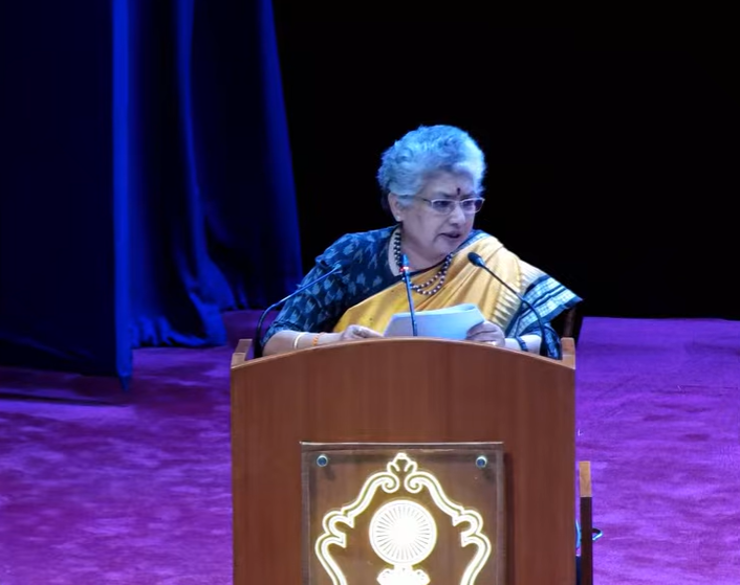
To be India’s first woman Chief Justice
Justice B. V. Nagarathna is due to retire on October 29, 2027. Under the established seniority convention, she is expected to become India’s first woman Chief Justice of India, succeeding Justice Vikram Nath. Her elevation would mark a historic milestone for the Indian judiciary, more than seven decades after the Supreme Court was established in 1950.
The significance of that prospect extends beyond representation, as the Chief Justice of India heads the Supreme Court and plays a central role in its administration, including the constitution of Benches, allocation of judicial work and the functioning of the institution. Although her expected tenure would be brief, lasting a little over a month, it would break a long-standing gender barrier at the highest level of the judiciary.
The prospect also comes at a time when the Supreme Court’s composition and institutional capacity have been receiving renewed attention. Following the elevation of Justice Sunita Agarwal in October 2026 and Justice V Mohana in June 2026, the number of women judges in the Apex Court has increased to three. The Court now has 37 sitting judges against a sanctioned strength of 38.
During the Sabarimala reference hearings in May 2026, Justice B. V. Nagarathna candidly responded to a remark by Senior Advocate Menaka Guruswamy about women’s representation in the judiciary. Recalling former US Supreme Court Justice Ruth Bader Ginsburg’s famous response to how many women on a nine-judge Bench would be enough, Guruswamy cited Ginsburg’s answer: “When all nine are women.”
Justice Nagarathna responded candidly:“I think it is an extreme statement because we cannot also do away with men.” She added that “perspective is also important.”
The exchange brought a moment of candour to a larger conversation about gender representation at the highest levels of the judiciary.
However, Justice Nagarathna’s response should not be mistaken for a lack of advocacy for women’s representation. At the International Women’s Day event organised by the Supreme Court Unit of the Akhil Bharatiya Adhivakta Parishad in March 2023, while speaking on “Embracing Equity in Justice Delivery System – Way Ahead,” she called for a more diverse judiciary, stressing that women needed “not merely symbolic, but substantive representation.” She stressed that a homogeneous Bar and Bench could discourage future generations of women from entering the profession.
At the centenary celebrations of Cornelia Sorabji at the University of Mumbai on March 15, 2025, Justice Nagarathna called for at least 30% of law officers representing Central and State governments, as well as legal advisers empanelled by public-sector organisations, to be women. She also advocated greater opportunities for competent women advocates to be elevated to High Courts.
More recently, at the “Where Women Lead, Justice Follows” symposium organised by the Indian Council of Arbitration, with FICCI FLO, at Federation House, New Delhi, on March 7, 2026, she called for greater gender diversity in arbitration and proposed that at least one member of every three-member arbitral tribunal should be a woman. She also highlighted the structural barriers that prevent women from advancing in the profession.
On April 4, 2026, at the Dr Rajendra Prasad Memorial Lecture at Chanakya National Law University, Patna, she reiterated her call for at least 30% representation of women among Central and State government law officers and public-sector panel advocates, pointing to the impact of pregnancy, childcare and family responsibilities on women’s legal careers.
Her remarks during the Sabarimala hearing, therefore, sit alongside a broader and consistent call for substantive inclusion, not the exclusion of men, but the creation of meaningful opportunities for women across the legal profession and dispute-resolution institutions.