
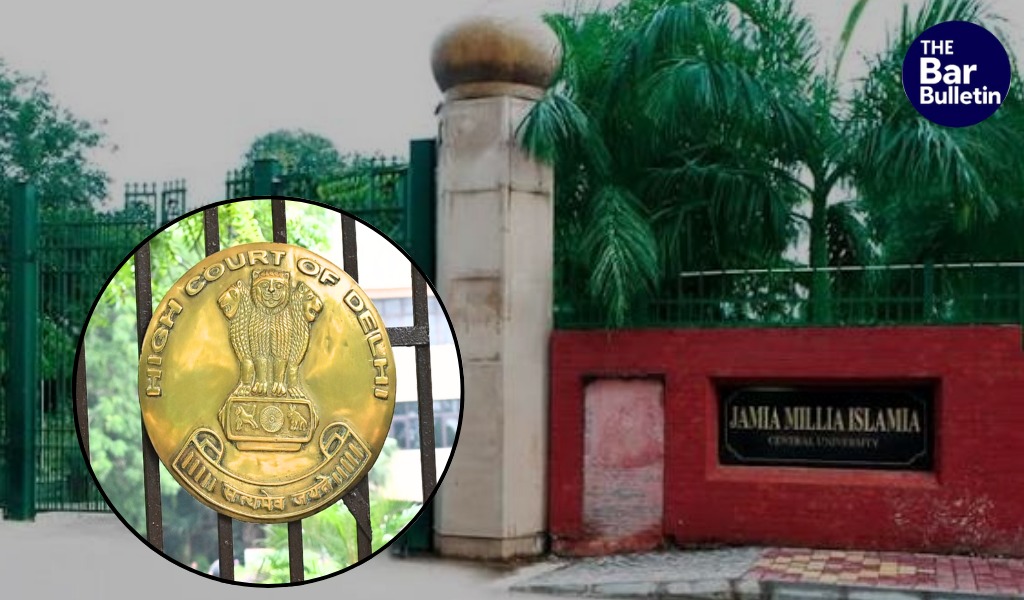

The Delhi High Court on Friday continued hearing the batch of petitions challenging the minority status of Jamia Millia Islamia, with the proceedings centering on the legal effect of the University’s 1997 Executive Council resolution declaring its minority character and whether it acquired statutory force in the absence of any amendment to the Jamia Millia Islamia Act, 1988.
During the hearing, Counsel for petitioner drew comparisons with the statutes governing several minority universities across the country. Referring to institutions such as Al-Karim University, St. Xavier’s University, Aliah University, and Khwaja Banda Nawaz University, counsel argued that where a university enjoys minority status, its constituting statute expressly reflects that character through provisions relating to sponsoring bodies, governance, appointments, admissions, or reservation for the minority community. He submitted that no such features are found in the Jamia Millia Islamia Act.
Counsel further argued that the 1997 resolution passed by Jamia’s Executive Council was merely recommendatory and never acquired statutory force. Referring to the University’s statutory framework, he submitted that any statute or ordinance requires compliance with the procedure prescribed under the Act, including the assent of the Visitor wherever applicable.
The Bench sought to crystallise the petitioner’s submission, observing:
“
“What you are saying is the initial ’97 resolution didn’t get converted into a statute… It could neither be a statute nor an ordinance. It has to be by way of enactment or amendment to the Act.”
The petitioner agreed, submitting that the 1997 resolution had “no legal effect” and could not alter the character of the University without legislative intervention. When counsel argued that the President’s failure to annul the resolution could not elevate it to a statutory instrument, the Bench remarked that it had understood the submission and asked him to address the arguments advanced by the opposite side.
Counsel also submitted that the subsequent resolutions passed after the National Commission for Minority Educational Institutions (NCMEI) declared Jamia a minority institution on 22 February 2011 would also fall if the Commission’s order itself is ultimately set aside. According to him, “an old resolution of 1997 without any statutory backing cannot in any manner change the nature of the Jamia.”
The Bench also questioned the petitioner on certain provisions of the 1997 resolution, including the clause stating that Urdu shall be the medium of instruction, asking whether the University presently follows Urdu as the medium of instruction at all levels.
Earlier in the hearing, the Bench directed counsel to prepare a comparative chart highlighting the provisions of various university statutes relied upon to demonstrate how minority character is reflected in their constituting enactments. The Court observed that such a chart would assist it in examining the petitioner’s comparative analysis instead of taking the Bench through each statute individually.
The hearing remained part-heard. The Bench indicated that it would next hear the submissions of the other side. The matter has been directed to be listed for further hearing in August.