

The energy transition is creating a new landscape of commercial and investment disputes, with geopolitical volatility, regulatory changes, technological developments and uncertainty in project valuations increasingly shaping the next wave of energy arbitrations.
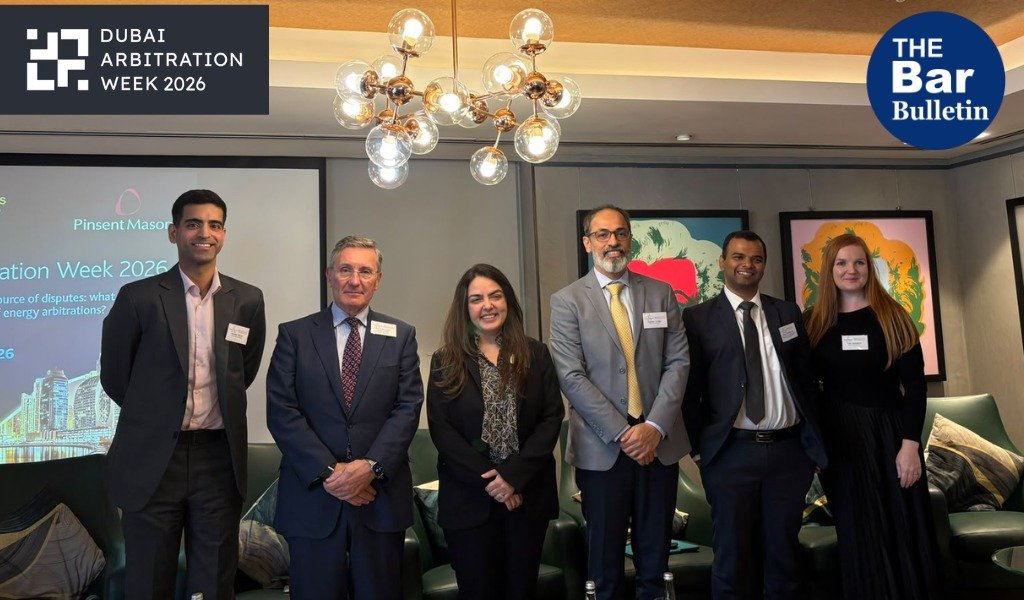
These issues came under discussion at a panel titled “Energy Transition as a Source of Disputes: What Is Driving the Next Wave of Energy Arbitrations?”, organised by Pinsent Masons and Osborne Partners during Dubai Arbitration Week 2026.
Moderated by Shanelle Irani, Partner, Pinsent Masons, the discussion featured David Brynmor Thomas, Independent Arbitrator; Tara Jamieson, Senior Counsel, Chevron; Manu Thadikkaran, General Counsel, Abu Dhabi Offshore Power Transmission Company; Montek Mayal, Partner and Practice Head – Asia & Middle East, Osborne Partners; and Gaurav Juneja, Partner, Khaitan & Co. .

Opening the discussion, David Brynmor Thomas explained that the energy transition must be understood as a fundamental transformation in how societies generate, store, transport and consume energy, rather than merely a shift from conventional fuels to renewable sources.
“
“The energy transition is not simply power, swapping out a gas turbine for a wind turbine,” he observed.
He highlighted the wider implications of energy storage, battery technologies, hydrogen, electricity-grid infrastructure and the changing requirements of existing energy systems. According to him, these developments will have significant commercial consequences and require arbitral tribunals to understand the technological and contractual context in which energy projects operate.
Tara Jamieson observed that disputes arising from the energy transition may not necessarily involve entirely new legal issues. Rather, familiar disputes concerning delays, cost overruns, supply-chain disruptions, force majeure and contractual interpretation are emerging in a more complex environment.
“
“I don’t think the disputes will be new. I think they’ll just look a bit different,” she said.
Drawing on her experience as in-house counsel, Jamieson emphasised the importance of anticipating geopolitical and regional risks when negotiating long-term contracts. She pointed out that parties entering into new arrangements must give greater thought to potential disruptions and whether the contractual allocation of risk adequately addresses them.
Manu Thadikkaran shifted the discussion to the assumptions underlying project contracts and whether contractual structures can absorb changes in commercial realities.
He explained that standard contractual templates often rely on assumptions of stable markets and competitive sourcing. However, when these assumptions break down, disputes arise over who should bear the resulting risk.
“
“The question is, can the contractual structure absorb?” he remarked.
He highlighted interface risks between interconnected projects, mismatches in back-to-back contractual obligations and notice periods. He also drew attention to the role of lenders in approving dispute settlements, cautioning that delays in obtaining such approvals can complicate the resolution of existing disputes and potentially give rise to further disagreements.
Montek Mayal examined how global macroeconomic volatility has fundamentally changed the assessment of damages in capital-intensive energy projects. Identifying four critical considerations causation, valuation methodology, assumptions and the valuation date, he explained that traditional approaches to damages assessment may no longer adequately capture the uncertainty surrounding energy investments.
“
“The short answer is it’s completely changed how we think about damages,” Mayal said.
He observed that damages experts are increasingly moving beyond traditional single-scenario discounted cash flow models towards scenario analysis, Monte Carlo simulations and option-pricing models to account for heightened market volatility.
Mayal emphasised that establishing causation has become particularly important, as experts must distinguish the impact of the contractual breach from wider disruptions arising from geopolitical developments, supply-chain constraints and currency fluctuations.
He also cautioned against incorporating the same risk multiple times into valuation models, whether through reduced projected cash flows or increased risk premiums. “You want to capture the risk once,” he explained, stressing that experts must assess how a particular risk actually affects the project rather than mechanically layering additional risk into the valuation.
Another significant issue he highlighted was the valuation date. Mayal explained that even a relatively small change in the date of assessment can materially affect damages calculations in volatile markets. He suggested that experts may need to present alternative assessments based on different valuation dates, particularly where significant developments occur between the filing of reports and the final hearing.
Responding to Mayal’s observations, David Brynmor noted that tribunals must carefully distinguish between questions of causation and the appropriate valuation date. He observed that subsequent events can complicate damages assessments, particularly where parties disagree on whether the valuation should reflect the position at the date of breach or developments that occurred thereafter. He expressed a preference for experts to present alternative scenarios transparently so that tribunals can assess the consequences of different assumptions.
The discussion also examined the growing significance of regulatory changes as a source of disputes, particularly in India’s renewable energy sector.
Gaurav Juneja highlighted how changes in government policies, duties and taxation can materially alter the economics of long-term power projects. Referring to solar power projects in India, he discussed instances involving safeguard duties on imported solar modules, increases in GST and customs duties, and the resulting disputes over compensation under change-in-law provisions.
He also referred to disputes involving power purchase agreements, where developers have challenged directions to reduce agreed tariffs despite having entered into long-term contractual commitments.
Juneja explained that while regulatory authorities have recognised certain policy and tax changes as qualifying changes in law, disputes continue over the extent of compensation, the timing of payment and interest. He emphasised that contractual commitments must be respected even where a cheaper source of power subsequently becomes available.
Bringing the discussion back to the commercial relationship between contracting parties, Tara Jamieson also emphasised that not every disruption necessarily needs to culminate in formal proceedings. She observed that the approach parties take to disputes is often influenced by the history and quality of their commercial relationship.
Where long-standing relationships are involved, constructive engagement and renegotiation may sometimes offer a more commercially viable alternative to invoking force majeure or commencing arbitration, particularly when supply-chain disruptions or geopolitical developments make the original contractual pricing commercially difficult.
In her opening remarks, Shanelle Irani had set the context for the discussion by observing that the question was no longer whether the energy transition would generate disputes, since these were already emerging. The more important questions were what was driving them, how they were being resolved and how investors and developers could better manage the associated risks.