

The Supreme Court has ruled that property devolving on a son under Section 8 of the Hindu Succession Act becomes his exclusive property, and grandson acquires no birthright and cannot seek partition during the father’s lifetime. The Court held that a son’s son is not a Class I heir under Section 8 of the Hindu Succession Act, 1956, and therefore cannot claim rights in such property merely by birth.
Reaffirming the ruling in Commissioner of Wealth Tax, Kanpur and others Vs. Chander Sen and others [(1986) 3 SCC 567], the Court held that property inherited by a son under Section 8 is his separate property and not property held as Karta of a Hindu Undivided Family. Once the properties of late N. Ramakrishnan were divided among his Class I heirs through a compromise decree, each heir became the exclusive owner of his or her allotted share.
The Apex Court held that the dispute was governed by succession under Section 8 and not by coparcenary principles under Section 6 or Section 29-A of the Tamil Nadu Amendment. Since the father had become the absolute owner of the property allotted to him in partition, the grandson could not seek a partition claiming coparcenary rights.
Briefly, the dispute concerned whether a grandson could claim a share in property that had come to his father after the death of the grandfather. J. Rajesh (Minor), represented by his mother, filed a suit in 1997 seeking partition and possession of half share in a property measuring 1811 sq. ft. He claimed that the property originally belonged to his grandfather, late N. Ramakrishnan, and therefore remained ancestral/joint family property in which he acquired rights by birth.
Before the suit was filed, the grandfather’s daughter, G. Lalitha, had instituted a partition suit in 1993. That suit ended in a compromise decree dated Feb 03, 1994, under which the appellant’s father, M. Kumaran, received the suit property as his share. Subsequently, the father sold the property to third parties through sale deeds executed in April 1997. The grandson challenged neither the compromise decree nor the sale deeds and only sought partition claiming a half share.
The Trial Court granted a preliminary decree for partition in favour of the minor. However, the first appellate court reversed that decision, holding that the property received by the father after partition became his absolute property and that the grandson acquired no right by birth in it.
Also read Bombay HC Declines Urgent Relief For Chhath Puja Celebrations At Girgaon Chowpatty
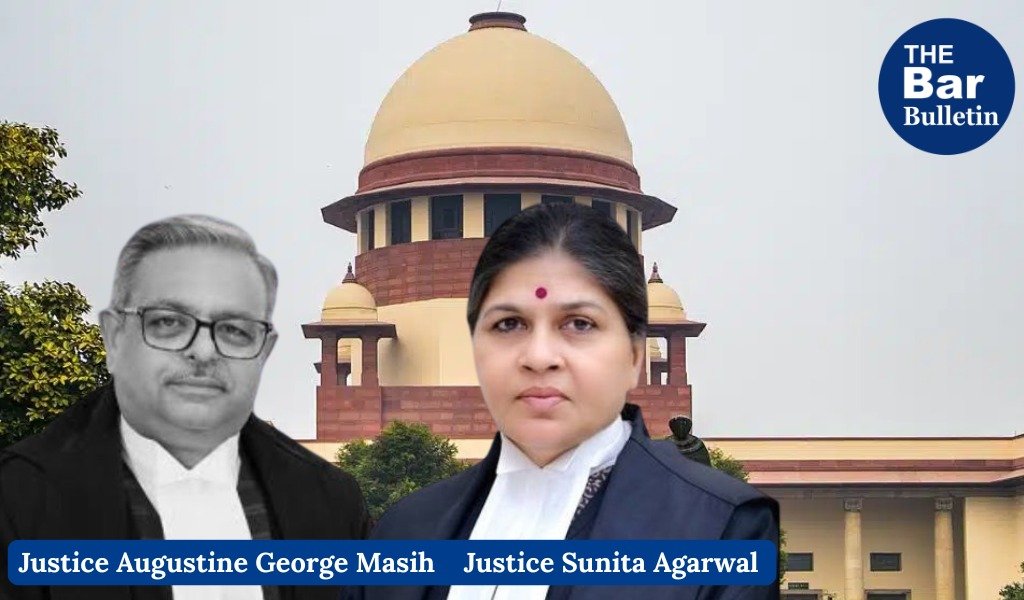
A Two-Judge Bench comprising Justice Sunita Agarwal and Justice Augustine George Masih observed that Section 8 of the Hindu Succession Act, 1956 provides a complete scheme for succession when a Hindu male dies intestate. Under this scheme, property devolves upon Class I heirs such as sons, daughters, widow and mother. A living son’s son (grandson) is not included among Class I heirs and therefore does not acquire any independent right in the grandfather’s property merely because of his birth.
The Court reiterated the principle laid down in Commissioner of Wealth Tax v. Chander Sen [(1986) 3 SCC 567], that when a son inherits property under Section 8, he takes it in his individual capacity and not as Karta of his own Hindu Undivided Family. Therefore, property inherited by a son from his father does not automatically become HUF property vis-à-vis his own children.
The Court further noted that once the properties of late N. Ramakrishnan were partitioned among his Class I heirs through the compromise decree, each heir became the exclusive owner of the property allotted to him or her. The joint coparcenary came to an end and the property ceased to retain the character of joint family property.
Rejecting the appellant’s reliance on Section 29-A of the Tamil Nadu Amendment to the Hindu Succession Act, the Court held that the provision was irrelevant to the facts of the case because the dispute was governed by succession under Section 8. The appellant was not a surviving coparcener at the time succession opened upon the grandfather’s death and therefore could not claim coparcenary rights through birth.
The Court also emphasized that the appellant’s father was alive when the suit was filed. Since the father himself had obtained the property as an exclusive owner after the partition, the grandson could not assert a superior or independent right in that property.
