
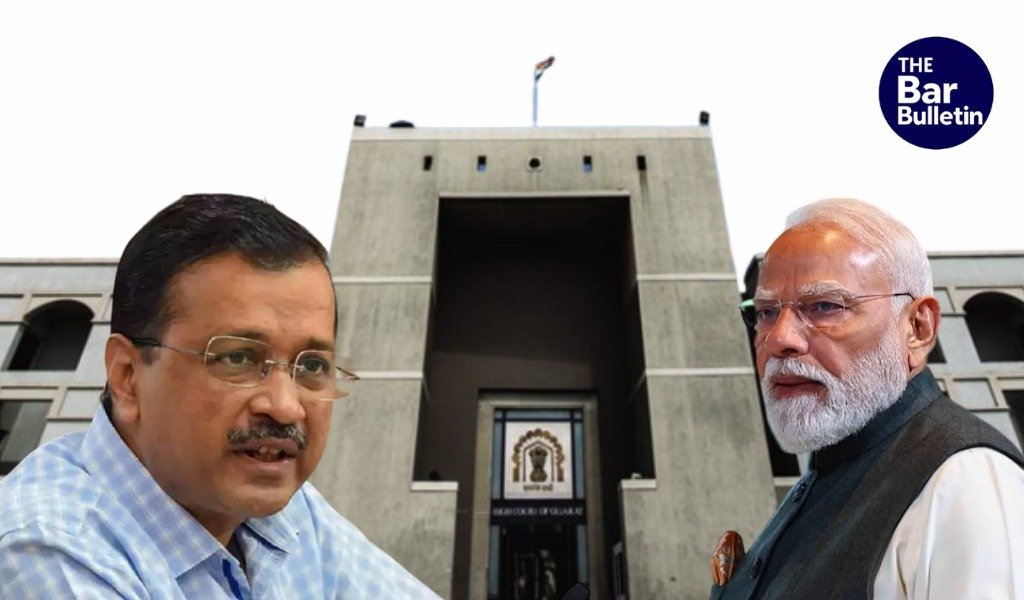

The Gujarat High Court has dismissed an intra-court appeal filed by AAP Chief Arvind Kejriwal, challenging the 2023 judgment which had quashed a 2016 Central Information Commission (CIC) direction requiring Gujarat University to provide information concerning Prime Minister Narendra Modi’s educational degrees and had imposed a ₹25,000 cost on Kejriwal.
A Division Bench of Chief Justice Sunita Agarwal and Justice D.N. Ray delivered the judgment. The appeal was confined principally to the observations made against him by the single judge and the ₹25,000 cost, rather than challenging the merits of the decision quashing the CIC’s 2016 order. Senior AdvocateAbhishek Manu Singhvi argued that Kejriwal had not pursued the proceedings before the CIC and the CIC had taken suo motu cognisance of his response in another RTI proceeding.
The Bench declined to expunge the observations made against Kejriwal by the single judge, noting that the manner in which the proceedings had unfolded before the CIC did not warrant interference. The Court also refused to interfere with the ₹25,000 cost imposed on him, holding that there was no error in the impugned judgment warranting appellate intervention. The Bench further observed that statutory authorities and courts should not be used for political purposes, stating:
“
“We may also add to what has been observed by the learned single Judge in the judgment impugned that the statutory authorities and the Courts should not be treated as a public platform to ventilate the political vengeance. A political leader holding public office cannot use the statutory proceedings for their political motives.”
The Division Bench thereafter examined the substantive RTI issue concerning disclosure of educational qualification records. It considered the exemptions under Sections 8(1)(e) and 8(1)(j) of the RTI Act, including the fiduciary relationship between educational institutions and students and the protection accorded to personal information.
The Court held that educational qualification documents such as marksheets and degrees constitute personal information and such information is also held by universities and examining bodies in a fiduciary capacity. Disclosure can therefore be directed only where the statutory requirement of larger public interest is satisfied. The Court further held that the information was protected under Section 8(1)(e) as information held in a fiduciary capacity, subject to the larger-public-interest exception.
The Bench also rejected the argument that the fact that the person concerned is the Prime Minister automatically makes his educational records subject to disclosure. It held that the fact that the information concerns a public office-holder does not by itself establish the public interest or larger public interest necessary to override the applicable exemptions. The Court further noted that the fact that information may already be in the public domain does not determine the obligations under the RTI Act.
The Court also criticised the manner in which the CIC had proceeded in the matter, holding that the Information Commissioner had gone beyond the statutory framework governing RTI proceedings. It observed that the RTI Act cannot be used as a tool to ventilate personal grudges or political vendetta.
“
“In any case, the RTI Act, 2005 cannot be used as a tool to ventilate personal grudges or political vendetta against an individual even if he or she is holding a public office, and information sought may be refused by the RTI authorities….we reach at an irresistible conclusion that the manner in which the Information Commissioner, Central Information Commission has acted in the present case from the very inception and making observations on his own notions expanding the scope of the procedure for dealing with the request for seeking information, he has simply crossed the boundaries within which he was supposed to act.”
The Bench further held that the fact that the information concerning the Prime Minister’s educational degree was already available in the public domain did not, by itself, bring the information within the ambit of “public interest” or “larger public interest” under the RTI Act. It noted that the CIC had not recorded any satisfaction that disclosure was warranted under the exemptions contained in Sections 8(1)(e) and 8(1)(j), and that “general curiosity among the people” could not constitute a basis for directing disclosure.
The Court also emphasised that even a public servant could not be compelled to disclose personal information merely because he holds public office. In its concluding observations, the Bench said:
“
“Balancing the two intersecting rights, namely, the right of privacy of an individual and the right to seek information of a citizen under the RTI Act, 2005, we are of the firm opinion that the disclosure of information, as directed by the CIC, in the instant case, was exempted personal information of an individual falling within the ambit of Section 8(1)(e) and (j) of the RTI Act, 2005 and the respondent University cannot be asked to disclose the same.”
The Bench accordingly found no error in the single judge’s judgment and dismissed the appeal, while leaving the ₹25,000 cost undisturbed
Background of the Case
The dispute originated in a 2016 CIC proceeding. During a hearing concerning information relating to Kejriwal’s Electoral Photo Identity Card, Kejriwal had submitted a written response seeking information concerning Modi’s educational degrees. The CIC treated that response as an RTI application and directed the PMO, Delhi University and Gujarat University to facilitate the search and disclosure of the information.
Gujarat University challenged the CIC’s direction before the High Court. A single judge subsequently quashed the CIC order and imposed ₹25,000 in costs, following which Kejriwal filed the present Letters Patent Appeal. The Division Bench has now dismissed the appeal, finding no merit in Kejriwal’s challenge to the observations and cost imposed by the single judge. The underlying CIC direction requiring disclosure of the degree-related information therefore remains quashed.
