
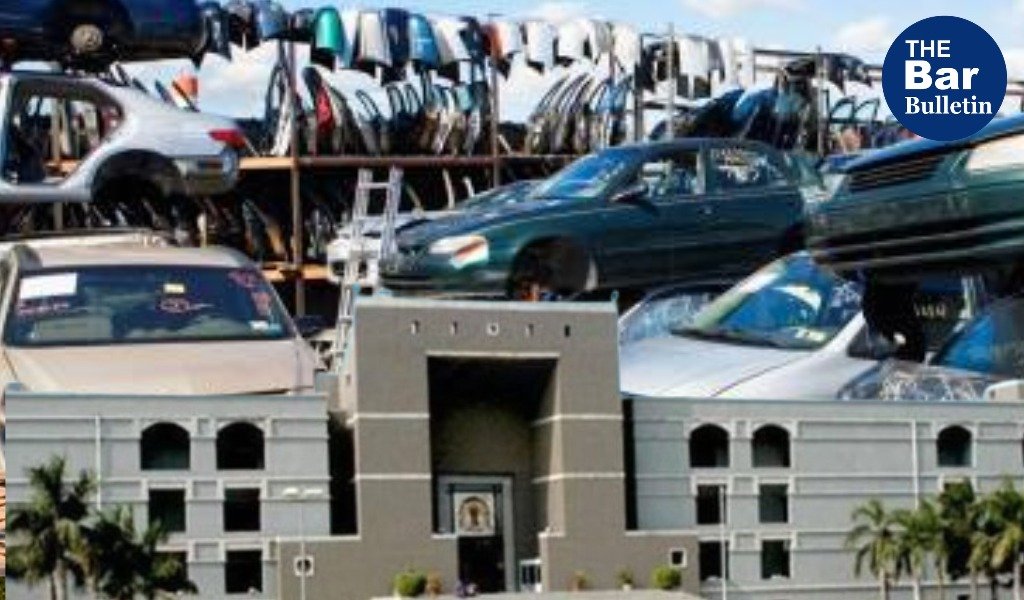

Holding that seized vehicles should not be left to deteriorate in police custody and can be released on appropriate safeguards pending trial, the High Court of Gujarat at Ahmedabad Bench has directed release of a Skoda car seized in a prohibition case registered by Kuvadva Road Police Station, subject to stringent conditions.
The Court reiterated that keeping seized vehicles parked for long periods in police custody serves no useful purpose and results in their deterioration. Emphasising the need for timely orders regarding interim custody of vehicles, the noted that the confiscation provisions under the Gujarat Prohibition Act do not create a complete prohibition against release of a seized vehicle during pendency of criminal proceedings.
The vehicle was ordered to be released on furnishing a solvent surety, an undertaking not to transfer the vehicle during trial, and a condition that any subsequent offence involving the vehicle would lead to confiscation.
Briefly, the petitioner approached the Gujarat High Court seeking release of a seized Skoda car. The vehicle had been seized in connection with an FIR registered at Kuvadva Road Police Station under the Gujarat Prohibition Act after police allegedly intercepted the vehicle and found it transporting liquor without a valid pass or permit. The petitioner invoked the Court’s jurisdiction under Articles 226 and 227 of the Constitution and Section 497 of the Bharatiya Nagarik Suraksha Sanhita, 2023, seeking interim custody of the vehicle.
A Single Judge Bench of Justice J. C. Doshi noted that the Supreme Court in Sunderbhai Ambalal Desai v. State of Gujarat [AIR 2003 SC 638] had strongly discouraged keeping seized vehicles parked in police stations for long periods, as they deteriorate and eventually become junk. The Supreme Court had observed therein that courts should pass appropriate orders for release of such vehicles by taking adequate bonds, guarantees, and security to ensure their production whenever required.
The Court further observed that although the State relied on the confiscation provisions under the Gujarat Prohibition Act, it did not dispute that the High Court possesses powers under Article 226 of the Constitution to order release of a vehicle in appropriate cases.
Importantly, the Court relied on the recent Supreme Court ruling in M/s ABC Express v. State of Gujarat [Criminal Appeal No. 4172 of 2026], which clarified that Section 98(2) of the Gujarat Prohibition Act does not create an absolute bar on release of a seized vehicle pending trial. The Supreme Court therein held that courts can still exercise powers under Section 451 CrPC (now Section 497 BNSS) to make appropriate orders regarding interim custody of seized property.
