
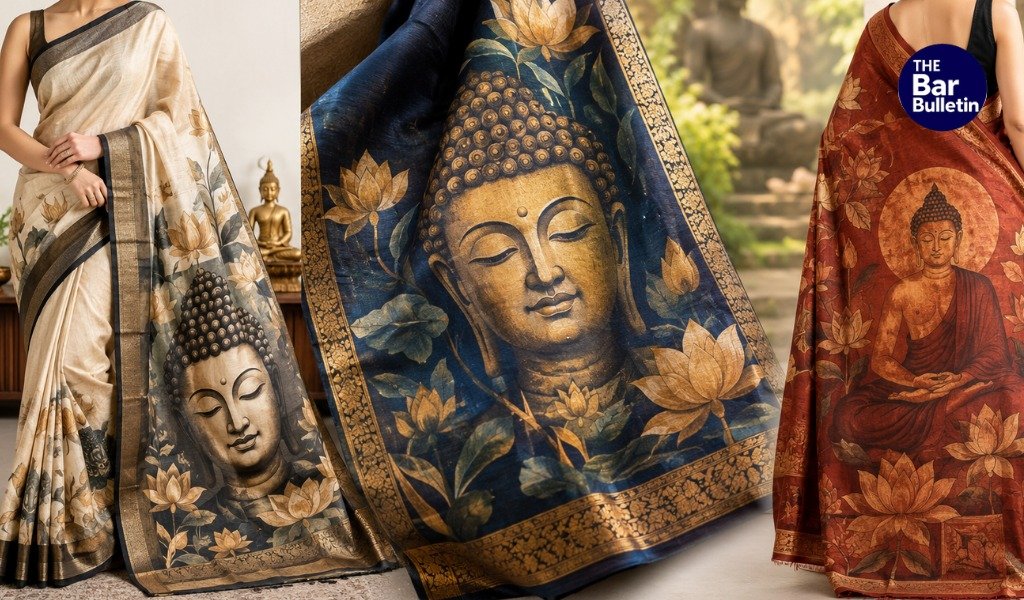

The Gujarat High Court has quashed an FIR registered against a Surat-based textile businessman under Section 295A read with Section 114 of the Indian Penal Code, holding that the material on record did not disclose the deliberate and malicious intention to outrage religious feelings necessary to constitute an offence under Section 295A IPC.
Justice P. M. Raval was dealing with a petition seeking quashing of FIR registered at Salabatpura Police Station, Surat. The FIR arose from allegations that sarees and textile materials bearing printed images of Lord Gautam Buddha were being sold at textile markets and shops, with the images appearing towards the lower portion of the garments, including the feet, border or pallu area. The complainant alleged that this amounted to degradation of the deity and intentionally wounded the religious sentiments of the community.
The petitioner, however, contended that he was a businessman dealing in sarees and dress materials and that the FIR was motivated by business rivalry. He denied any intention to hurt religious sentiments and argued that the essential ingredients of Section 295A were absent. It was also submitted that the FIR was lodged nearly two days after the alleged incident.
Opposing the plea, the complainant and the State argued that the photographs accompanying the petition themselves disclosed a prima facie case. They submitted that the High Court, while exercising jurisdiction under Section 482 CrPC, ought not to conduct a mini-trial and that the matter should be permitted to proceed to trial.
The High Court referred to the Supreme Court’s decision in State of Haryana v. Bhajan Lal, AIR 1992 SC 604, reiterating that the inherent jurisdiction under Section 482 CrPC may be exercised where, among other circumstances, the allegations even if taken at face value do not constitute an offence, where the allegations are inherently improbable, or where the proceedings are manifestly attended with mala fide or instituted with an ulterior motive.
On the scope of Section 295A, the Court relied upon the Supreme Court’s discussion in Mahendra Singh Dhoni v. Yerraguntla Shyamsundar, (2017) 7 SCC 760, referring to the Constitution Bench decision in Ramji Lal Modi v. State of U.P., AIR 1957 SC 620. The Court emphasised that Section 295A does not penalise every act of insult to religion. Rather, it applies to aggravated forms of insult committed with a deliberate and malicious intention to outrage the religious feelings of a class.
Examining the photographs and the police report, the High Court noted that the applicant had allegedly got sarees and other cloth material printed with images of God and Gautam Buddha covering the lower portion of the garments. The Court also noted that similar material was being sold by other persons in Surat. Crucially, however, it found that the photographs did not suggest an insult or attempt to insult religion or religious beliefs with deliberate and malicious intent so as to attract Section 295A IPC.
The Court held that the applicant was engaged in routine commercial activity involving sarees and dress materials based on prevailing market trends and designs. Mere printing or selling of textile material containing artistic depictions of a deity or revered icon, even where the image appears near the lower border or pallu of a garment, cannot by itself be presumed to demonstrate deliberate malice or an intention to disrupt public order.
The Court further observed that commercial activity involving religious motifs, in the absence of any overt act, inflammatory rhetoric or demonstrable intention to denigrate a religious belief, does not cross the threshold of criminally punishable insult under Section 295A. The Court cautioned that a contrary approach would expand the criminal provision beyond its intended constitutional parameters and penalise commercial conduct in the absence of criminal mens rea.
Finding that the foundational ingredients of Section 295A were absent, the Court concluded that the FIR, even when its allegations were taken at face value, failed to establish a prima facie case of aggravated insult to religion. It held that continuation of the criminal prosecution would amount to an abuse of the process of law, bringing the case within parameters (1), (3), (5) and (7) of Bhajan Lal.
Accordingly, the High Court allowed the application and quashed the FIR and all consequential criminal proceedings against the applicant.
