
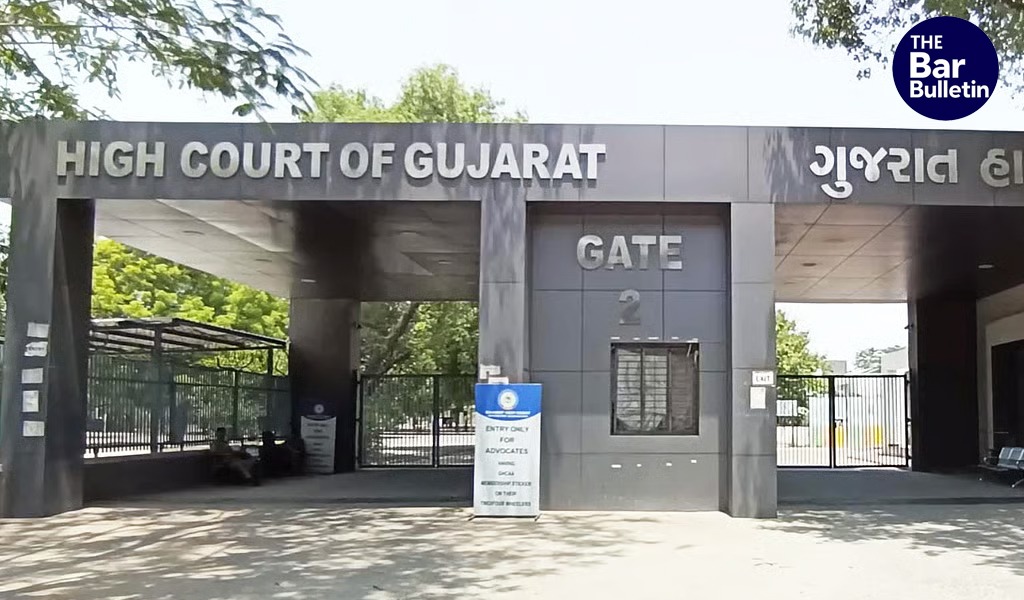

The Gujarat High Court (Ahmedabad Bench) has clarified that where tenants of shop premises affected by road widening accept alternative accommodation provided in lieu of the demolished tenanted premises, such acceptance operates as an implied surrender or extinguishment of the earlier tenancy rights. In such a situation, the tenants cannot later claim that tenancy continues in the remaining fragment of the old demolished structure. If they re-enter or continue in the leftover portion, their possession is not that of tenants but of encroachers or trespassers.
The Court further laid down that once the landlord-tenant relationship has ceased, the protection of the Rent Act and the exclusive forum of the Small Causes Court do not apply. The ordinary civil court can entertain a suit for possession against such persons because the dispute is no longer one between landlord and tenant, but one concerning removal of unauthorised occupation.
A Single Judge Bench of Justice J.C. Doshi found that the defendants could not point to even a single document showing that the landlord-tenant relationship continued after the original shops were demolished in the road widening exercise. The Court noted that if the defendants were really continuing as tenants in the remaining portion from 1990 onwards, they should at least have produced some rent receipt or equivalent document to show payment or recognition of tenancy after that date. Their failure to produce such material was treated as significant.
The Court rejected the defendants’ attempt to rely on selected pleadings from the plaintiff’s earlier application as an admission of continuing tenancy. The Court held that those pleadings could not be read in fragments. On a combined reading, the plaintiff had in fact described the defendants as unauthorised encroachers and had sought demolition of the portion occupied by them for proper implementation of the road widening scheme. The Court therefore held that the plaintiff had never accepted that the defendants remained tenants after demolition.
The Court noted that AMC was under no statutory obligation to provide alternative premises, and that the alternative accommodation was offered and accepted as a substitute for compensation. The later municipal scheme and resolutions showed that the affected shopkeepers, including tenants, were allotted alternative accommodation on lease terms, after which the original shops were taken over and demolished for road widening.
On that basis, the Court held that once the tenants vacated the original premises and shifted to the alternative sites, there was an implied surrender of tenancy. The Court said the tenants could not legally claim to retain tenancy rights in the demolished original shops while also enjoying alternative premises granted in lieu of those very shops. According to the Court, after demolition and acceptance of alternative accommodation, any later re-entry into the leftover structure could only be treated as encroachment or trespass.
The High Court therefore held that no landlord-tenant relationship survived on the date when the suits were filed. Once that conclusion was reached, the defendants could not rely on the Rent Act or the special jurisdiction of the Small Causes Court. Their status after 1990 was held to be that of rank trespassers or encroachers, and the City Civil Court was found to have proper jurisdiction under Section 9 of the Code to entertain the suits and grant relief.
The Court also rejected the defendants’ complaint that they were denied a fair opportunity to contest the suits. It found that the trial court had given them multiple opportunities to cross-examine the plaintiff and lead evidence, but they failed to avail them. Their challenge based on alleged advocate negligence was also rejected, with the High Court relying on Supreme Court observations that litigants cannot simply blame their lawyers and avoid the consequences of their own inaction. The Court treated the plea of lack of opportunity as a tactic to delay the decree. The Court further observed that the standard rent proceedings relied upon by the defendants did not help them because the relevant standard rent application had been dismissed for non-prosecution and had never resulted in any adjudication on merits.
Briefly, the appeals arose from a common judgment, where the City Civil Court, Ahmedabad decreed the suits in favour of the plaintiff-owner and directed the defendants to vacate the respective suit properties, restrained them from creating third party rights, and awarded damages of Rs.1,000 per month from September 2013 until vacant possession. The civil suit had already abated due to the defendant’s death, and no appeal was filed against that abatement.
The plaintiff was the owner of a bungalow property on Final Plot Nos. 827-828, T.P. Scheme No. 3, Ellisbridge, Ahmedabad, where several shops existed in the front portion abutting the main road. The defendants or their predecessors were tenants in those front shops. In 1986, Ahmedabad Municipal Corporation initiated road widening proceedings affecting around 80 shop owners and occupiers, including these defendants. The affected persons had challenged the road widening, but that petition was withdrawn after AMC agreed to provide alternative accommodation to the affected occupiers and tenants.
Pursuant to that arrangement, AMC provided alternative accommodation to the affected shop occupiers near Diwan Ballubhai School in Paldi on a nominal annual rent of Rs.101 and odd, after which the road widening was carried out and the original shops were demolished. According to the plaintiff, once the tenants accepted the alternative accommodation in lieu of the demolished premises, they lost whatever tenancy rights they had in the original shops. The plaintiff’s case was that the defendants later re-entered the remaining narrow portion of the old shops, which was only a small leftover strip, and started occupying it unauthorisedly with the object of pressuring the plaintiff.
The defendants resisted the suits mainly on the ground that they had been tenants for more than 60 years and that tenancy did not come to an end merely because a substantial portion of the shops had been demolished or because alternative accommodation had been allotted by AMC. They argued that some part of the original premises still remained, so the landlord-tenant relationship continued, and therefore only the Small Causes Court under the rent law had jurisdiction. They also argued that without notice under Section 12 of the Rent Act, no eviction action could be maintained.
