
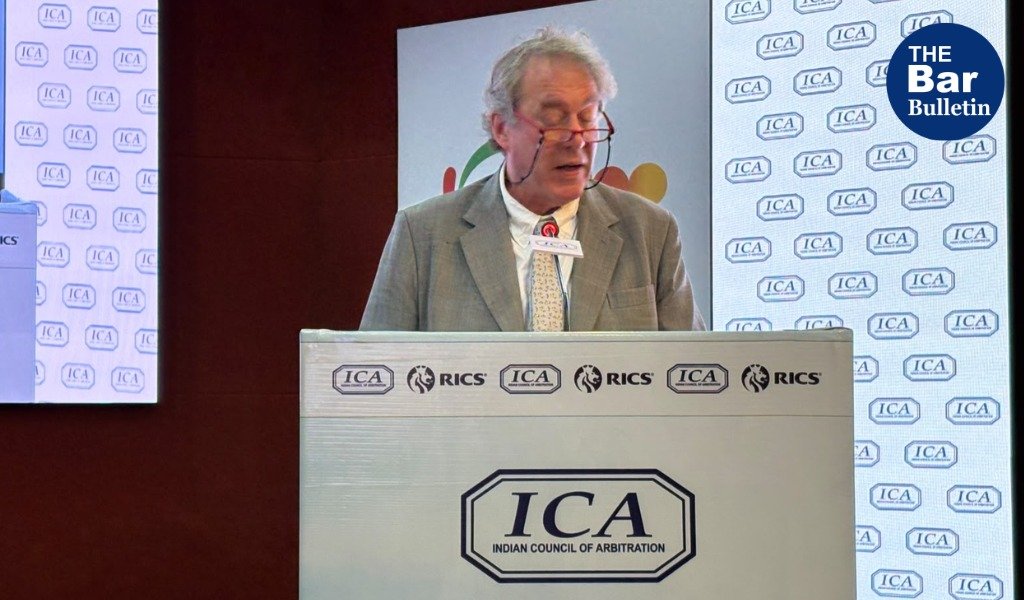
The Indian Council of Arbitration (ICA), in collaboration with the Royal Institution of Chartered Surveyors (RICS), organised the ICA–RICS Conclave on “Mediation in Transition: Institutional Trust, Professional Standards and the Age of Artificial Intelligence” on 21 November 2026 at Federation House, New Delhi. The conclave brought together distinguished professionals and experts to deliberate on the changing landscape of mediation, the importance of institutional credibility and professional standards, and the opportunities and challenges presented by artificial intelligence in dispute resolution.
Delivering the opening address, Mr. Arun Chawla, Director General, Indian Council of Arbitration (ICA), emphasised that mediation must be viewed not merely as an alternative to traditional dispute resolution but as an important instrument of commercial continuity, investment security and economic development. He highlighted its particular relevance in sectors such as infrastructure, construction and the built environment, where disputes can affect contractual relationships, ongoing projects, investments and wider economic interests. He observed that mediation enables parties to move beyond adversarial legal positions towards collaboration, preserving business relationships and facilitating commercially sustainable outcomes.
Referring to India’s evolving mediation framework, including the Mediation Act, 2023, and the establishment of the Mediation Council of India, Mr. Chawla stressed that legislative reform alone cannot create an effective mediation ecosystem. It must be supported by credible institutions, robust professional standards and public confidence in the process. He also highlighted the growing role of artificial intelligence in dispute resolution, noting its potential to assist with document review, information analysis and administrative efficiency. However, he cautioned that technology cannot replace the human elements of trust, empathy, confidentiality and professional judgement that remain fundamental to successful mediation.
He identified three essential pillars for the future of mediation: institutional trust, professional standards and responsible technological innovation, emphasising that technology must strengthen professional judgement rather than substitute it.
Delivering the special address, Mr. Nigel Clarke, Independent Chair of the Standards and Regulation Board, Royal Institution of Chartered Surveyors (RICS), highlighted the importance of mediation in resolving commercial disputes, particularly in the construction and infrastructure sectors, where complex contractual relationships can give rise to costly and prolonged disagreements. Referring to the Mediation Act, 2023, he described it as an important development in strengthening India’s mediation framework, while emphasising that the effectiveness of mediation depends on more than legislation and institutional arrangements.
Mr. Clarke noted that institutional trust must be reinforced through professional competence, ethical conduct, impartiality and accountability. He highlighted RICS’ role in promoting these values through its professional standards, independent regulatory framework and dispute resolution services.
He also marked the 50th anniversary of the RICS Dispute Resolution Service, noting its contribution over five decades to dispute resolution and avoidance through mediation, arbitration, adjudication and other mechanisms. He observed that the focus is increasingly shifting towards preventing unnecessary disputes through early intervention, professional expertise and constructive engagement.
Addressing the growing influence of artificial intelligence, Mr. Clarke noted that AI can significantly assist dispute resolution professionals in document review, claims analysis, case preparation and administrative processes. However, he emphasised that its adoption must be accompanied by appropriate safeguards to protect confidentiality, impartiality and professional accountability.
“
“AI can assist professional analysis and decision-making, but it cannot replace human judgment or professional accountability. Ultimately, our objective is to ensure that technological innovation strengthens rather than undermines trust and confidence in mediation and dispute resolution,” he said.
Mr. Clarke further announced that RICS is developing new practice guidance on the use of artificial intelligence in dispute resolution. The draft guidance is expected to be published for public consultation in early 2027, providing dispute resolution professionals an opportunity to contribute to its development. He also referred to the RICS professional standard on the responsible use of artificial intelligence in surveying practice, introduced in March 2026, which addresses governance, transparency, risk management, professional oversight and accountability.
Highlighting RICS’ commitment to promoting diversity and expanding professional opportunities, Mr. Clarke also drew attention to the RICS Women in Dispute Resolution Scholarship for India. The scholarship offers one fully funded place in the RICS Diploma in International Arbitration, an 18-month programme commencing in March 2027. Open to eligible women professionals from the legal profession as well as construction, project management, quantity surveying, engineering and related disciplines, the initiative seeks to encourage greater participation and representation of women in the field of dispute resolution. Applications are open until 11 December 2026.
In his closing remarks, Mr. Chris Alder, Senior Executive Officer, Standards and Regulation, RICS, highlighted the complementary roles of ICA and RICS in advancing mediation through institutional collaboration, professional standards and international expertise. He observed that mediation is fundamentally about dialogue, collaboration and building consensus between parties to achieve fair and sustainable resolutions.
Reflecting on the growing integration of artificial intelligence into professional practice, Mr. Alder noted that the key question is no longer whether AI will become part of alternative dispute resolution, but how it can be harnessed to make mediation more effective and efficient without compromising trust. While acknowledging its potential to analyse large volumes of information, identify issues and support case preparation, he cautioned against the risks of inaccurate analysis, fabricated information, confidentiality breaches and an unjustified sense of certainty in AI-generated outputs.
He emphasised that mediators and other dispute resolution professionals must exercise professional competence and scepticism when evaluating AI-generated information. Technology may support analysis, but accountability for professional decisions must remain with the individuals concerned. He also highlighted the importance of establishing clear boundaries and safeguards regarding the use of AI, particularly when handling confidential information and sensitive dispute-related material.
The conclave reinforced the shared commitment of ICA and RICS to strengthening India’s mediation ecosystem through institutional cooperation, professional excellence and responsible technological innovation. The deliberations highlighted the need for mediation to evolve into a trusted and preferred mechanism for commercial dispute resolution, supported by competent professionals, credible institutions and technology that enhances rather than compromises the integrity of the process.