
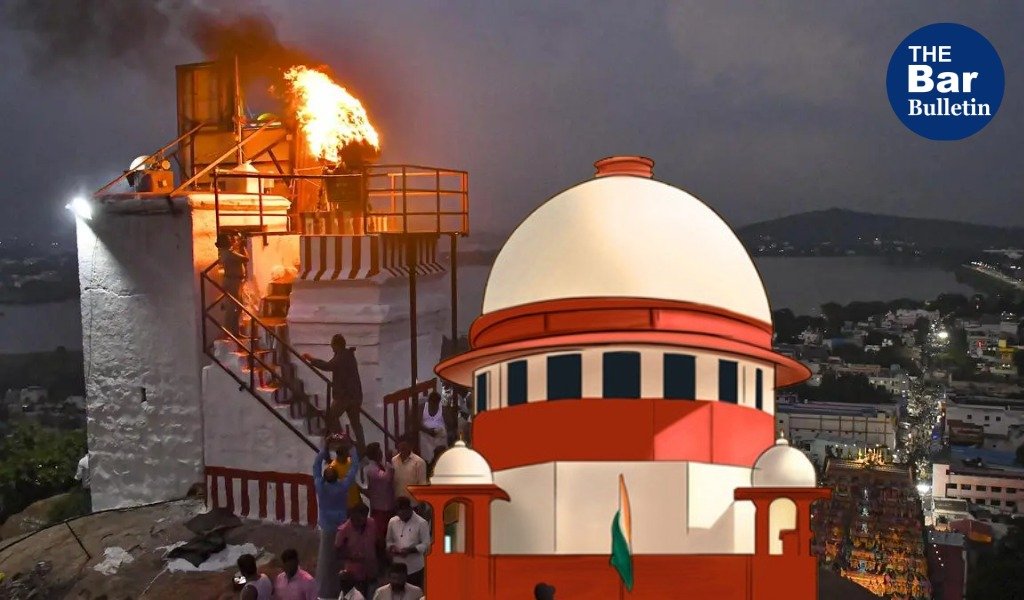

The Supreme Court has permitted the lighting of the ceremonial lamp at the Deepathoon, a stone pillar on Thirupparankundram Hill in Madurai, on November 24, 2026, coinciding with the Karthigai Deepam festival. The permission has been granted as a one-time interim arrangement, subject to stringent safeguards, without recognising or enforcing any claimed customary, religious or proprietary right over the site.
A Bench of Justice Aravind Kumar and Justice Vipul M. Pancholi passed the order while hearing a batch of proceedings arising from the Madras High Court’s January 6, 2026 judgment concerning dispute arose over whether the Karthigai Deepam ceremonial lamp could be lit at the Deepathoon, a stone pillar on Thirupparankundram Hill, Madurai, amid competing claims over the right to perform the ceremony at the disputed location. The Madras High Court had directed the lighting of the lamp there, prompting challenges before the Supreme Court.
The Court directed that the lighting ceremony be conducted exclusively by a restricted team authorised by the Devasthanam. The District Collector, Madurai, will determine the composition and number of persons in the team in consultation with the Temple Executive Officer, the Archaeological Survey of India (ASI) and the Commissioner of Police, Madurai.
The Supreme Court clarified that no member of the general public would be permitted to accompany the authorised team to the Deepathoon. No procession, public congregation, demonstration, slogan-raising or activity beyond the ceremonial lighting of the lamp would be allowed at the site.
The District Administration will determine the timing, access route and duration of the ceremony, keeping in view public safety, fire prevention, archaeological protection and maintenance of peace. The ASI has also been directed to prescribe conditions for the protection and preservation of the monument and its surroundings.
Also Read: Supreme Court Ends Monitoring of Ram Mandir Donation Theft Probe After Chargesheet Filed
The Bench further clarified that the existing religious observances at customary locations must continue undisturbed and that lawful religious activities, access and enjoyment of the Dargah and other institutions must not be interfered with.
The Court observed that the dispute raises several important constitutional and legal questions, including the scope of religious freedom, enforceability of asserted religious practices, the authority of temple administration in matters of religious observance and the permissible limits of judicial intervention.
Noting that broader questions concerning Articles 25 and 26 of the Constitution are also awaiting authoritative consideration by a Nine-Judge Constitution Bench in the Sabarimala reference, the Court said it was neither necessary nor appropriate to examine those issues at the interim stage. The Bench observed:
“
“What weighs with us at this stage is the peculiar nature of the occasion and the proximity of the festival, which is scheduled to take place on 24.11.2026. The opportunity to perform the ceremony on that particular day, if denied, cannot be restored by any subsequent adjudication. Equally, we are conscious that the performance of the ceremony, once permitted, cannot be undone. It is precisely for this reason that any interim arrangement must be narrowly confined, carefully regulated and incapable of creating any enduring legal consequence. Having considered the competing interests, and without pronouncing upon their respective merits, we are of the view that a limited, one-time arrangement, subject to stringent safeguards, would appropriately balance the interests involved.”
The Court also stayed the findings recorded in paragraphs 1 to 141 of the Madras High Court’s impugned judgment, insofar as they concern the present proceedings, until further orders.
Importantly, the Supreme Court clarified that its permission should not be construed as a finding that the stone pillar is a place of customary religious observance or that lighting the lamp there constitutes an essential religious practice. All questions concerning title, possession, customary usage, religious entitlement, temple administration and access to the site have been expressly left open.
It further directed that neither the permission granted nor the performance of the ceremony could be relied upon as evidence of an established custom, precedent of religious usage, possessory right or entitlement to access the site. The one-time arrangement would also not provide an independent basis for seeking similar permission in subsequent years.
The District Collector, Madurai, has been directed to submit a brief compliance report within three days after the festival. The matters have been listed for further hearing in the second week of January 2027.
