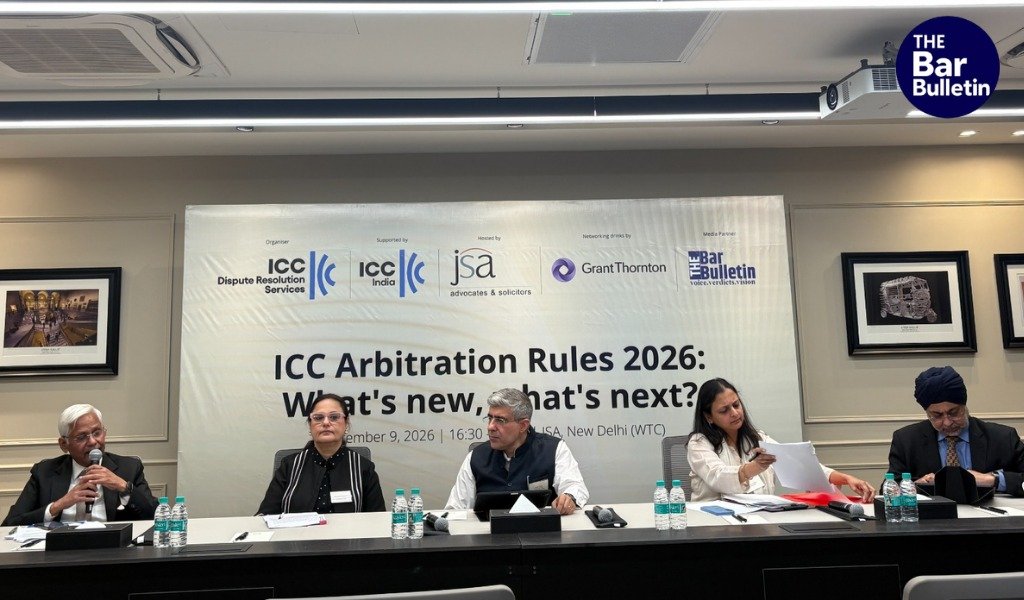

The ICC India Arbitration Group, in association with J. Sagar & Associates (JSA) and supported by Grant Thornton and The Bar Bulletin, hosted a session on “ICC Arbitration Rules 2026: What’s New, What’s Next?” in New Delhi, bringing together leading arbitration practitioners and professionals to discuss the key changes introduced by the revised ICC Arbitration Rules and their practical implications for parties and counsel in India.
Aanchal Basur gave the opening remarks, setting the context for the revised Rules and the process that led to their adoption. She highlighted the extensive consultation undertaken during the revision process and the objective of making arbitration more efficient, flexible and responsive to the needs of parties.

Khushboo Deshmukh, Deputy Director, India, ICC Dispute Resolution Services, presented highlights from ICC’s 2025 dispute resolution statistics. She noted that ICC registered 894 cases in 2025, making it the third-best year in its history, with 69% of cases being cross-border and 31% involving parties of the same nationality. The statistics also showed the broad geographical and sectoral reach of ICC arbitration, with more than 2,500 parties from 147 countries participating in ICC arbitrations.

She also highlighted ICC’s scrutiny of arbitral awards as an important quality-control mechanism. Of the 607 awards that reached the ICC Court in 2025, 595 were approved with comments, while 67 were not approved, underscoring the institution’s multi-level scrutiny process aimed at enhancing the enforceability of awards.
The panel discussion moderated by Amar Gupta, Joint Managing Partner, JSA opened with Rashmi Kathpalia examining the removal of the mandatory requirement for Terms of Reference. Drawing on her extensive experience as in-house counsel, she noted that while Terms of Reference provided a useful roadmap by crystallising the dispute and identifying the issues for determination, their preparation could also be time-consuming and expensive. She observed that the change was therefore a welcome development for in-house counsel, while noting that the revised framework would need to be tested in practice.
Amar Gupta then turned to the role of the Initial Case Management Conference (CMC), asking Renu Gupta, Partner, Olive Law how parties and counsel should prepare for the CMC under the revised Rules. Renu observed that the change could effectively bring significant case-definition work forward into the first 30 days of the arbitration. She noted that issues such as claims and counterclaims, bifurcation, document production and expert evidence could require parties to undertake substantial preparation at a much earlier stage.
The panel thereafter considered the new early determination mechanism under Article 30. Sr Adv Amit Sibal drew a comparison with summary judgment principles under Indian commercial litigation, particularly the approach under Order XIII-A of the Commercial Courts Act. He emphasised that early determination should be reserved for cases where the lack of merit or jurisdiction is ‘obvious, clear, and easily apparent on the face of the submissions’, rather than becoming a vehicle for a mini-trial.
Amit also highlighted the potential risks of both underuse and overuse of the mechanism. While tribunals may be cautious about terminating claims before a full evidentiary process, parties could potentially deploy early determination applications tactically to delay proceedings. He suggested that tribunals could address such risks through effective case management and appropriate costs orders.
Gaganpreet Puri subsequently discussed the suitability of expedited procedures, cautioning against using monetary thresholds as the sole indicator of complexity. He observed that a high-value dispute could be straightforward to determine, while a lower-value dispute could involve intricate valuation issues and extensive evidence. He emphasised that the complexity of the dispute, rather than merely its monetary value, should inform whether expedited arbitration is appropriate.
Drawing on practical experience, Gaganpreet noted that expedited proceedings can be particularly effective where disputes involve straightforward liability or quantum questions and do not require extensive expert evidence. He also highlighted the commercial value of obtaining a final determination within a significantly shorter timeframe.
The panel then returned to the early determination mechanism, with Renu Gupta sharing her experience of applications seeking early disposal in arbitration proceedings. She cautioned that such applications can themselves become a source of delay if parties use them tactically, noting that she had encountered proceedings being diverted for ‘6 to 8 months, sometimes even more’ because of such applications. She stressed the need for greater clarity on what would constitute a matter that is “manifestly without merit” or “manifestly outside the tribunal’s jurisdiction”.
The discussion then moved to arbitrator disclosure requirements. Amit noted the revised approach under which arbitrators are encouraged to err on the side of disclosure where they are in doubt, while emphasising that disclosure does not itself establish a lack of independence or impartiality. He pointed out that the objective should be to identify potential conflicts at an early stage rather than allowing them to surface after substantial progress has been made in the arbitration.
Amit referred to instances where challenges to arbitrators had arisen late in proceedings following non-disclosure of previous appointments or relationships. He observed that the real test of the revised disclosure regime would be whether it resulted in “fewer late surprises”, rather than simply whether the number of challenges increased or decreased.
The panel also considered the new emergency and highly expedited procedures. Rashmi also discussed the practical utility of emergency arbitration, particularly where parties seek urgent measures to preserve the status quo or restrain actions such as invocation of a bank guarantee. She noted, however, that the enforceability of an emergency arbitrator’s order in India remained an important practical consideration, particularly where a party may not voluntarily comply.
She also discussed the significance of the revised provisions permitting relief in circumstances involving non-parties and ex parte measures, while cautioning that parties should carefully assess the enforceability and practical effectiveness of emergency relief before choosing the mechanism.
Returning to the issue of conflicts, Gaganpreet Puri drew upon his experience as an expert witness to emphasise the importance of proactive disclosure. He observed that in a closely connected professional ecosystem, perceived conflicts can be as important as actual conflicts. He stressed that transparency at the outset is preferable to discovering a potential conflict midway through proceedings, stating that “once your credibility is lost, it’s lost.”
He also highlighted the importance of systematic conflict checks and maintaining comprehensive databases of prior engagements, relationships and appointments to identify potential conflicts before they become a problem.
In the concluding segment of the discussion, Renu returned to the disclosure provisions and highlighted the corresponding obligation on parties to provide information that can assist arbitrators in undertaking effective conflict checks. She noted that parties are required to submit lists of persons and entities that prospective arbitrators should consider while assessing potential conflicts. Describing this as a significant development from a cultural and procedural perspective, she observed that comprehensive disclosure by parties could substantially assist in preventing conflicts from emerging at a later stage.
Renu also reiterated her concern regarding the Initial Case Management Conference, particularly whether the new framework could effectively result in substantial elements traditionally addressed through Terms of Reference being compressed into the first 30 days of the proceedings.
The discussion concluded with the observation that the effectiveness of the 2026 ICC Rules will ultimately depend on how they operate in practice. The panellists emphasised that while the revised Rules introduce important tools for efficiency, flexibility and transparency, their success will depend equally on disciplined case management, responsible use of procedural mechanisms and proactive disclosure by both arbitrators and parties.
The session concluded with observations on the practical impact of the 2026 Rules and whether their objectives of greater efficiency and flexibility would be realised in practice. Sameer Jain, Partner, PSL Chambers and Chair, ICC India Arbitration Group, said the new Rules were designed around the requirements of modern arbitration and encouraged practitioners to actively engage with the ICC India Arbitration Group.

The event concluded with vote of thanks by Divyam Agarwal.