
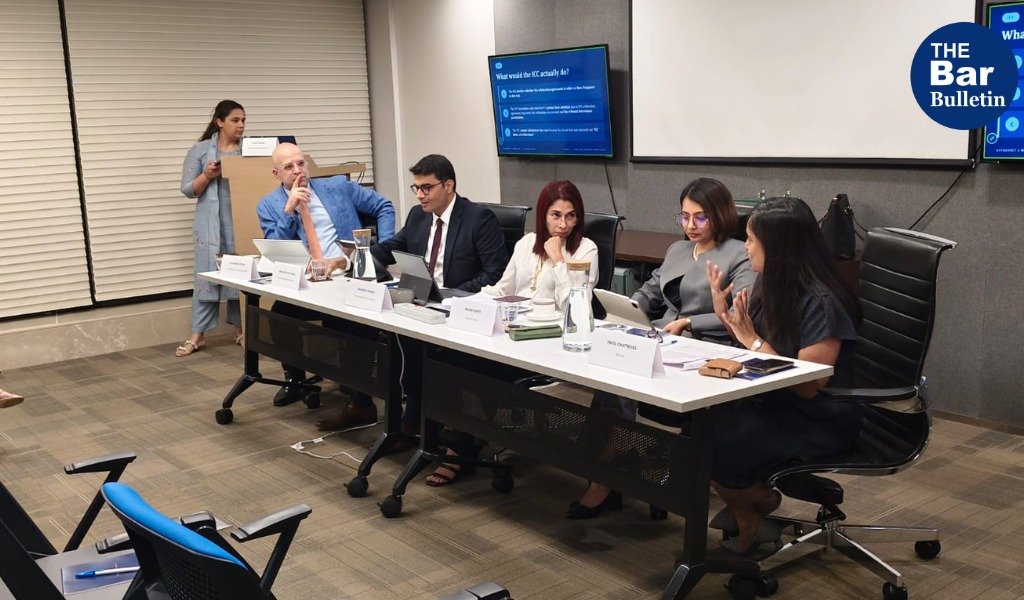

The International Chamber of Commerce (ICC) Dispute Resolution Services organised Inside an ICC Arbitration: An Interactive Journey in Mumbai on October 28, 2026 hosted by Shardul Amarchand Mangaldas, offering participants a practical insight into the various stages of an ICC arbitration under the ICC Arbitration Rules 2026. Through a simulated arbitration, the session demonstrated how parties, counsel, arbitrators and the institution interact at different stages of the proceedings, from procedural decisions to the conduct of hearings.
Niyati Gandhi served as the simulation host, guiding participants through the case scenarios and inviting the panellists to respond in accordance with their respective roles in the arbitration process. Savani Gupte played counsel for the respondent, Abhileen Chaturvedi represented the claimant, Shaneen Parikh acted as the arbitrator, Payel Chatterjee represented the ICC Court, while Alexander G. Fessas explained the role of the ICC Secretariat at different stages of the proceedings.
Also Read ICC India Arbitration Conference 2026 to Be Held in Mumbai on October 31
One of the key scenarios examined whether a dispute involving 14 alleged technical defects, extensive documentary evidence, expert testimony and a substantial counterclaim could be resolved under the ICC’s highly expedited or expedited procedures, or whether it required the ordinary arbitration process.
Presenting the respondent’s position, Savani Gupte argued that the reference to a 90-day period in the arbitration clause did not, by itself, establish that the parties had agreed to a highly expedited procedure. She pointed out that the clause provided for three arbitrators, whereas the highly expedited procedure contemplated arbitration before a sole arbitrator. She further submitted that the complexity of the dispute, the volume of evidence and the counterclaim weighed against adopting either the highly expedited or expedited procedure.
Alexander G. Fessas, explaining the institutional and jurisdictional dimensions, highlighted the difficulties that may arise in disputes involving joint ventures and parties who may not have signed the arbitration agreement. He observed that where jurisdictional questions require extensive examination, resolving them could take considerable time and undermine the purpose of emergency arbitration.
Representing the claimant, Abhileen Chaturvedi argued that the parties had intended to resolve their dispute within a short period. Referring to the ICC Rules’ highly expedited procedure, he submitted that the dispute was relatively narrow and turned principally on whether the technology supplied met the contractual specifications. According to him, this could be determined through a focused process without extensive documentary proceedings. He also suggested that any counterclaim could be addressed separately, including through bifurcation, if necessary.
Payel Chatterjee, representing the ICC Court, examined the institution’s role in facilitating procedural efficiency. She observed that the ICC Court may, in appropriate circumstances, give effect to an expedited procedure by appointing a sole arbitrator even where the arbitration agreement provides for three arbitrators. However, she noted that the applicability of the expedited procedure would depend on the claims and counterclaims and whether the applicable monetary threshold was exceeded. If the ordinary procedure became necessary, she suggested that strict procedural timelines could still help expedite the proceedings.
Shaneen Parikh, acting as the arbitrator, addressed the question of balancing procedural efficiency with fairness and enforceability. She noted that the dispute involved 14 alleged technical defects, six proposed fact witnesses and two expert witnesses on each side. The documentary record was also substantial. In these circumstances, she considered it inadvisable to attempt to resolve the dispute within an artificially compressed timeframe.
The simulated arbitrator consequently opted for the ordinary procedure while seeking to ensure that the proceedings remained tightly managed. The procedural directions contemplated completion of pleadings within two months, followed by document production, with each party limited to 20 narrowly framed document requests. The directions also sought to streamline witness and expert evidence, including a joint expert report identifying areas of agreement and disagreement, and contemplated a two-to-three-day evidentiary hearing.
By assigning the panellists distinct institutional and procedural roles, the simulation demonstrated how different participants approach the same dispute from their respective positions. It also brought out the role of the ICC Court and Secretariat alongside counsel and the arbitral tribunal in ensuring that proceedings move forward efficiently.
The discussion highlighted that expedited arbitration is not simply about shortening timelines. The choice of procedure must account for the arbitration agreement, the nature and value of the claims, jurisdictional questions, evidentiary requirements and the parties’ opportunity to present their cases.
The central takeaway was that efficiency in arbitration is not measured by speed alone, but by the ability to deliver a fair, effective and enforceable resolution within a well-managed procedural framework.