
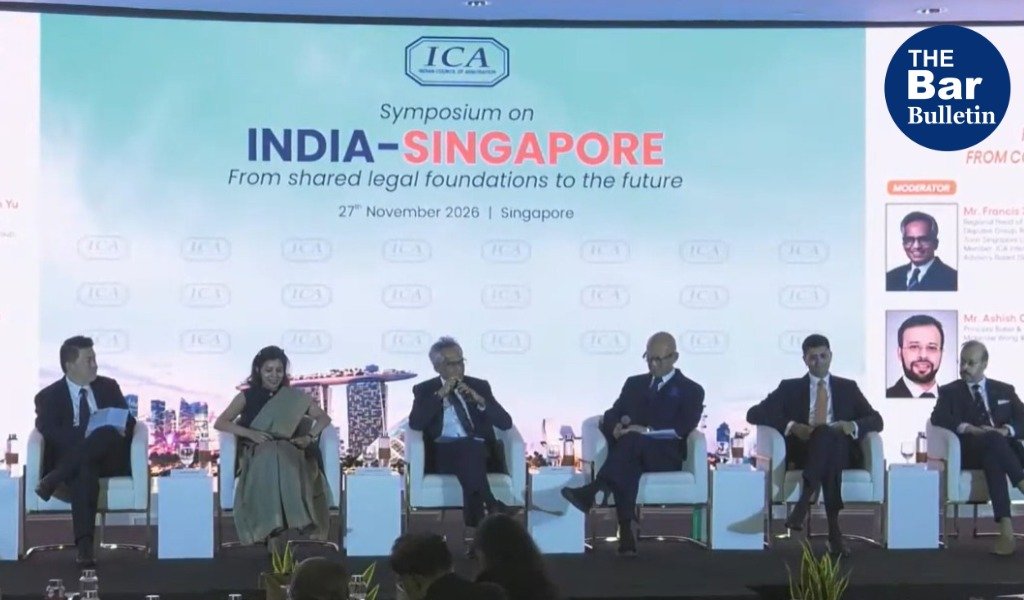

Experts in international arbitration and commercial dispute resolution have called for stronger cooperation between India and Singapore, including clearer cross-border protocols, greater coordination between the two judiciaries and increased opportunities for Asian legal practitioners.
The observations were made during a panel discussion titled “Beyond Litigation: From Commercial Justice to Commercial Continuity” at the Indian Council of Arbitration’s (ICA) symposium on “India–Singapore: From Shared Legal Foundations to the Future”, held at The Fullerton Hotel, Singapore.
The session was moderated by Francis Xavier SC, Regional Head of the Disputes Group at Rajah & Tann Singapore LLP, and featured:
● Jimmy Yim, SC, Chairman, Drew & Napier LLC;
● Chou Sean Yu, Managing Partner and Head of the Litigation & Dispute Resolution Group, WongPartnership LLP;
● Ashish Chugh, Principal, Dispute Resolution Practice Group, Baker McKenzie Wong & Leow, Singapore;
● Abhisaar Bairagi, Partner, Dispute Resolution Practice Group, Khaitan & Co.; and
● Nitesh Jain, Partner, Dispute Resolution and Arbitration Practice, Trilegal.
Nitesh Jain: Singapore Continues To Be Preferred Seat For India-Related Arbitrations
Opening the discussion, Francis Xavier SC asked Nitesh Jain about the current state of the India-Singapore alternative dispute resolution and dispute resolution corridor.
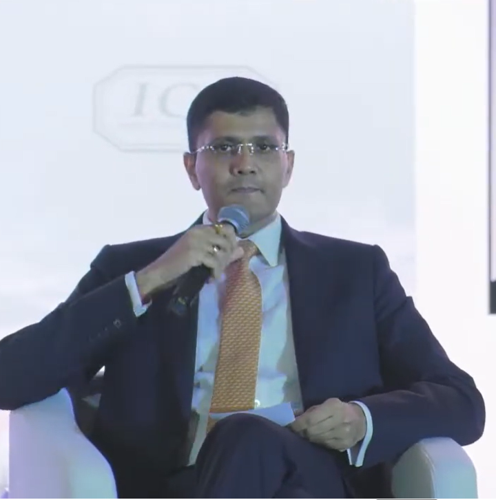
Responding to the question, Nitesh Jain said Singapore continued to be a preferred seat for India-related arbitrations. He also highlighted the Indian Supreme Court’s recognition of the principle of transnational estoppel in the Nagaraja v. Milestone matter, describing it as a significant development for enforcement of foreign arbitral awards. Explaining its implications, he said:
“
“This will fast track enforcement and the reason is because most of the issues would have already been settled by the seat court. So the Indian court’s interference, which is in any event in enforcement of foreign award, is very, very limited, even on public policy issue it’ll become very limited.”
He further called for India to ratify the Singapore Convention on Mediation, introduce cross-border insolvency rules and provide clarity on the rules governing foreign lawyers’ participation in international arbitrations in India.
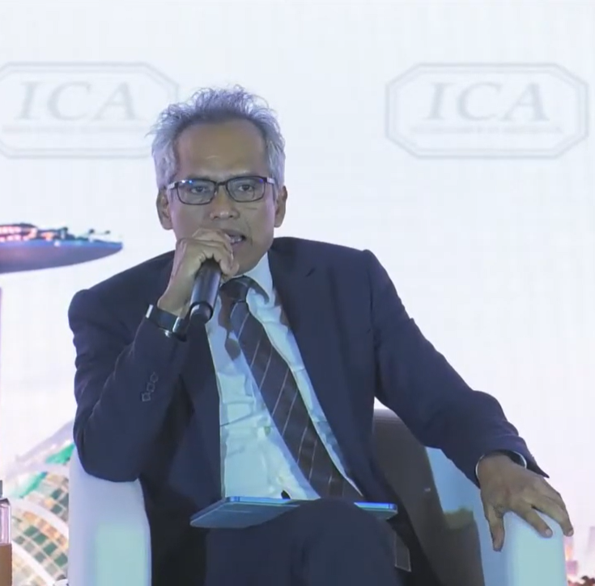
Jimmy Yim: India-Singapore Dispute Resolution Corridor Is Widening

Following Nitesh Jain’s remarks, the moderator invited Jimmy Yim to share the Singapore perspective on developments in the India-Singapore corridor. Jimmy Yim agreed with Nitesh Jain’s assessment of the significance of transnational estoppel and said the development could reduce unnecessary proceedings in enforcement matters.
He also observed that the corridor was expanding due to increasing trade and investments between the two countries, greater movement of legal talent and the growing use of mediation as an alternative dispute resolution mechanism. He said:
“
“The corridor is definitely widening, growing and it’s a reflection of a few things. One is first is a reflection of the increased trade and investments between the two countries, and secondly it’s also an increased recognition of the flow of talents.”
Jimmy Yim also highlighted the importance of mediation, noting that it could provide a more efficient route to resolving disputes and facilitate their subsequent enforcement in India.
Ashish Chugh: Choice Of Dispute Resolution Mechanism Cannot Be One-Size-Fits-All
The moderator next turned to Ashish Chugh, asking whether parties involved in disputes between Indian and Singapore entities should adopt a calibrated approach when selecting a dispute resolution mechanism.
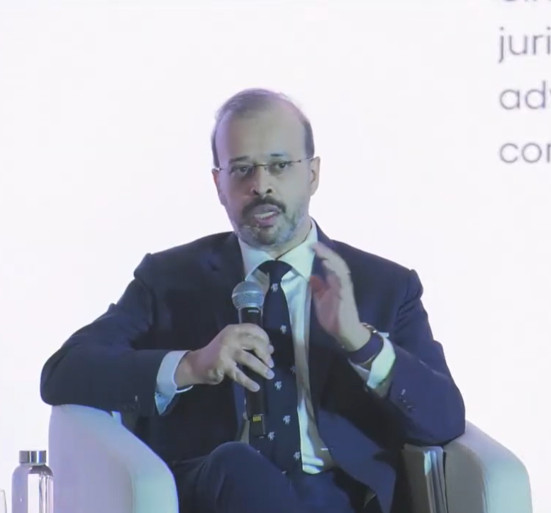
Ashish Chugh said that although Singapore-based institutions such as the Singapore International Arbitration Centre (SIAC) and the International Chamber of Commerce (ICC) were frequently considered for India-related disputes, choosing a seat or institution required a more detailed assessment.
He explained that the decision depended on commercial, tactical and regulatory considerations, including the nature of the counterparty, the subject matter of the contract and the remedies available.
Referring to financing agreements, Chugh said parties often prioritised the jurisdiction where they could secure the most effective remedy and recover outstanding amounts. He also pointed to disputes involving regulatory issues in third countries, where proceedings before local courts or tribunals might be necessary. He said:
“
“The main point here is that particular analysis can be quite granular. It’s not going to be one size fits all where you can say this one particular institution is my preference and therefore I should be able to choose this. There may be constraints, considerations that you may have to take which point in a different direction.”
Abhisaar Bairagi: India And Singapore Have Reached Considerable Convergence On Enforcement Of Final Awards

Moving to the cross-border enforcement of arbitral and court orders, Francis Xavier SC asked Abhisaar Bairagi how courts in India and Singapore dealt with orders passed by courts and arbitral tribunals in the other jurisdiction, and whether such orders were uniformly enforced.
Abhisaar Bairagi said the position largely depended on the nature of the order. She noted that there was considerable convergence between the two jurisdictions in relation to final arbitral awards, with both following the framework of the New York Convention and adopting a narrow interpretation of public policy. She said:
“
“We’ve finally reached a stage in India where you can say that if you have an award from Singapore and you want to enforce it in India, you don’t have to be nervous about it.”
However, she pointed out that interim awards and measures involved a different position. While Singapore recognised foreign interim awards within its enforcement framework, India followed a different approach, requiring parties in certain situations to approach Indian courts for relief.
She also referred to the reciprocal arrangements between India and Singapore for enforcement of money decrees.
Chou Sean Yu: Asian Arbitrators And Practitioners Need Greater Visibility
The moderator subsequently asked Chou Sean Yuhow how participation in the India-Singapore dispute resolution corridor could be increased, particularly to enable Indian practitioners to play a more prominent role in arbitrations seated in Singapore and vice versa.
Responding, the he said that Indian and Singaporean practitioners had reached a comparable level of expertise with their international counterparts. However, he identified a lack of visibility and opportunities as a key obstacle to their wider recognition. He said:
“
“What I think is missing is visibility, the lack of awareness and the lack of profiling and the lack of understanding of how good our Asian arbitrators and practitioners are. We have to be very intentional about it. We have to give that young practitioner that opportunity. We have to give that Asian arbitrator or practitioner that opportunity to prove themselves.”
He called for greater Asian thought leadership, more training and advocacy opportunities, and increased mentorship for young practitioners handling cross-border disputes.
Panelists Call For Common Protocols And Greater Judicial Cooperation
Towards the conclusion of the discussion, Francis Xavier SC asked each panellist to identify one key measure that India and Singapore should focus on to strengthen the functioning of the dispute resolution corridor.
Ashish Chugh called for greater interoperability between the two legal systems, suggesting that common protocols could address recurring issues concerning interim relief, witness evidence and enforcement.
Nitesh Jain emphasised the need for more substantive cooperation between the two judiciaries, including opportunities for judges to understand how courts in the other jurisdiction handle commercial disputes. He also suggested training programmes and workshops to familiarise Indian arbitrators with international arbitration practices.
Jimmy Yim called for clearer protocols and greater engagement with general counsel of Indian corporations to improve the drafting of dispute resolution clauses.
Abhisaar Bairagi highlighted the importance of understanding cultural differences between the two jurisdictions while introducing legal practitioners and handling cross-border matters.
Chou Sean Yu reiterated the importance of training, mentorship and thought leadership, observing that stronger professional relationships would form the foundation of a sustainable India-Singapore dispute resolution corridor.