
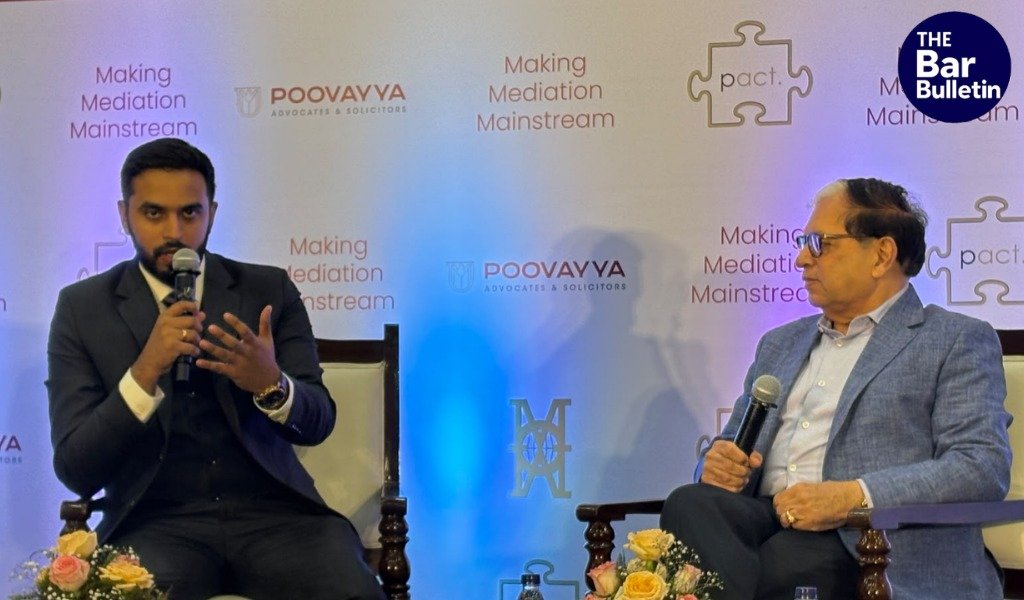

Justice (Retd.) Arjan Kumar Sikri, Arbitrator and Mediator, has described mediation as “a better form of access to justice”, calling for greater awareness among lawyers, companies and General Counsel on the use of mediation as part of commercial dispute resolution.
Justice Sikri was speaking to Jonathan Rodrigues, Host of The Mission Mediation Podcast, during a fireside chat. The discussion focused on the role of mediation clauses in commercial contracts, the relationship between mediation and arbitration, and the practical challenges in making mediation a first step in commercial disputes.
Opening the discussion, Jonathan highlighted the need to shift the way mediation is perceived within the legal and commercial ecosystem. He observed that at many conferences, “mediation is being treated like a charity case”, describing it as a service that is often seen as falling between other dispute-resolution processes.
Rodrigues pointed out that a commercial dispute may involve several issues, not all of which necessarily require adjudication through arbitration. He noted that out of 10 or 12 issues in a dispute, three or four may potentially be resolved through mediation if identified at an early stage.
Against this backdrop, he questioned why mediation clauses are still not routinely incorporated into commercial contracts.
Justice Sikri attributed the gap, among other factors, to the continuing mindset around mediation. Recalling the early days of court-annexed mediation following the introduction of Section 89 of the Code of Civil Procedure, he said there was initially considerable resistance among lawyers, with some viewing alternative dispute resolution as a potential threat to their revenue.
According to Justice Sikri, the situation has changed considerably over the last two decades, with lawyers now recognising the value of mediation. However, he said this acceptance has not yet translated into mediation being routinely built into commercial contracts.
He noted that mediation in India is still often associated with matters being referred by courts, whereas in jurisdictions where mediation has developed more extensively, parties can approach professional mediators directly when a dispute arises, even in the absence of a contractual or court referral.
Justice Sikri emphasised the need to create greater awareness among General Counsel and corporate decision-makers, given the increasingly important role they play in advising companies on dispute resolution.
He also rejected the perception that mediation necessarily reduces professional opportunities for lawyers. Referring to practices in jurisdictions where mediation has become established, he said mediation can provide opportunities not only for mediators but also for lawyers representing parties in mediation proceedings.
Justice Sikri stressed that mediation should not be viewed as being in competition with arbitration. Rather, the two mechanisms can operate as complementary avenues of dispute resolution, depending on the nature of the dispute and the interests of the parties.
He described mediation as “a better form of access to justice”, pointing not only to its potential to reduce the burden on courts but also to its ability to produce solutions that may not be available through a conventional adjudicatory process.
Rodrigues further highlighted a practical challenge faced by lawyers when commercial disputes are resolved quickly through mediation.
Sharing an example of a dispute that had been ongoing for several months before being referred to mediation and settled within weeks, Rodrigues noted that clients may sometimes question legal fees when a matter is resolved rapidly.
His point was that lawyers should clearly explain and define the work involved in acting as mediation counsel, rather than allowing mediation to be perceived as reducing the value of the legal services provided.
The discussion thus linked the commercial case for mediation with the role of lawyers in implementing and advising clients on mediation clauses.
The conversation also examined whether a mediator should subsequently act as an arbitrator if mediation fails to resolve a dispute.
Justice Sikri said that, as a matter of principle, a person who acts as mediator should ordinarily not subsequently act as arbitrator in the same dispute, given the different roles and the confidential information that may arise during mediation.
At the same time, he shared an example from his experience where mediation resulted in the resolution of approximately 80% of a dispute, while the remaining 20% turned on a legal issue.
Rather than restarting the entire dispute through a fresh arbitration, the parties ultimately adopted a streamlined mechanism to resolve the remaining issue. Justice Sikri said the example demonstrated how parties can develop practical solutions once a substantial portion of a dispute has already been resolved through mediation.