
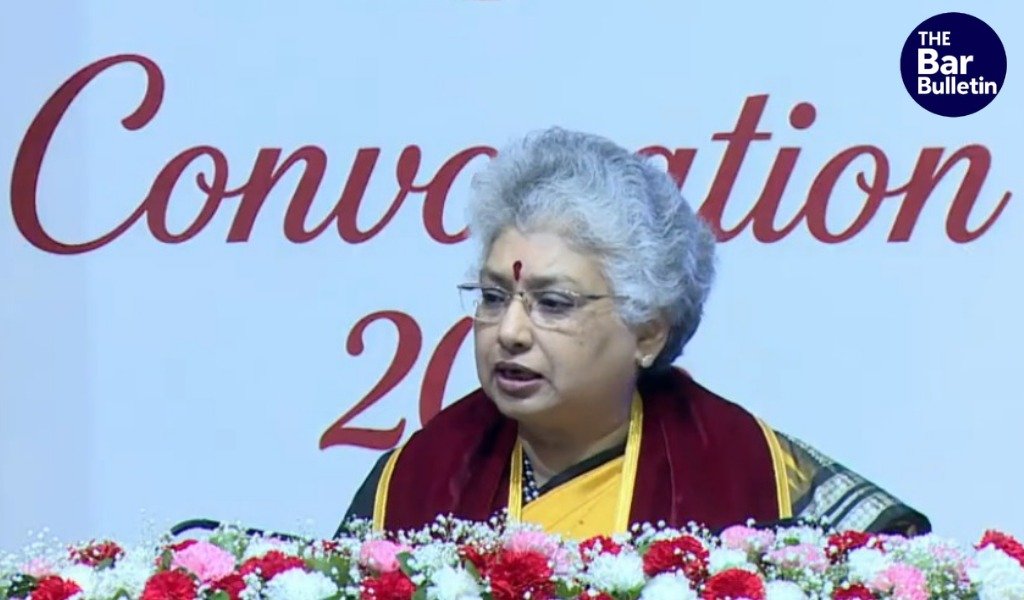

Supreme Court Judge Justice B.V. Nagarathna has called on Bar Councils to introspect on their role in upholding professional ethics, morality and competence, while urging members of the Bar to “take a stand” and speak in a singular voice on sustaining the justice delivery system. Addressing the 13th Convocation of National Law University Delhi, for the B.A. LL.B. (Hons.) and Ph.D. programmes, she said the Bar must also reflect on its usefulness to litigants, its role in safeguarding democracy and upholding the majesty of courts, warning that lapses by the Bar could have a deep impact on India’s political and civic life.
She also made a pointed observation on the standing of Bar Councils within the profession, saying, “When a bar council does not earn the respect of its members it is not a good sign for the legal profession.” Justice Nagarathna said the legal profession had historically played an important role in the country’s freedom struggle and therefore lawyers today too had a responsibility to take a stand on issues affecting the justice system.
“
“The bar in India must think about the usefulness to the litigant public, its role in safeguarding democracy and in upholding the majesty of courts of law and its indispensability in upholding justice and rule of law. The bar councils, whether the central or the states, must introspect on their role and importance in upholding professional ethics, morality and professional competence.
When a bar council does not earn the respect of its members it is not a good sign for the legal profession. As a legal system is bought down by the pendency, delays, costs and uncertainily, the bar in india must rise and speak in a singular voice as to how it could sustain the system of justice dispensation in India.
Just as the members of the legal profession rose to participate in our struggle for freedom and independence, I think the time has now come for each of its members to take a stand. Any lapse or errors of the bar will have a deep impact on our political and civic life, hence their importance in our society. I humbly urge every member of the bar to change their mindset and endure to work for their clients as a public service or else they lose their relevance in the future to come. I do not want to live to see that day.”
She further urged graduating law students to see the legal profession as more than a means of earning a livelihood, stressing its role in public service, the rule of law and constitutional democracy. Justice Nagarathna said legal training gives lawyers a special kind of power to interpret, argue, persuade and decide, but that this power comes with a corresponding responsibility to use it for public good.
“
“As you receive your degree, you are not merely being conferred a personal achievement, you are taking on a collective responsibility. In these days of fast-growing commerce and increasingly lucrative opportunities, it is easy to forget that a life in law is one rendered in public service. Legal training equips you with a special kind of power, the power to interpret, to argue, to persuade and to decide. But with this power comes a trust, a trust that you will use your skills not just in pursuit of private gain, but in service of public good.”
She asked the graduates to be guided by their ethical and constitutional responsibilities when confronted with difficult professional choices, particularly where the law may be silent or contested. Justice Nagarathna also emphasised that a lawyer’s duty does not end with following a client’s instructions. She said lawyers must sometimes advise clients against pursuing courses of action that are legally untenable or contrary to the rule of law.
“
“There will be times when the easier choice might seem expedient, where convenience might tempt you to look away from the harder questions. In those moments, I urge you to pause, reflect on your duties as professionals and citizens within the Constitution and ask, what does justice require of me here? What is the fair and principled course? Is my conduct aligned with constitutional values?…But a lawyer cannot be reduced to a person who sells legal knowledge by the hour. A client may instruct you but there will be occasions when your duty will be to tell a client that the course of action they want to pursue is unwise, legally untenable and neither in their own interests or in the interest of the rule of law.”
Describing the legal profession as an “office of trust”, she said lawyers have obligations both towards their clients and towards the institutions within which they practise. She further spoke about the importance of devotion to duty, distinguishing it from simply being diligent or conscientious. For Justice Nagarathna, devotion involves accepting an obligation because the cause itself is worth serving, irrespective of personal gain or loss.
Justice Nagarathna also urged the graduating students to develop a broader understanding of Alternative Dispute Resolution. She said the lawyer’s role should not be confined to identifying a client’s legal position, but should extend to understanding the actual problem the client wants resolved. She said this approach makes a lawyer more effective by shifting the focus from simply winning a legal dispute to identifying what the client actually needs. She also encouraged young lawyers to learn negotiation, settlement drafting and practical aspects of arbitration and mediation.
Justice Nagarathna also addressed the changing nature of legal work in the age of artificial intelligence. She said routine research and drafting would become faster and information would become cheaper, but this would make judgement, rather than mere knowledge, increasingly valuable.
“
“The premium on merely knowing things will therefore decline. However, the premium on judgement will remain intact no matter where AI comes to. And judgement is built by seeing the whole dispute and sizing it up, not merely the proposition of law contained within it…If arguing before a court of law, ensure that fake judgments obtained through AI are not cited. Don’t fall prey to hallucination. Use your judgement to cite the correct decisions before the courts of law.”
She also underlined the importance of an independent Bar in a constitutional democracy, arguing that its independence exists not for the benefit of lawyers themselves but because democracy requires professionals capable of acting without seeking permission from the State, the market or even their own clients. Justice Nagarathna concluded by reminding the graduates that their new professional status carries a larger constitutional responsibility, describing them as officers of the court and stewards of the Constitution.