
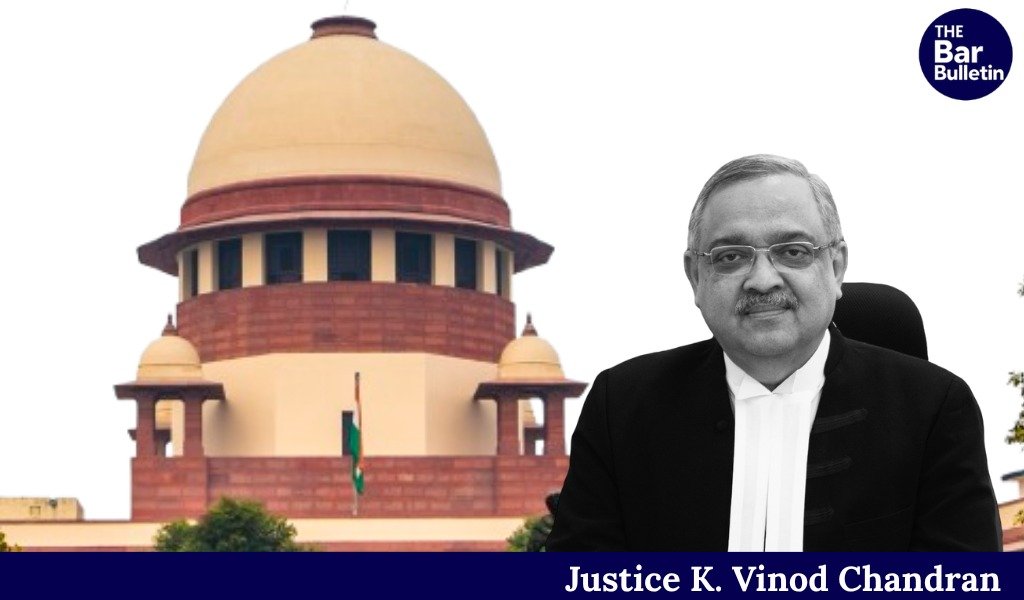

JusticeK. Vinod Chandran has dissented from the Supreme Court’s decision to modify the mandatory three-year practice requirement for entry-level judicial service, holding that there was no ground to review the earlier judgment prescribing three years’ practice before appearing for the Civil Judge (Junior Division) examination.
Notably, the three-judge bench of Chief Justice Surya Kant, Justice AG Masih and Justice K Vinod Chandran has heard the review petition challenging the 3-year mandatory practice ruling of May 2025. The majority view of CJI and Justice AG Masih has modified the earlier judgment, permitting all law graduates to apply during the transitional period up to March 31, 2027, while deeming them to have completed one year of practice. Selected candidates will undergo one year of intensive Judicial Academy training followed by one year of structured clerkship, with the latter split between the District Judiciary and a sitting High Court Judge.
From April 1, 2027, candidates will be required to have at least one year of actual Bar practice, followed by the same one-year training and one-year clerkship after selection.
Justice Chandran, however, said he was unable to persuade himself that a review of the earlier decision of a three-judge Bench was warranted. He emphasised that the requirement of practical exposure at the Bar was necessary before a law graduate could embark on a judicial career.
His principal objection was that judicial service cannot be equated with other public services. Unlike executive officers, a judicial officer exercises independent adjudicatory functions, including recording and analysing evidence and delivering judgments, without administrative supervision over those judicial acts.
On the argument that young lawyers receive little meaningful courtroom work during their initial years, Justice Chandran disagreed. He explained that Bar experience involves much more than arguing cases, including exposure to files, drafting, research, cross-examination and observing court proceedings.
“
“when a senior lawyer or litigant would not entrust a case to a lawyer who is fresh out of college, will it be safe to entrust such persons with the decision-making process in a case; when even legal services require an amount of experience to ensure; not mere representation, but quality assistance….No training schedule, before or after recruitment, can give a budding jurist; be it a lawyer or a judge, the feel of the life and its worries, throbbing in every brief; which she experiences in practise.”
He further relied on the earlier All India Judges’ Association & Ors. v. Union of India & Ors., (1993) 4 SCC 288, to stress that first-hand experience of the justice system cannot simply be substituted by academic knowledge or pre-service training.
Also Read: 3 Years to 1 Year: SC Relaxes Practice Requirement For Entry-Level Judicial Service
Justice Chandran also disagreed with the majority’s newly prescribed two-year post-selection training and clerkship model for candidates with one year of practice. He noted that such trainees would initially receive reduced remuneration, while courts could remain unmanned and vacancies remain unfilled during the training period. He also flagged the possibility of creating different classes of recruits depending on their prior experience.
While concurring with the Chief Justice that some prior experience of court functioning is desirable, he rejected the “via media” adopted by the majority to reduce the effective practice requirement and compensate through post-selection training.
Justice Chandran observed that the majority of High Courts continued to regard Bar experience as imperative and said that law graduates should have exposure to the affairs of man and the travails of a litigant before deciding their destinies. In a particularly pointed observation, he said:
“
“The forensic and analytical skills of an adjudicator are better learnt in the profession by observing what happens in the Courts… the Court room being the most profound of all classrooms…A Presiding Officer’s mistake puts to peril a litigant, and her remedy is only by way of an appeal. A lawyer’s mistake can be remedied by an experienced Presiding Officer, a seasoned Senior or an astute colleague, or even by a ministerial staff of the Court with first-hand experience of the proceedings. The requirement of experience is the need of the hour and essential in the immediate future, otherwise we would be accused of creating a cadre of careerists rather than of jurists capable of enriching a robust system, alive to the needs of the nation, society and its people.”
He concluded that the requirement of experience remained necessary to prevent the judicial system from producing “a cadre of careerists rather than of jurists” and, with “profound respect and intense regret,” disagreed with the majority. He held that the review petitions ought to be dismissed.
