
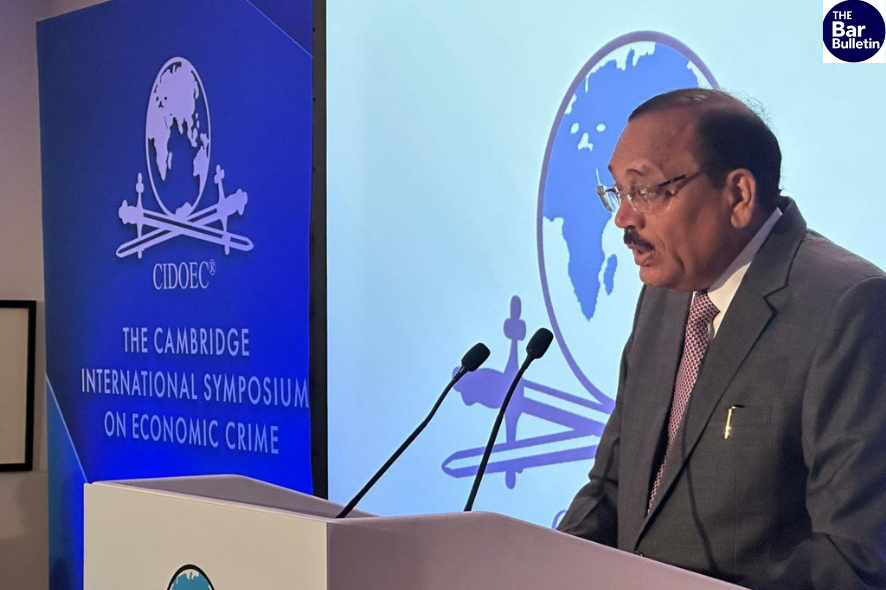

Supreme Court Judge Justice Suryakant has called for stronger international cooperation to trace, freeze and recover proceeds of economic crime, stressing that illicit wealth frequently moves across jurisdictions and cannot be effectively tackled by countries acting in isolation.
Delivering the Closing Address at the 43rd International Symposium on Economic Crime in Cambridge, Justice Suryakant said economic crime is not a new phenomenon, but has evolved alongside commerce, technology and financial systems. He noted that while the scale of illicit wealth generated globally is enormous, the proportion ultimately recovered remains very small.
Justice Suryakant highlighted the importance of the principle of “taking the profit out of crime”, referring to the jurisprudential maxims fraus omnia corrumpit fraud vitiates everything it touches and nemo debet locupletari ex aliena jactura, no one should be enriched by another’s loss.
Speaking about India’s legal framework, he outlined the mechanisms under the Prevention of Money Laundering Act, 2002 (PMLA) for tracing, provisionally attaching and ultimately confiscating proceeds of crime. He also referred to the Fugitive Economic Offenders Act, 2018, which seeks to prevent individuals accused of serious economic offences from defeating the legal process by remaining outside India.
Justice Suryakant acknowledged the importance of procedural safeguards while dealing with economic offences and highlighted the judiciary’s role in ensuring that investigative powers are exercised within the framework of due process. Referring to recent Supreme Court decisions, he emphasised the need to balance effective investigation with constitutional protections.
He also addressed the growing threat of digital arrest scams, noting the Supreme Court’s intervention in the matter and the need for legal and institutional responses to emerging forms of financial fraud.
On victim restitution, Justice Suryakant highlighted the importance of ensuring that victims do not have to wait indefinitely for criminal proceedings to conclude before pursuing recovery of their assets. He observed:
“
“The victim’s restitution need not be held hostage to the pace of the prosecutor’s case.”
Turning to the international dimension of economic crime, Justice Suryakant observed:
“
“Illicit wealth, after all, rarely stays where it was stolen.”
He stressed that the movement of illicit assets across borders makes international cooperation indispensable. He highlighted the role of Mutual Legal Assistance Treaties (MLATs) and other mechanisms of cross-border cooperation in tracing and recovering assets and returning them to the jurisdiction from which they originated.
Justice Suryakant further emphasised that no jurisdiction, regardless of the strength of its institutions or resources, can effectively pursue economic crime alone. He pointed to mechanisms including non-conviction-based forfeiture, unexplained wealth orders, beneficial ownership registries and financial intelligence sharing as tools that can strengthen the global response to illicit wealth.
He also stressed that the effectiveness of a legal system should ultimately be assessed by whether the gap between its legal promises and their delivery narrows progressively through cases and judgments.
Concluding his address, Justice Suryakant said the response to economic crime must be founded on vigilance, cooperation and the Rule of Law, and called for greater collective efforts to ensure that criminal proceeds do not remain beyond the reach of justice merely because they have crossed a national border.