
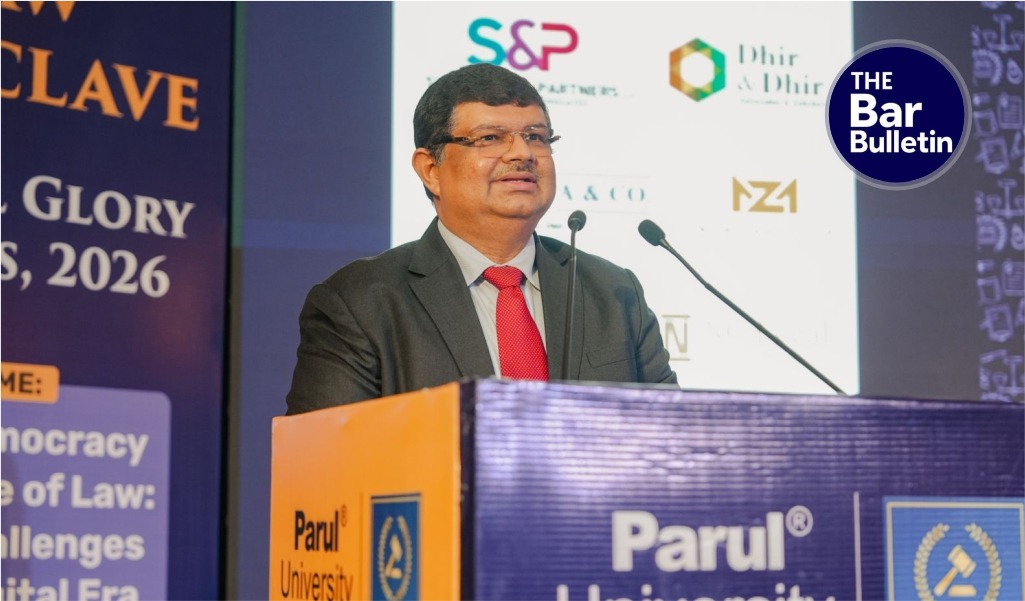

Delivering the valedictory address at the Law Conclave 2026 organised by Parul University, Justice Tejas Karia called for a constitutional approach to addressing the challenges posed by the rapidly evolving digital ecosystem, observing that the most significant legal questions of the future would increasingly arise from data governance, artificial intelligence, digital rights and algorithmic decision-making.
Speaking on the theme ‘Data, Democracy and Rule of Law: Legal Challenges in the Digital Era’, Justice Karia said that information has become “the defining force of the twenty-first century” and that data now functions as the “lifeblood of contemporary society”. While technological advancement has created unprecedented opportunities for innovation, governance and economic growth, he cautioned that it has simultaneously concentrated informational power in the hands of governments, private corporations and digital platforms, giving rise to complex constitutional and legal concerns.
Describing information power as “one of the most significant forms of authority in modern society”, Justice Karia emphasised that the rule of law exists to ensure that every form of power remains subject to constitutional restraint. “That principle cannot be diminished merely because the power is in digital form,” he said, adding that “the greater the concentration of power, the greater the need for constitutional safeguards.”
Justice Karia observed that modern democracies are no longer confronted with a scarcity of information but with its overwhelming abundance, coupled with the growing influence of digital platforms and artificial intelligence in shaping public discourse and human behaviour. He stressed that legal frameworks must evolve to address issues such as misinformation, online accountability, cross-border cybercrime, algorithmic bias and platform regulation, while simultaneously protecting privacy, freedom of expression and democratic values.
Referring to the Digital Personal Data Protection Act, 2023, Justice Karia described the enactment of a statutory data protection framework as a significant step towards recognising the rights of individuals and defining the responsibilities of data fiduciaries. However, he noted that the true constitutional test would lie in its principled implementation, requiring a careful balance between privacy, innovation, transparency and legitimate governmental objectives.
On artificial intelligence, Justice Karia acknowledged its transformative potential in fields such as healthcare, education, public administration and even judicial administration, where technological tools are improving efficiency and accessibility. At the same time, he cautioned that algorithmic systems cannot be permitted to function without accountability, observing that
“
“the rule of law cannot accept accountability without explanation and algorithms cannot become immune from scrutiny simply because they are technologically sophisticated.”
Concluding his address, Justice Karia urged law students and young lawyers to prepare for a legal landscape increasingly shaped by emerging technologies. He reminded them that while technology would continue to evolve, constitutional values must remain constant, stating that “the technology may be new, but the values that must drive your response remain timeless.”