
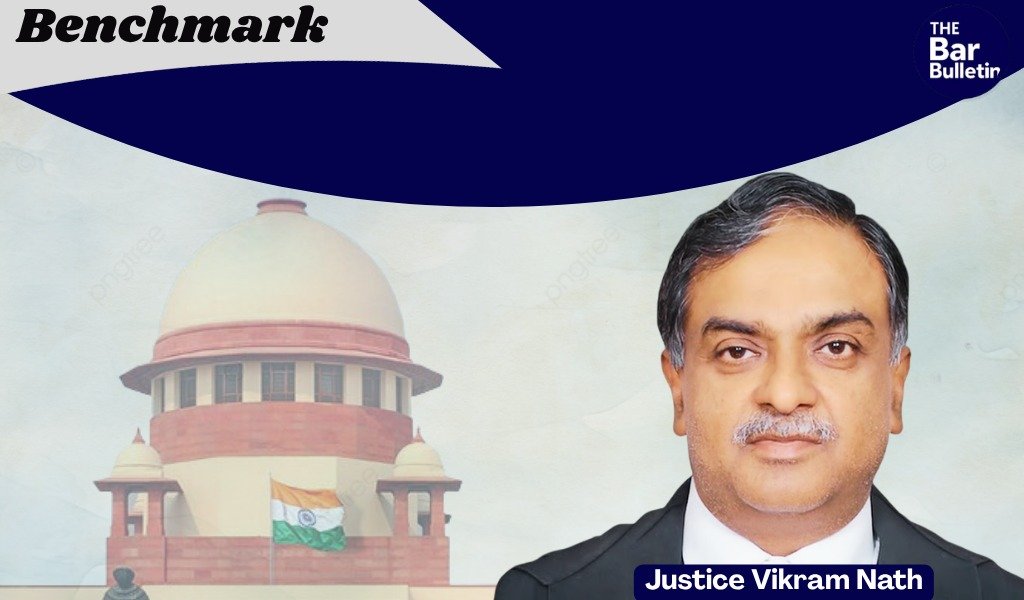

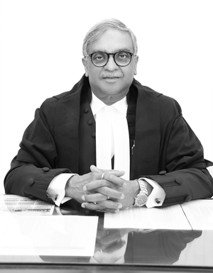
Justice Vikram Nath is a prominent judge of the Supreme Court of India, widely recognized for his broad-based jurisprudence spanning constitutional law, criminal justice, and institutional reform, built on a legal career that spans nearly four decades and four generations of his family. Justice Nath’s judicial philosophy is characterized by a commitment to substantive equality in affirmative action, a nuanced approach to juvenile culpability that distinguishes cognitive awareness from emotional maturity, and a firm insistence on procedural fairness as well as finality in the administration of justice.
Early Life and Education
Justice Nath was born on 24-09-1962 in Kaushambi, Uttar Pradesh, India. He hails from a family of lawyers, being the fourth generation in his family to pursue law. He graduated in Science in 1983 and obtained his degree in law from the Lucknow University in 1986. Thereafter, on 30-03-1987, Justice Vikram Nath enrolled with the Bar Council of Uttar Pradesh and practised as an advocate at the Allahabad High Court for over 17 years.
Judicial Career
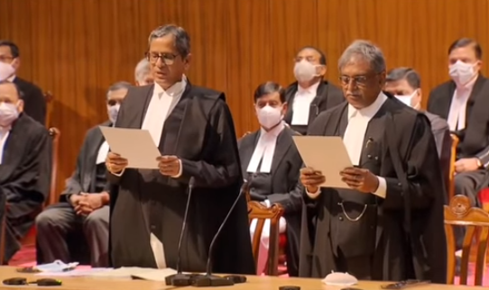
On 24-09-2004, Justice Vikram Nath was elevated as an Additional Judge of the Allahabad High Court and took oath as a permanent judge on 27-02-2006. After serving for 15 years, he was appointed as the 26th Chief Justice of the Gujarat High Court on 10-09-2019. Notably, during his tenure at the Gujarat High Court, he introduced live-streaming of court proceedings, making him the first Chief Justice of a High Court in India to do so. This was an important step toward using technology to enhance transparency and public access to judicial proceedings. On 31-08-2021, Justice Nath was elevated as a Judge of the Supreme Court of India. He is likely to serve as the Chief Justice of India before his retirement in 2027.
Administrative and Institutional Roles
Beyond adjudication, Justice Nath has held significant administrative responsibilities in the administration of justice and the legal-services framework. He served as Chairman of the Supreme Court Legal Services Committee and has served as Chairperson of the e-Committee of the Supreme Court of India, overseeing the use of information and communication technology across the Indian judiciary since May, 2025. On 24-11-2025, Justice Nath assumed office as the Executive Chairman of the National Legal Services Authority (NALSA). He also serves as Chairman of the Mediation and Conciliation Project Committee, which works toward developing and strengthening mediation as a mode of dispute resolution.
Notable Judgments
Barun Chandra Thakur v. Master Bholu & Anr. [2022 SCC OnLine SC 870]
A Division Bench of Justice Vikram Nath and Justice Dinesh Maheshwari formulated critical legal directives regarding how juveniles aged 16 to 18 accused of heinous crimes should be assessed under Section 15 of the Juvenile Justice (Care and Protection of Children) Act, 2015. They also held that the mental capacity and the ability to understand consequences of acts are not the same. It was stated that a child may be aware of the consequences of their actions but lacks the emotional competence to control them.
Union of India v. M/s Union Carbide Corporation [2023 INSC 222]
As a key member of the 5-Judge Constitution Bench alongside Justice S.K. Kaul, Justice Sanjiv Khanna, Justice Abhay S. Oka, and Justice J.K. Maheshwari, Justice Vikram Nath dismissed the central government’s curative petition seeking an additional ?7,844 crore ($1.2 billion) from Union Carbide Corporation. It was reinforced that a decades-old settlement cannot be unilaterally reopened, particularly when the Union of India failed to offer a sufficient legal rationale or prove a fresh operational fraud.
CBI v. Dr. R.R. Kishore [2023 INSC 817]
Writing for a five-judge Bench, Justice Nath authored the judgment holding that the striking down of Section 6A of the Delhi Special Police Establishment Act, 1946, which had granted immunity to senior bureaucrats for corruption offences, applies retrospectively from the date of the provision’s insertion.
State of Punjab v. Davinder Singh [2024 INSC 562]
A seven-judge Constitution Bench comprising Justice Dr. DY Chandrachud (CJI), Justice B.R. Gavai, Justice Bela M. Trivedi, Justice Pankaj Mithal, Justice Manoj Misra, Justice Satish Chandra Sharma, and Justice Vikram Nath held by a 6:1 majority that sub-classification of Scheduled Castes among reserved categories is permissible, to grant separate quotas for the more backward groups within the SC category. Justice Bela M. Trivedi dissented, holding such sub-classification impermissible, while Justice Gavai’s opinion additionally held that the ‘creamy layer’ exclusion principle should also apply to SCs and STs. Justice Nath joined the majority opinion.
Vasanta Sampat Dupare v. Union of India [2025 INSC 1043]
Sitting with Justices Sanjay Karol and Justice Sandeep Mehta, Justice Vikram Nath upheld an accused’s right to have a sentence re-examined under Article 32 and set aside the death sentence of an appellant convicted of sexually assaulting and murdering a four-year-old, holding that constitutional remedy under Article 32 remains available where there has been a clear, specific and serious breach of procedure.
Mission Accessibility v. Union of India [2025 INSC 1376]
Justice Nath and Justice Sandeep Mehta issued key directions to the Union Public Service Commission (UPSC) to enhance accessibility for persons with disabilities, including permitting candidates to change the name of their scribe within a reasonable period before the examination.
Rehana Khan v. Rizwan Siddhiquee [2026 INSC 907]
Justice Vikram Nath authored the primary judgment for a three-judge Supreme Court bench, upholding a two-year suspension for advocate Rizwan Siddhiquee and affirming that absolute advocate-client confidentiality remains binding even after a relationship ends or a client becomes hostile. He additionally condemned both parties for prolonging an 11-year dispute and imposed an exemplary cost of Rs.5,00,000 on each participant.
Sujata Kumari & Ors. v. Rahul Kumar & Anr. [2026 INSC 896]
A Division Bench of Justice Nath and Justice Sandeep Mehta ruled that a mother’s independent income cannot automatically justify halving a father’s financial obligation to maintain minor children under Section 125 of the CrPC. The Court highlighted that child maintenance cannot be determined by a strict calculation based solely on parental salaries. Crucially, the Bench emphasized that the daily care, upbringing, and emotional labor provided by the mother, with whom the children reside, constitutes a significant non-monetary contribution that must be factored into the equation.
Padam Mehta & Anr. v. State of Rajasthan & Ors. [2026 INSC 476]
Justice Vikram Nath, presiding alongside Justice Sandeep Mehta on the Division Bench, co-authored this landmark judgment by ruling that a child’s right to receive primary education in their mother tongue is fundamentally protected under the freedom of speech and expression (Article 19(1)(a)). The High Court’s order was set aside and the State government was directed to implement a comprehensive, time-bound policy introducing Rajasthani as a school subject across both government and private institutions.
In Re: “City Hounded by Strays, Kids Pay Price” v. The State of Andhra Pradesh [2026 INSC 506]
Justice Vikram Nath headed the Bench that balanced public safety and animal welfare by ruling that Article 21’s right to life includes freedom from the apprehension of dog attacks. He harmonised statutory protections by mandating the strict nationwide implementation of the Animal Birth Control Rules while ordering the permanent removal of stray dogs from restricted sensitive zones like schools and hospitals.
Prakruthi Jain v. Bar Council of India [W.P. (C) No. 31/2025]
Justice Vikram Nath led the three-judge Bench and played a pivotal role in balancing academic discipline with student welfare. Addressing the “chaos” caused by a lower court ruling that had diluted minimum attendance norms, Justice Nath fiercely defended the standards of legal education while ensuring students weren’t unfairly penalized by sudden regulatory shifts.
STS Gladies v. Bar Council of India & Anr. [2026 SCC OnLine SC 1921]
As part of a Division Bench, Justice Nath issued an interim order granting provisional enrolment as advocates to eligible law graduates. By permitting their entry under strict document verification safeguards, the bench prevented avoidable prejudice to candidates while leaving the final validity of Rule 5 for later adjudication.
A Legacy in Making
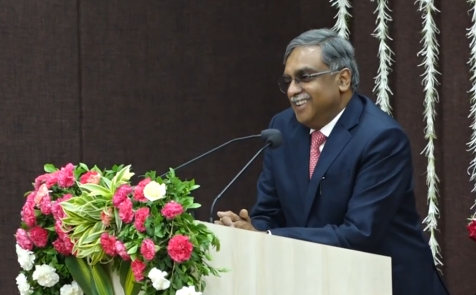
Justice Vikram Nath has been a consistent voice for professional ethics and confidentiality in legal practice. His career reflects a steady arc while his judgments reveal a jurist who is neither doctrinaire nor result-oriented, but attentive to the practical consequences of legal doctrine. Justice Nath’s continuing stewardship of institutions like NALSA and the Supreme Court’s e-Committee suggests that his legacy will extend well beyond individual judgments, into the structural modernization of how justice is delivered and accessed across the country.