
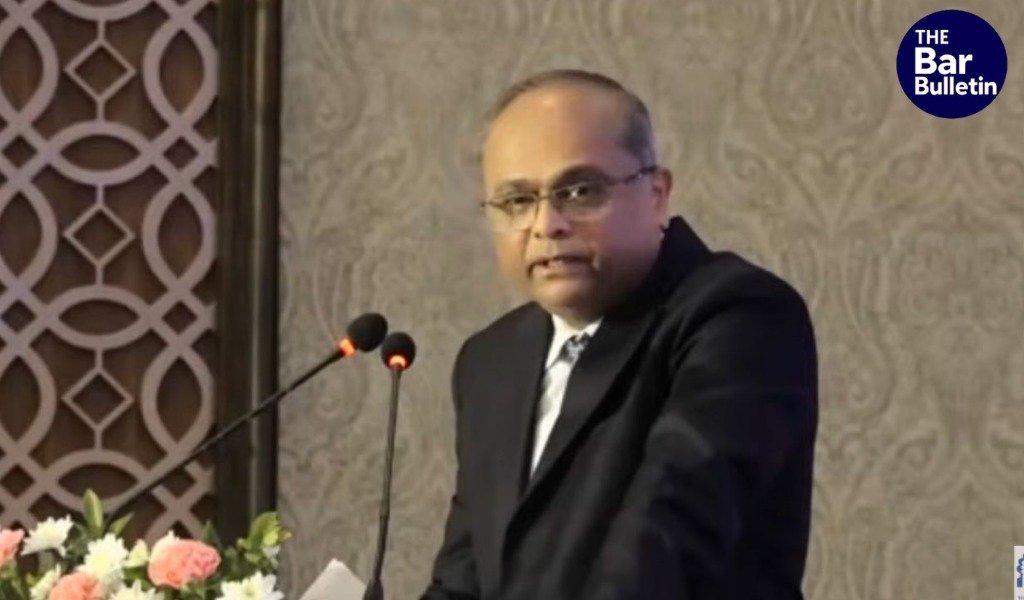

Justice Vipul Pancholi, Judge, Supreme Court said that the future of arbitration in India would depend on the country’s ability to build a dispute-resolution ecosystem that inspires confidence among domestic and international parties.
Speaking at the inaugural ceremony of GHAC Arbitration Week 2026, Justice Pancholi observed that arbitration could no longer be viewed merely as an alternative to litigation, but had become an important component of the architecture of commercial justice. He noted that changing business practices, technology and international commerce had increased expectations from dispute-resolution mechanisms, with parties seeking fairness, speed, certainty, confidentiality and predictability.
“The question before us is not whether arbitration has a future in India. It certainly does. The question is, what will that future look like?”
Justice Pancholi highlighted the evolution of India’s arbitration framework following the 2015, 2019 and 2021 amendments. According to him, the reforms reflected an evolving legislative policy aimed at reducing delays and unnecessary judicial intervention, promoting institutional arbitration and professional standards, and strengthening the framework governing enforcement and the integrity of arbitral awards. However, he stressed that legislation is only the beginning, and that the success of an arbitration regime must ultimately be measured by the confidence it inspires.
He said a party should be able to approach arbitration with the assurance that the rules and process are clear, the tribunal is independent, proceedings are conducted efficiently and the eventual award will receive meaningful and effective enforcement.
On institutional arbitration, Justice Pancholi said strong arbitral institutions provide confidence, procedural discipline and consistency while reducing the burden on courts. He said institutions must continue to evolve and remain efficient without becoming bureaucratic, and must be accessible without compromising sophistication. He highlighted the role of the Gujarat High Court Arbitration Centre (GHAC) in contributing to this objective, noting Gujarat’s position as a major centre of commerce, industry, infrastructure and international business.
Addressing conflicts, disclosure and arbitral independence, Justice Pancholi said an arbitrator’s authority ultimately rests on the confidence of the parties. Disclosure, he observed, is not merely a technical formality but an essential safeguard of procedural legitimacy. At the same time, he cautioned that standards must be applied with intelligence and proportionality, so that every professional or social connection does not automatically become a ground for challenge.
Justice Pancholi also emphasised that an arbitration-friendly judiciary does not mean complete judicial withdrawal.
“
“The real objective is not the absence of judicial supervision. It is disciplined judicial supervision,”
he said, stressing the need for mutual respect between courts, arbitral institutions and the arbitral process.
He further highlighted that efficiency in dispute resolution is itself an element of justice, observing that every unnecessary delay, avoidable procedural complication and uncertainty in enforcement carries a cost for businesses and stakeholders.
Concluding his address, Justice Pancholi called for the discussions during Arbitration Week to translate into institutional reforms and better practices. He said India could aspire to become a preferred seat for international commercial disputes, but this would require sustained commitment from all stakeholders and a legal profession willing to constantly examine and improve itself.
He called for an arbitration ecosystem in which party autonomy is respected, arbitrators are independent, courts are supportive, institutions are professional and awards are effectively enforced.