
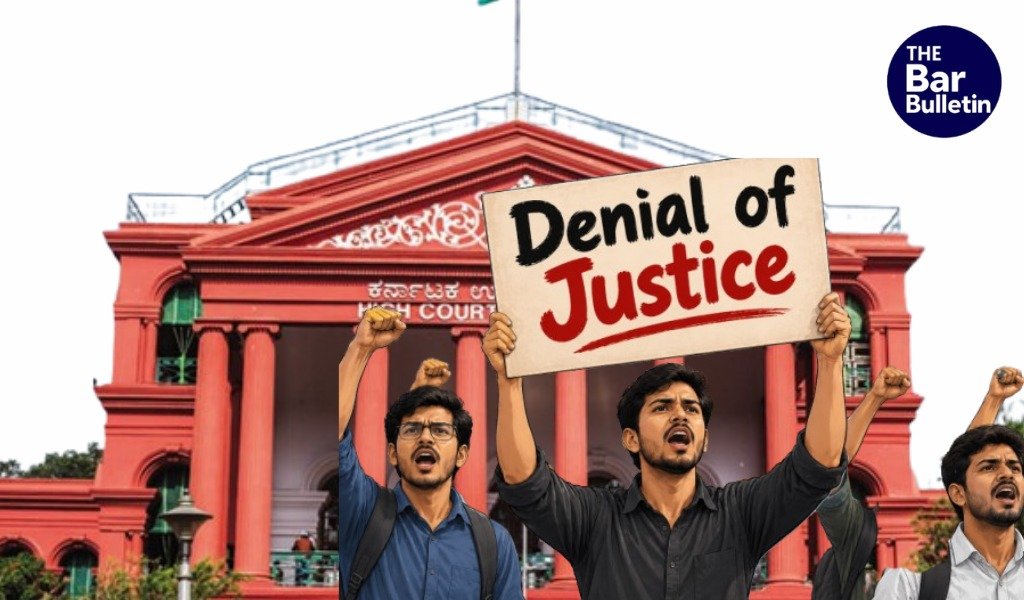

The Karnataka High Court has quashed an FIR registered against 13 men over posters describing a Supreme Court judgment as a ‘denial of justice’ and calling for raising a voice for justice, holding that the slogans constituted dissent protected under Articles 19 and 21 of the Constitution.
Justice H.P. Sandesh allowed the criminal petition and quashed the FIR registered under Sections 153A, 295A and 120B of the Indian Penal Code (IPC), along with Section 3 of the Karnataka Open Place Disfigurement Act, 1951.
A complaint was lodged after posters bearing slogans criticising a Supreme Court judgment were found on roadside walls in Mangaluru. The complaint stated that the posters referred to the Popular Front of India and called the judgment a denial of justice.
The petitioners contended that the slogans did not attract the offences alleged and that the expression of dissatisfaction with a judicial verdict was protected by the constitutional guarantee of freedom of speech and expression. They relied on the Supreme Court’s decision in Javed Ahmad Hajam v. State of Maharashtra, (2024) 4 SCC 156, which discussed the scope of Article 19(1)(a) and the right to dissent in a democracy.
Also Read Gauhati High Court Grants Bail to Zubeen Garg’s Cousin in Singer’s Death Case
Opposing the plea, the State argued that the posters were put up in a public place immediately after the Supreme Court judgment and could create disharmony in the country.
The High Court, however, observed that the slogans merely expressed dissatisfaction with the judgment and stated that justice had been denied. It held that the contents of the complaint did not satisfy the ingredients of offences under Sections 153A and 295A IPC.
Referring to the principles laid down by the Supreme Court, the Court observed that the assessment of whether an expression promotes disharmony or enmity must consider its general impact on a significant number of reasonable people. The possibility that a few individuals might develop hatred or ill will would not, by itself, be sufficient to attract Section 153A IPC.
The Court held that the case was fit for the exercise of its inherent powers under Section 482 of the Code of Criminal Procedure, as the slogans amounted to dissent against a judicial judgment rather than an expression intended to create communal disharmony.
Accordingly, the Court allowed the petition and quashed the FIR against all 13 petitioners.
