
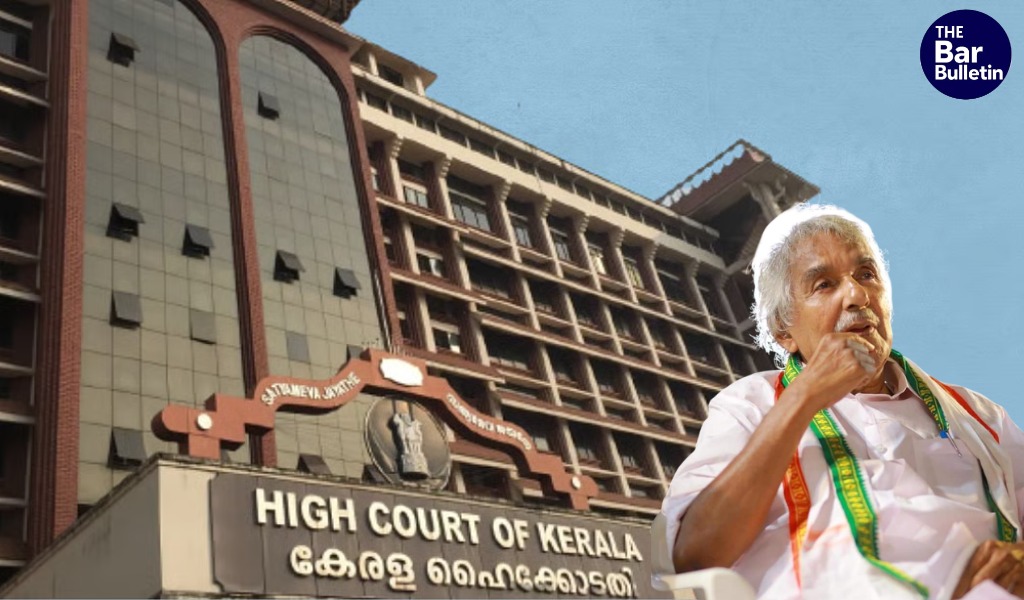

The Kerala High Court has held that elected local body representatives must strictly adhere to the statutory form of oath prescribed under the Kerala Municipality Act and Kerala Panchayat Raj Act, ruling that oaths taken in the names of Mother India, political martyrs, Gurudeva, specific Hindu deities, and former Chief Minister Oommen Chandy were not valid under law.
The Court declared invalid the oaths of 20 Bharatiya Janta Party’s (BJP)Thiruvananthapuram Corporation councillors and Vadakkencherry Grama Panchayat member, directing them to take fresh oaths in the manner prescribed under the relevant statutes.
Justice P.V. Kunhikrishnan was dealing with two writ petitions challenging the validity of oaths administered to councillors of the Thiruvananthapuram Municipal Corporation and a member of the Vadakkencherry Grama Panchayat. The petitioners contended that the statutes permit an elected representative to either swear “in the name of God” or make a “solemn affirmation,” and that deviations from the prescribed form rendered the oath invalid.
The Court noted that several councillors had taken oath in the names of “Bharathamba” (Mother India), “martyrs of my organisation,” Gurudeva, Lord Ayyappa, Sree Padmanabha Swamy and other specific deities, while a Panchayat member swore “by God’s blessing in the name of Oommen Chandy.” Emphasising the significance of the oath-taking process, the Court observed:
“
“Taking an oath by an elected person in a democracy means that the elected person is promising the electorate that he will be honest, he will follow the constitution and the rule of law, and he will serve the people with sincerity. Therefore, when he takes the oath, it should be taken as prescribed by the relevant statute and rules.”
Relying on the Division Bench decision in Haridasan Palayil v. Speaker, Kerala Legislative Assembly [2003 KHC 1078], which held that one of the settled principles of law is that if a particular thing is required to be done in a particular way, it must be done in that way and no other. In that case, it was further held that the Constitution does not permit any deviation. It insists upon strict compliance. A deviation is not a mere irregularity, but it is a manifest illegality.
Justice Kunhikrishnan observed that the statutory forms under both enactments clearly require the oath to be taken either “in the name of God” or by way of a solemn affirmation and that elected representatives cannot alter the prescribed form according to personal or political preferences.
The Court also referred to the principle laid down in Haridasan Palayil that if variations are permitted, “there would be no end to the modifications or variations,” and agreed with the view that oath-taking provisions demand strict compliance.
“
“Before concluding, I am forced to say why we do not call the almighty of all religions with a common name, God? If that happens, there ends the whole problem. We are forgetting the declaration of Sree Narayana Guru, a century back, which says that (One Caste One Religion One God to Humankind). Adi Sankaracharya, born in Kerala, propagated “Advaita Vedanta,” a form of Non-dualism. As per our Constitution, India is a Sovereign, Socialistic, Secular, Democratic Republic. The Constitution provides the right to freedom of religion, including freedom of conscience and the right to freely profess, practice, and propagate religion. It also grants the right to manage religious affairs, among other things. This also includes the right to believe in any God, and the citizen can choose any god of their choice.”
