

The Karnataka High Court (Bengaluru Bench) has held that in cases involving allegations of sexual harassment of students by a teacher, technicalities such as the absence of a board resolution for transfer or the post facto nature of such approval become secondary and cannot override the fundamental duty of institutions to protect the dignity and safety of victims. The post facto approval of transfer of Dr. Ashwin Hebbar from SIMS to Haveri Institute of Medical Sciences cannot be said to be against the law, as extraordinary situations demand extraordinary solutions.
The Court held that a person facing such serious charges of sexual abuse and harassment of his own students must remain suspended until the disciplinary enquiry is completed and an appropriate order of punishment is passed. The order dated Nov 17, 2025 revoking the suspension was cancelled as being unjustified, particularly since the charge sheet had already been issued and the suspension was revoked within four and a half months for gross misconduct.
Further, the Court held that the Director and the Principal Secretary conducted themselves unbecoming of Government servants by protecting the accused and being insensitive to the victims, warranting disciplinary action against both. Accordingly, the order dated Nov 17, 2025 revoking the suspension of Dr. Ashwin Hebbar was cancelled, and he shall remain suspended till the disciplinary enquiry is completed and an appropriate order of punishment is passed. However, he shall remain attached with Haveri Institute of Medical Sciences. Disciplinary action was also recommended against Dr. Virupakshappa V, Director of SIMS, and Mr. Mohammed Mohsin, IAS, Principal Secretary/Additional Chief Secretary, Department of Medical Education. Further, the Department of Personnel and Training, Government of India, and the State Government were directed to take appropriate action against Mr. Mohammed Mohsin.
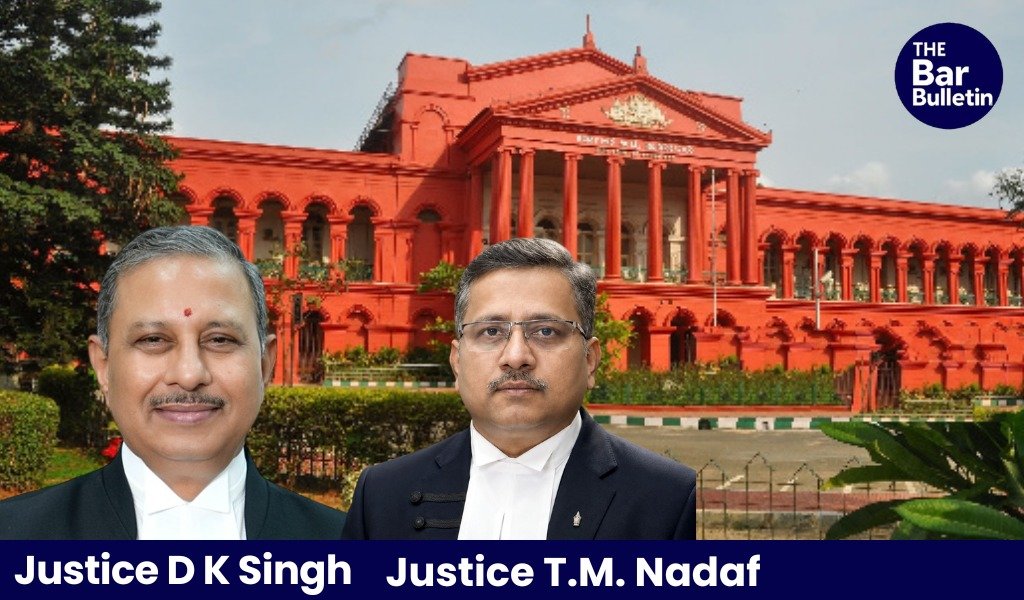
The Division Bench comprising Justice D K Singh and Justice T.M. Nadaf expressed grave concern that the ICC in the first instance forced the complainant to withdraw her complaint of such gross misconduct and sexual abuse, effectively closing the matter without any action against Dr. Ashwin Hebbar, who as a professor was expected to be a guide and protector of his students. The court observed that the professor of a medical college enjoys a dominant position with the power of giving internal examination marks and viva voce, and that students would not complain for fear of their career, defamation, and further humiliation.
The court noted that no departmental enquiry was ever held against Dr. Ashwin Hebbar for the first incident, and that having been emboldened by the interim order and the writ court’s judgment quashing his suspension, he went on to sexually harass another student within less than a year. The court observed that only two complainants could muster the courage to come forward and that there could have been several other victims.
The court found the Director’s recommendation dated Oct 06, 2025 to be a glowing encomium that deliberately omitted any reference to Dr. Ashwin Hebbar’s past and present misconduct, the ICC findings, the FIR, or his arrest. The Director cited Dr. Ashwin Hebbar’s 1,029 surgeries, 19 publications, and his role as unit head under NMC guidelines as grounds for reinstatement, and even invoked the cause of poor and backward community patients to justify revocation of suspension. The court observed that Dr. Ashwin Hebbar appeared to be a well-connected and powerful person who had secured letters from political persons and NGOs in his favour.
The court noted that the Principal Secretary, Mr. Mohammed Mohsin, had withheld in his affidavit the fact that he himself had directed the Director to make the recommendation for revocation, and later tried to shift the blame entirely onto the Director. The Director, in turn, explained that he had acted on the Principal Secretary’s direction and relied on a State Government notification dated Nov 25, 2020 referencing Rule 10 of the Karnataka Civil Services (Classification, Control and Appeal) Rules, 1957, which provides that an employee cannot be kept under suspension for more than six months without review.
The court examined Rule 10(5)(b) of the Karnataka Civil Services (Classification, Control and Appeal) Rules, 1957, which provides that if a departmental inquiry is not commenced or a charge sheet is not filed within six months from the date of suspension, the competent authority must review the suspension. However, the court noted that in the present case the charge sheet had already been issued on Nov 12, 2025, and therefore there was no occasion for withdrawing the suspension within four and a half months for such gross misconduct.
The court observed that both the Director and the Principal Secretary had been totally insensitive to the honour, dignity, and trauma of the girl students subjected to sexual abuse, and had themselves committed gross misconduct by protecting an accused facing charges of sexually abusing his own students. The court also criticised the writ court for being insensitive in staying the transfer of Dr. Ashwin Hebbar without any concern for how the victims would feel facing him every day in the institution.
Briefly, Dr. Ashwin Hebbar, an Associate Professor in the Department of General Surgery at Shimoga Institute of Medical Sciences (SIMS), faced two separate complaints of sexual harassment, the first in 2022 by a former MBBS student and Junior Resident, Dr. A, who alleged that he squeezed her chest when she visited him to enquire about postgraduate education, and the second in 2025 by Dr. P, a second-year postgraduate student, who alleged that he inappropriately touched her thigh and held her hand under the table during a department dinner party at a hotel in Shimoga.
In the first instance, the Internal Complaint Committee (ICC) under the POSH Act, instead of proceeding with enquiry, forced the complainant to withdraw her complaint and closed the matter, prompting Dr. A to approach the Deputy Commissioner the very next day seeking re-enquiry. A Local Committee was constituted which found the allegations prima facie established, leading to Dr. Ashwin Hebbar’s suspension. However, the writ court quashed the suspension order on June 19, 2024 on the ground that the Local Committee could not have been constituted under Section 10(4) of the POSH Act and that no departmental proceedings had been initiated.
In the second instance, an FIR was registered under Section 75(2) of the Bharatiya Nyaya Sanhita, 2023 and Sections 3(1)(w)(i) and 3(2)(va) of the SC/ST (Prevention of Atrocities) Amendment Act, 2015. Dr. Ashwin Hebbar was arrested on June 26, 2025, remained in judicial custody till July 04, 2025, and was placed under suspension on July 03, 2025. The POSH Committee, in its interim report dated 03.07.2025 and final report dated Aug 05, 2025, found the allegations prima facie true, noting that witnesses had observed the harassment and that Dr. Ashwin Hebbar had even called a colleague requesting him to testify on his behalf.
Despite the gravity of the charges, the Director of SIMS, Dr. Virupakshappa V, wrote a glowing recommendation on Oct 06, 2025 for revocation of suspension, praising Dr. Ashwin Hebbar’s surgical output, publications, and indispensability to the institution, without mentioning his past or present misconduct, the ICC findings, or the FIR. The Principal Secretary, Mr. Mohammed Mohsin, IAS, who had himself directed the Director to make this recommendation, passed the order dated Nov 17, 2025 revoking the suspension and transferring Dr. Ashwin Hebbar to Haveri Institute of Medical Sciences, all within four and a half months of suspension and despite the charge sheet having already been issued on Nov 12, 2025.
