
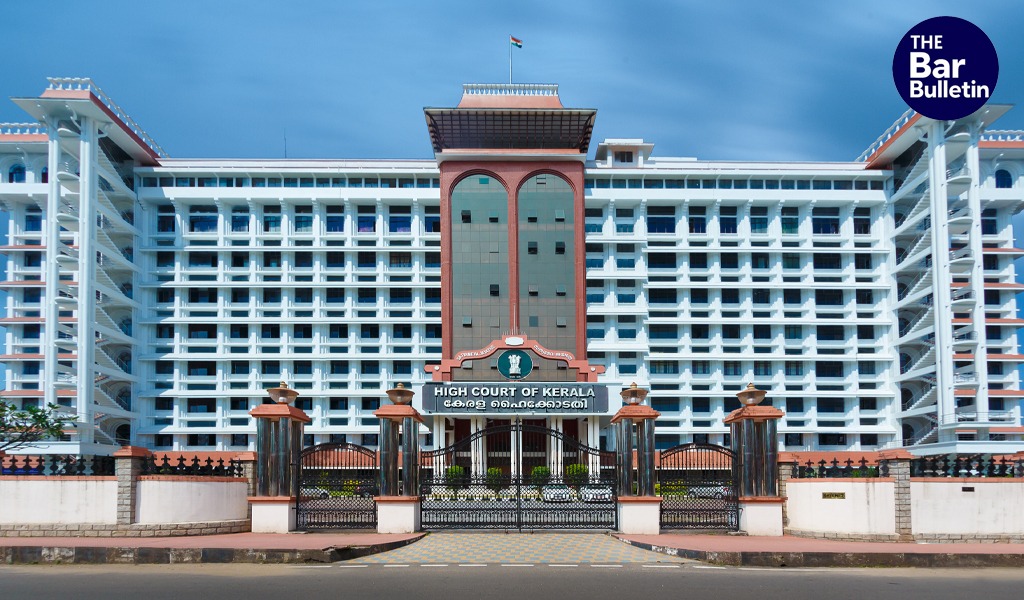

The Kerala High Court (Ernakulam Bench) has held that Section 36AAA of the Banking Regulation Act does not require RBI to grant a personal hearing before superseding the Board of a co-operative bank, because the Legislature deliberately omitted such a requirement from that provision while expressly including it in Section 36AA. Secondly, the proviso to Section 36AAA(1) makes consultation with the concerned State Government mandatory, and consultation only with the Registrar of Co-operative Societies is not sufficient compliance. Any order passed without such consultation is legally unsustainable.
The Court also affirmed that RBI is legally competent to supersede the managing committee of a co-operative bank under the Banking Regulation Act even if that committee is democratically elected under the State co-operative law.
A Single Judge Bench of Justice M.A. Abdul Hakhim observed that although orders causing civil consequences ordinarily attract the requirement of a hearing, the statutory scheme here was different. The Bench noted that Section 36AA expressly provides a reasonable opportunity of representation before removal of managerial persons, whereas Section 36AAA, dealing with supersession of the Board of a co-operative bank, contains no such requirement. The omission was treated as deliberate, and the Bench held that a hearing cannot be read into Section 36AAA.
The Bench referred to the Bombay High Court’s decision in Sandeep S. Ghandat vs. Reserve Bank of India [2024 SCC OnLine Bom 3584], and agreed that importing natural justice into Section 36AAA would defeat the purpose of the provision, because RBI is expected to act swiftly in public interest, to protect depositors, and to prevent further deterioration or mismanagement in the affairs of a co-operative bank. It also found that in the present case, RBI had first inspected the Bank, then issued regulatory restrictions, and only thereafter passed the supersession order with written reasons.
On the consultation requirement, the Bench drew a clear distinction between the “State Government” and the “Registrar of Co-operative Societies.” It held that while the Registrar may be a competent officer in matters concerning co-operative societies, consultation with the Registrar is not the same as consultation with the State Government when the statute specifically requires consultation with the State Government. The Bench said that where a statute prescribes that an act must be done in a particular manner, it has to be done in that manner alone.
The Bench further held that the competent authority for such consultation was the State Government represented by the Secretary of the Co-operation Department, and not the Registrar, who is hierarchically subordinate to the Government under the Kerala Co-operative Societies framework. It also clarified that the State Government’s failure to object later was irrelevant, because mandatory prior consultation itself was the statutory requirement.
On RBI’s power to supersede an elected committee, the Bench rejected the petitioner’s democratic-governance objection. It held that in the case of co-operative societies carrying on banking business, the Banking Regulation Act also applies, and RBI has independent authority under Section 36AAA to supersede the Board of Directors. The democratic structure under the Kerala Co-operative Societies Act does not immunise a co-operative bank from RBI action under the central banking law.
Briefly, a petition was filed by M.P. Jackson, the former President of Irinjalakuda Town Co-operative Bank, challenging the RBI’s order dated Oct 07, 2025 issued under Section 36AAA read with Section 56 of the Banking Regulation Act, 1949, by which the Bank’s Board of Directors was superseded and an Administrator was appointed for one year, from Oct 07, 2025 to Oct 06, 2026.
The background was that RBI had conducted an inspection of the Bank with reference to its financial position as on March 31, 2022 and found several irregularities. Thereafter, RBI issued All-Inclusive Directions on July 29, 2025 under Section 35A of the Banking Regulation Act, imposing regulatory restrictions for six months from July 30, 2025. The Bank later sought permission to sell its non-banking assets to improve its financial position, and RBI clarified on Sep 24, 2025 that the AID did not prohibit such sale. However, despite this, RBI proceeded to pass the supersession order under Section 36AAA.
The petitioner challenged the RBI order on three grounds: first, that the order was passed in violation of principles of natural justice without giving a hearing; second, that Section 36AAA required consultation with the State Government, but RBI had only consulted the Registrar of Co-operative Societies; and third, that RBI could not displace a democratically elected managing committee of a co-operative bank without recourse to the Kerala Co-operative Societies Act.
The RBI opposed the petition by arguing that Section 36AAA does not provide for a prior hearing, unlike Section 36AA, and therefore natural justice cannot be read into the provision. RBI also argued that consultation with the Registrar of Co-operative Societies was sufficient compliance with the requirement of consultation with the State Government, and further maintained that it had full authority under the Banking Regulation Act to supersede the managing committee of a co-operative bank where its affairs warranted such intervention.
