
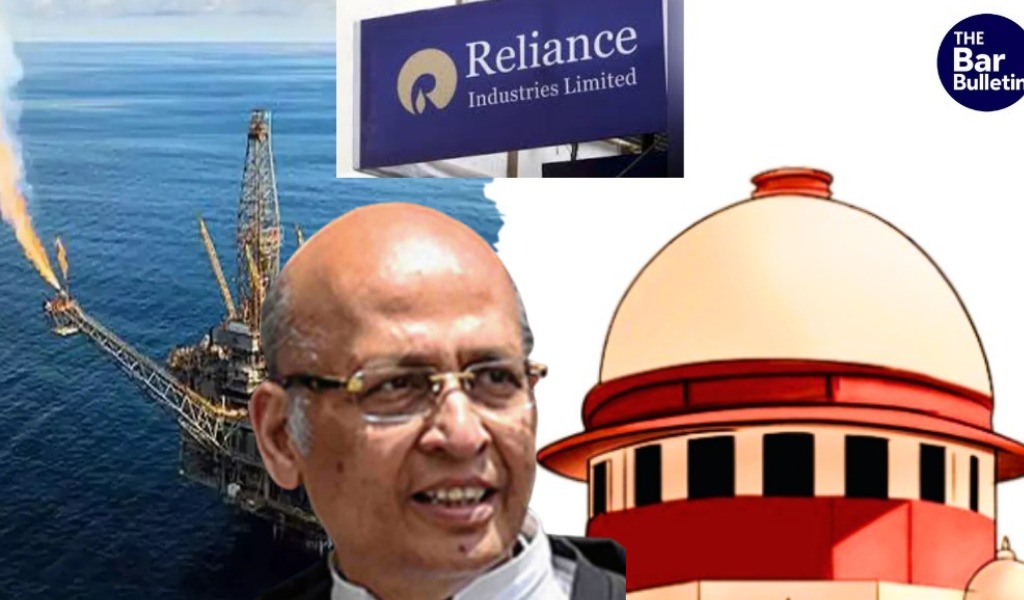

Senior Advocate Abhishek Manu Singhvi on Thursday assailed the Delhi High Court division bench judgment setting aside an arbitral award in Reliance Industries’ favour in the KG-D6 gas migration dispute, arguing before a Bench of Chief Justice Surya Kant, Justice Joymalya Bagchi and Justice Vipul M Pancholi that the High Court impermissibly imported constitutional doctrines into a contractual arbitration dispute.
Also read- Supreme Court Hears Reliance, BP and NIKO Appeal in KG-D6 Gas Migration Dispute
https://thebarbulletin.com/supreme-court-hearing-kg-d6-gas-migration-dispute-appeals/
Appearing for Reliance Industries, Dr Singhvi argued that the division bench wrongly invoked Article 297 of the Constitution and the public trust doctrine to overturn concurrent findings of the arbitral tribunal and the single judge, despite neither principle prohibiting the extraction of migrated gas under the production sharing contract (PSC).
He contended that the Government of India’s policy framework itself was designed to maximise exploitation of natural resources without public investment, with the contractor bearing both capital risk and operational cost. “The policy is a very good policy of the Government of India to exploit our natural resources to the full without investing money and risk. Risk is mine, money is mine,” Dr Singhvi submitted.
He argued that while ownership of offshore natural resources under Article 297 indisputably vests in the Union, the constitutional provision could not be used abstractly to invalidate contractual arrangements made under that very framework. He submitted that the arbitral tribunal had expressly examined whether any clause of the PSC violated Article 297 and found none, whereas the division bench reversed the award without identifying any specific contractual breach of constitutional mandate.
Defending the arbitral award’s reasoning, Mr Singhvi submitted that the tribunal had correctly held that the PSC permitted extraction of gas that had naturally migrated into Reliance’s contract area, as the contractor was operating strictly within its licensed geographical limits and had not undertaken any deliberate extraction from ONGC’s adjoining block.
Using the analogy of fugitive minerals, He argued that natural gas, unlike static minerals such as coal, migrates due to pressure differences and does not respect artificial contractual boundaries. He maintained that any gas extracted was fully accounted for under the existing petroleum sharing regime, with audit, royalty, cost petroleum deductions, profit sharing, and sale controls all remaining in favour of the Government of India.
Responding to allegations of concealment, He argued that the so-called 2003 D&M report only tentatively indicated a possibility of connectivity between reservoirs and was not determinative. He further pointed to the Government’s own later refusal to order joint development, despite being aware of migration concerns, on the ground that ONGC’s slower operational readiness would delay resource exploitation.
He also attacked the High Court division bench for effectively undertaking a merits review barred under Sections 34 and 37 of the Arbitration and Conciliation Act, arguing that even if another interpretation were possible, the arbitral tribunal’s view was at the very least a plausible one that could not be interfered with in appellate review.