
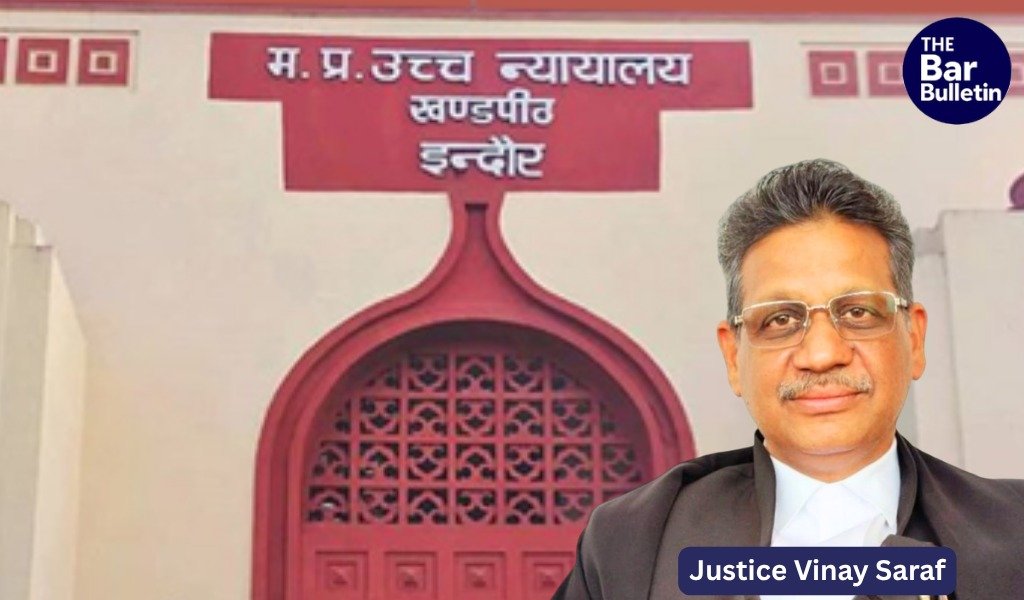

The Madhya Pradesh High Court has held that the limitation period for challenging an arbitral award under Section 34 of the Arbitration and Conciliation Act, 1996, begins from the date a party receives a certified copy of the award, even if the arbitral tribunal had not delivered the signed copy as required under Section 31(5) of the Act.
Justice Vinay Saraf dismissed an appeal filed against the rejection of an application to set aside an arbitral award as time-barred. The Court held that once the party obtains the certified copy of the award, the limitation period begins to run, and failure to challenge it within the prescribed period cannot be excused merely because the signed copy was not formally delivered.
The dispute arose from a claim filed by M/s Sulabh Syntex before the Arbitration Board of Shrimant Maharaja Tukoji Rao Cloth Market Merchants Association, Indore, seeking recovery of ₹2,28,210 for goods allegedly purchased by M/s Maheshwari Vastra Bhandar, of which the petitioner was the proprietor. On December 11, 2018, the Arbitration Board passed an ex parte award directing recovery of ₹2,27,710, along with interest and arbitration costs of ₹9,340.
The petitioner contended that she had never received the signed copy of the award from the arbitral tribunal. She obtained a certified copy on March 18, 2019, and subsequently filed an application under Section 34 seeking to set aside the award. The application was dismissed by the District Court as time-barred, prompting her appeal before the High Court.
The question before the High Court was whether the limitation period under Section 34(3) could commence from the date on which a party independently obtained a certified copy of an arbitral award, despite non-delivery of the signed copy under Section 31(5).
The High Court acknowledged that delivery of a signed copy of an arbitral award is a mandatory statutory requirement. It referred to Supreme Court decisions, including Union of India v. Tecco Trichy Engineers and Contractors and State of Maharashtra v. ARK Builders Pvt. Ltd., which emphasise that limitation ordinarily begins upon receipt of the signed award in accordance with Section 31(5).
However, the Court distinguished the present case on the ground that the petitioner had herself obtained a certified copy of the award. It held that such receipt gave her the necessary knowledge to pursue a challenge under Section 34.
It further explained that an application under Section 34 can be filed with either the signed copy or the certified copy of the award. Once the certified copy is received, a party cannot indefinitely postpone the commencement of limitation by relying on the non-delivery of the signed copy. The Court held:
“
“Once the certified copy is received and a party is aggrieved by the award and does not choose to file the application for setting aside the same within the limitation period prescribed by the law, then the party would have to suffer for the negligent inaction.”
The High Court noted that Section 34(3) prescribes a period of three months for filing an application to set aside an arbitral award, with a further period of 30 days that may be condoned if sufficient cause is established. The statute expressly bars condonation beyond that additional period.
In the present case, the petitioner obtained the certified copy on March 18, 2019, but filed her application to set aside the award only on September 16, 2019, after approximately six months. The Court rejected the contention that limitation could not begin without formal delivery of the signed copy, observing that such an interpretation would allow a party who had already obtained the certified award to enjoy an unlimited period to challenge it. The Court stated:
“
“Section 31(5) cannot be interpreted in a manner that if the Arbitral Tribunal has not delivered the signed copy of the award, then the award would not be enforceable in any case or no limitation would start to file the objections under Section 34 despite receipt of the certified copy and the party in default will enjoy the unlimited limitation.”
It concluded that the limitation period in the case began from the date the petitioner received the certified copy, and her application was filed beyond the permissible period. Accordingly, the High Court found no error in the District Court’s decision to dismiss the Section 34 application as time-barred and affirmed the impugned order.
