
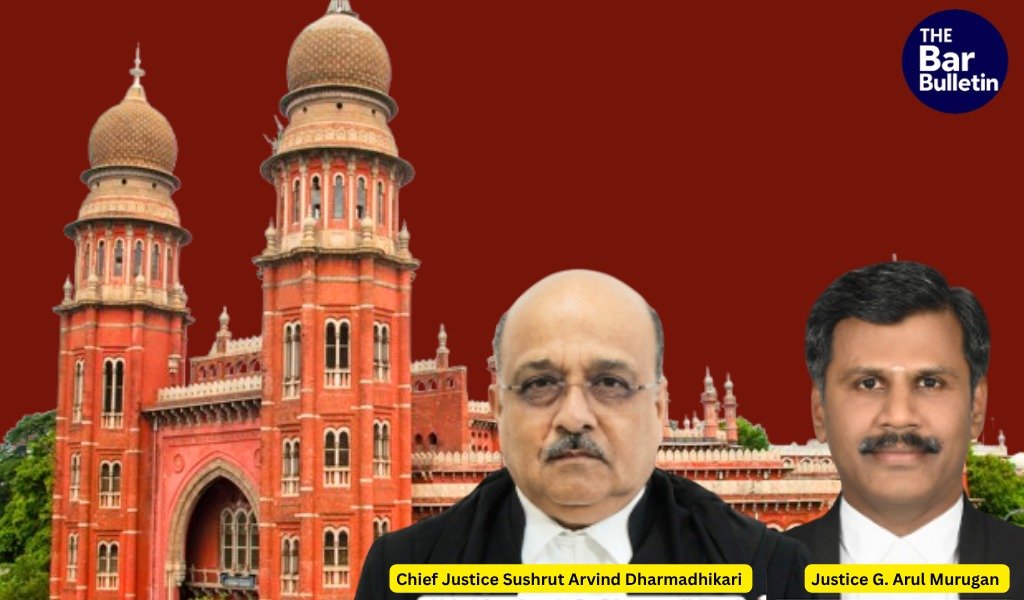

In a public interest litigation (PIL) filed before the Madras High Court seeking a direction upon the respondents to take effective preventive and penal measures against organised campaigns, public meetings, processions, demonstrations, speeches, social media publications, or other activities scandalising, intimidating or undermining the authority of the judiciary or personally targeting any sitting judge of the Court or any Constitutional court, a Division Bench of Chief Justice Sushrut Arvind Dharmadhikari and Justice G. Arul Murugan issued four directives while disposing of the petition.
The dispute traced back to a judgment delivered on 25-06-2026 by a Division Bench of the Court sitting at the Madurai Bench wherein it was declared that a government order dated 09-03-2024 was unconstitutional and it was held that a person could not claim backward class benefits purely by virtue of religious conversion, noting that such practice was inconsistent with both constitutional principles and Islamic theology.
After the judgment, several organizations, including respondents 4 and 5, launched public protests across the State of Tamil Nadu. The petitioner asserted that these actions moved past normal public criticism and became personalized, hostile and defamatory campaigns against one of the sitting members of the Division Bench. Posters were displayed, rallies were organized and videos were distributed on social media, allegedly using abusive language and caste-based remarks.
The petitioner contended that Article 19(1)(a) protected fair, reasoned criticism of legal rulings but not deliberate personal attacks, intimidation or attempts to lower the authority of the bench. It was argued that the State had a constitutional duty to maintain an environment where Judges could work without fear, favour or external pressure, and that local police failed to prevent the targeted assemblies or restrict objectionable material online, which emboldened lawbreakers and threatened public order.
The Court stated that true judicial independence meant judges must be free to decide cases solely on the law and the facts, and noted that the Supreme Court had reiterated that an independent judiciary was part of the basic structure of the Constitution. It reasoned that citizens had an undeniable right to disagree with a judgment, but that a clear legal line existed between criticizing a legal conclusion and attacking the individual judge who authored it. The Court stated that coordinated actions using abusive, defamatory or caste-based language against a sitting judge did not fall under protected free speech and violated the reasonable restrictions under Article 19(2).
The Court found that the State police had not remained entirely passive, as they denied permissions and registered cases, but noted that the widespread scale of the protests showed that regular local measures are not always enough. It was held that law enforcement agencies must act quickly and uniformly across all districts to ensure personal vitriol is not allowed to masquerade as legitimate public protest. Further, the Court held that an FIR is not an encyclopaedia of the entire incident or an exhaustive roster of offenders, that the registration of two FIRs showed criminal law had been set in motion, and that the identification of specific individuals fell within the investigation.
It was held that the mere absence of individual names at the preliminary stage did not attract the doctrine of res ipsa loquitur to imply institutional passivity, so long as the ongoing investigation process is carried to its logical conclusion. Further, the Court stated that a blanket order banning all public discussions or peaceful gatherings concerning court rulings would go too far and infringe legitimate democratic expression. However, the Court also said that the State has a strict obligation to ensure that its public spaces and digital networks are not used to threaten the safety and integrity of judicial institutions.
Thus, the Court disposed of the writ petition with four directives. First, the state police and district administration were to continue evaluating applications for public meetings, marches or protests regarding judicial matters on a strict case-by-case basis. Second, no permission was to be granted for any gathering or march aiming to personally target, defame or intimidate a sitting judge, and officers were to end any permitted assembly that turned into a personal attack and take appropriate legal action. Third, the Cyber Crime Division of the Police was directed to maintain active surveillance over digital platforms and act swiftly against criminal intimidation of sitting judges. Fourth, the police were to complete the investigation into the FIRs in a fair, thorough and expeditious manner.
