
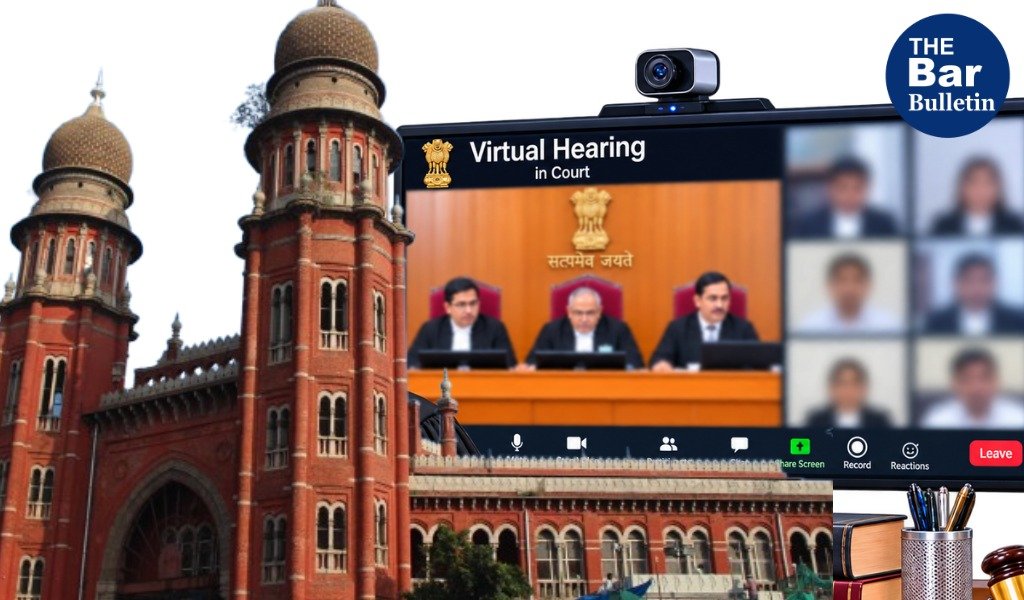

The Madras High Court has quashed criminal proceedings against an advocate accused of engaging in an obscene act with a woman while attending a virtual court hearing in December 2021, holding that the prosecution materials failed to establish the ingredients of the offences alleged against him. Justice M. Nirmal Kumar allowed a petition seeking to quash the proceedings pending before the Mahila Court, Chennai.
The case arose after a video showing the advocate allegedly engaging in an intimate act with a woman during virtual proceedings of Court Hall No.11 went viral on social media on December 20, 2021. The High Court had taken suo motu cognizance and directed the CB-CID to register an FIR.
The prosecution alleged that the advocate had exploited the woman’s financial condition and subjected her to sexual exploitation by offering money, food and clothes. He was charged under Sections 228, 294(a), 354A and 370(2) IPC, Section 4 of the Tamil Nadu Prohibition of Harassment of Woman Act and Section 67A of the IT Act.
The advocate contended that the incident took place in his private office and he was unaware that the Microsoft Teams hearing was still running in the background of his laptop. His junior had also stated that he routinely operated the laptop and had minimised the video conference on the day of the incident.
Rejecting the prosecution’s case, the Court observed that there was no material to establish that the advocate had knowingly streamed the incident or intended to interrupt judicial proceedings. It further held that the alleged act had taken place in a private office and that the prosecution had failed to establish the ingredients of sexual harassment and trafficking. The Court observed:
“
“The live feed of a video conferencing platform, which displayed because of a technical circumstance and not through any act of the petitioner directed towards publishing or transmitting the material, does not amount to publication or transmission by him within the meaning of Section 67A. There is no material of the petitioner’s knowledge, intention or volition, and the offence under Section 67A of the IT Act is not made out. Notably, the respondent, while dropping Section 292(2)(a) IPC for want of identification of the person who circulated the video, has not explained how the same circulation could continue to found a charge under Section 67A against the petitioner.”
Addressing the advocate’s contention that he had already been punished in contempt proceedings, the Court clarified that contempt proceedings and criminal prosecution were distinct and that the bar against double jeopardy under Article 20(2) of the Constitution was not attracted in the strict sense. However, it held that the question before it was whether continuation of the prosecution would be oppressive, particularly when the alleged occurrence had already resulted in contempt proceedings, imprisonment, payment of compensation and professional action by the Bar Council.
The Court clarified that its decision of quashing the criminal proceedings did not amount to approval of the advocate’s conduct.
“
“It must be made clear that this Court does not approve of the conduct of the petitioner, an advocate, which has been described by the Division Bench in strong terms, and for which he has been dealt with by the Court in contempt jurisdiction and by his professional body,” the judge observed.
Holding that the materials collected by the prosecution did not disclose the ingredients of the offences charged, the High Court quashed the criminal proceedings pending against the advocate before the Mahila Court, Allikulam, Chennai.
