
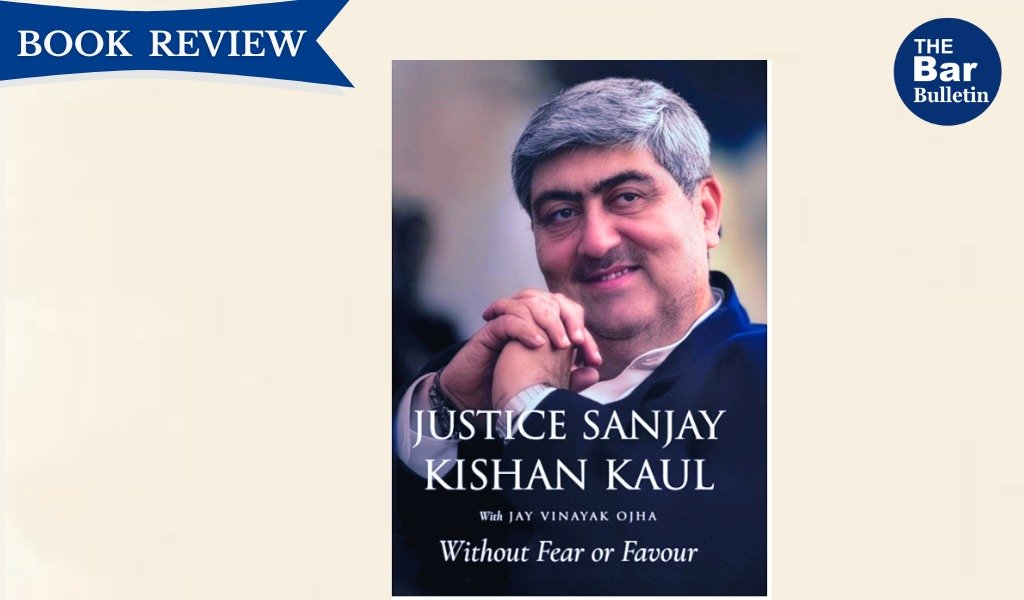

Some books recount a career; others use a life to examine the institutions and historical forces that shape a nation. Without Fear or Favour, by Justice Sanjay Kishan Kaul and Jay Vinayak Ojha, belongs to the latter category. Moving between personal history, judicial decision-making and reflections after retirement, the book offers an insider’s account of the institution entrusted with protecting the Constitution and the tensions that can emerge within it.
Divided into seven chapters, the book traces Justice Kaul’s journey from his formative years to the inner workings of the Supreme Court and, finally, to his reflections on judicial independence, arbitration, mediation and institutional reform. Its value lies not merely in the experiences it recounts, but also in the questions it raises about the exercise of judicial power, the conventions that sustain constitutional institutions and the responsibilities that accompany public office.
High Noon – The Supreme Court: Inside the Institution
‘High Noon – The Supreme Court’ is the book’s institutional centrepiece. Moving beyond judgments, it examines judicial appointments, the collegium, administrative authority and the relationship between the judiciary and the Executive. Its central concern is that judicial independence depends not only on constitutional safeguards but also on the processes and conventions through which institutional power is exercised.
The Collegium: Independence, Influence and Opacity
Justice Kaul’s account of judicial appointments raises questions about the distinction between consultation and pre-approval. While the government has a role in the appointments process, the author cautions against practices that risk allowing executive preferences to influence the collegium before it has formally deliberated.
Reflecting on his differences with Justice Dhananjay Y. Chandrachud over appointments, Justice Kaul candidly writes that he believed Chandrachud was “too deferential to the government on appointment matters.” He is careful to distinguish his position from those who oppose any government consultation. His concern, rather, is that consultation must not become a mechanism through which the Executive acquires influence over the collegium’s decisions before the collegium has formally considered them.
He elaborates on this distinction with a particularly telling observation:
“
“But there is a difference between consultation and what I came to regard as pre-approval seeking the government’s nod before the collegium had even formally deliberated. That sends the wrong signal. Any political class will always assert itself if you give them a wedge in the door. This is not in any sense a partisan matter but simply a question of the inevitable institutional dynamics of power.”
Justice Kaul’s argument is not that the Executive must be excluded from the appointments process, but that the judiciary must preserve its decisional autonomy while engaging with the government.
He drives home the point in an even more direct assessment of the appointments process:
“
“This is the reality of the appointment process. It is fantasy to imagine that the collegium is isolated from political pressures. Governments assert themselves: If you give them an opening, they will grab it. The challenge is to maintain institutional integrity while navigating these pressures.”
Rather than presenting judicial independence as an absolute separation from executive influence, Justice Kaul acknowledges the pressures that accompany appointments while emphasising the need to resist their encroachment upon institutional autonomy. His account suggests that the strength of the collegium lies not in the absence of political pressure, but in its ability to withstand it.
At the same time, Justice Kaul does not portray the collegium as an institution incapable of functioning effectively. He acknowledges its consensual character and the effort to balance merit, seniority, regional representation and diversity in judicial appointments. As he observes:
“
“At its best, the collegium is a consensual body where the best judicial talent from around the country can receive its due recognition.”
This is an important counterpoint to the book’s criticism of delays, opacity and executive interference. The collegium, in Justice Kaul’s account, remains capable of recognising judicial talent and balancing competing institutional considerations. The challenge is to ensure that these ideals are reflected consistently in its functioning.
His discussion of the National Judicial Appointments Commission (NJAC) adds further complexity to the debate. Acknowledging shortcomings in the collegium system does not necessarily mean abandoning judicial independence; equally, defending independence should not make the existing appointments process immune from criticism. Justice Kaul’s reflections suggest that institutional independence and institutional accountability need not be competing ideals.
The Craft of Judging: Reasons, Restraint and Precedent
Justice Kaul cautions against the temptation to turn judgments into extended academic discussions. As he puts it, “the invitation to pontificate is always tempting”. For him, the discipline of judging lies in resisting that temptation and remaining focused on the dispute that the court must resolve.
He acknowledges that the Supreme Court must sometimes explain legal principles at greater length, particularly in constitutional matters. Yet, even then, the purpose of a judgment remains important: to decide the case before the court and articulate the reasons necessary to reach that decision.
This emphasis becomes especially significant in a precedent-based system. Justice Kaul explains the importance of distinguishing the ratio decidendi, the reasons essential to a decision from obiter dicta, or observations that are not necessary to decide the case. When judgments contain extensive discussions beyond the issues requiring determination, distinguishing binding principles from incidental observations can become difficult.
His account offers a useful reminder that judicial writing is not simply about demonstrating legal knowledge. It is about clarity, precision and an understanding of the consequences that judicial reasoning carries for future cases.
Justice Kaul distils the structure of a judgment into “the operative part (who won?) and the reasoning (why?)”. The formulation captures a deceptively simple principle: the outcome must be clear, and the reasons must explain it. The temptation to expand a judgment beyond these essentials, he suggests, must be resisted unless the legal question genuinely requires a wider exposition.
For legal practitioners and students, this is one of the book’s most instructive reflections. It speaks to a persistent challenge in legal writing: the difference between a judgment that is intellectually expansive and one that is judicially effective.
Law Clerks, Mentorship and Accountability
Justice Kaul’s account of working with law clerks brings a more personal dimension to his judicial philosophy. His description of the relationship with his clerks as an extended family conveys the importance he attached to mentorship and the professional community built around judicial work. The relationship, he explains, continued even after clerks left his office and after his retirement.
Justice Kaul also recounted a grammatical error in a judgment of national importance. Two clerks had been involved in the work, and the mistake had altered the meaning of the judgment after it was pronounced in open court. Rather than attributing the error to them, Justice Kaul approached the Chief Justice and accepted responsibility for correcting it.
His message to the clerks was straightforward:
“
“Errors happen because you work”.
The episode illustrates a principle that extends beyond the courtroom. Responsibility, in his account, cannot be separated from authority. A judge may rely on clerks and colleagues, but the work ultimately leaves the office under the judge’s signature. Accountability therefore requires the willingness to own an error rather than shift blame to those who assisted in the process.
The 2018 Judges’ Press Conference: An Institutional Earthquake
Justice Kaul’s reflections on the January 2018 press conference by four senior Supreme Court judges provide another revealing perspective on institutional dysfunction. He describes the episode as an extraordinary rupture that exposed fault lines within the judiciary and damaged relationships within the Court.
The press conference, in which Justices Jasti Chelameswar, Ranjan Gogoi, Madan Lokur and Kurian Joseph publicly raised concerns about the functioning of the Court and the Chief Justice’s allocation of cases, remains one of the most extraordinary episodes in the Supreme Court’s recent history.
Justice Kaul’s assessment is particularly interesting because it recognises both the significance and the cost of taking internal disagreements into the public domain. He describes the division of opinion within the Court: some believed that the Chief Justice, as master of the roster, could exercise his authority as he considered appropriate; others believed the grievances were genuine but should not have been aired publicly; and some questioned the wisdom of the press conference regardless of the underlying concerns.
Justice Kaul largely aligned himself with the third position. He acknowledged that the grievances were not necessarily illegitimate, but remained unconvinced that a press conference was the right way to address them. In his assessment, the episode failed to bring the underlying issues into sufficient focus and instead generated a media frenzy.
He also reflects on the consequences for relationships within the institution. As he observes, “a loss of collegiality was inevitable”.
The underlying concern was serious: the four judges believed that politically sensitive cases were being assigned to particular Benches, bypassing seniority. Justice Kaul’s account does not dismiss the concern; rather, it questions whether taking the dispute into the public domain ultimately served its purpose.
Obiter Dicta: Reflections Beyond the Bench
‘Obiter Dicta’ turns to the questions that remained after Justice Kaul demitted office in December 2023, following more than twenty-two years as a judge. He frames his concerns about the administration of the Supreme Court as institutional rather than personal, reflecting on the limits of individual agency within a constitutional institution.
Justice Kaul’s post-retirement reflections similarly invite consideration rather than present a definitive programme for reform.
They also offer an interesting counterpoint to his insistence on restraint in judicial writing. While a judgment must remain focused on the dispute before the court, a memoir provides space to examine the institutional questions that individual judgments cannot always address. The form allows a retired judge to reflect on the processes, relationships and conventions that influence the administration of justice.
Arbitration and Mediation
Arbitration and mediation provide some of the chapter’s most forward-looking reflections. Justice Kaul raises concerns about delays and excessive judicial intervention in arbitration, particularly where prolonged scrutiny threatens the finality of arbitral awards. His discussion of curative jurisdiction in commercial disputes highlights the risk that repeated judicial intervention may weaken confidence in arbitration as an effective alternative to litigation.
The issue is not whether judicial scrutiny should disappear, but whether intervention remains proportionate to its purpose. Commercial parties must have confidence that arbitral awards will receive the finality contemplated by law if India is to strengthen its position as a destination for arbitration.
This concern connects with the book’s broader philosophy of judicial restraint. Just as judgments should not become vehicles for unnecessary exposition, arbitration should not lose its purpose through layers of intervention that undermine the finality parties sought by choosing it. In both contexts, the question is whether legal processes remain directed towards the purpose for which they exist.
Mediation offers a different perspective. Mediation can create space for solutions that address the human interests beneath a dispute, rather than simply determining which party prevails. Where litigation identifies rights and liabilities, mediation may help parties recognise the concerns that sustain a conflict and arrive at a resolution that a formal adjudication might not achieve.
Conclusion
The strength of Without Fear or Favour lies in examining the judiciary beyond its judgments. Judicial appointments, collegium functioning, roster allocation, constitutional interpretation, arbitration and mediation may appear to be separate subjects, but they converge on questions of how power is exercised, how institutions preserve public confidence and how justice is delivered in practice.
The book is particularly valuable when Justice Kaul moves from institutional controversy to the everyday craft of judging. His insistence on clear reasoning, disciplined judgments, accountability for errors and the mentorship of young lawyers reveals that judicial independence is not sustained by constitutional doctrine alone. It also depends on professional conduct, institutional culture and the willingness to take responsibility.
The book offers no easy answers. Instead, it makes a case for candour, transparent processes and a willingness to acknowledge institutional shortcomings. Its enduring value lies in the questions it leaves with readers about the responsibilities of public office and the obligation to examine the institutions through which justice is delivered.