
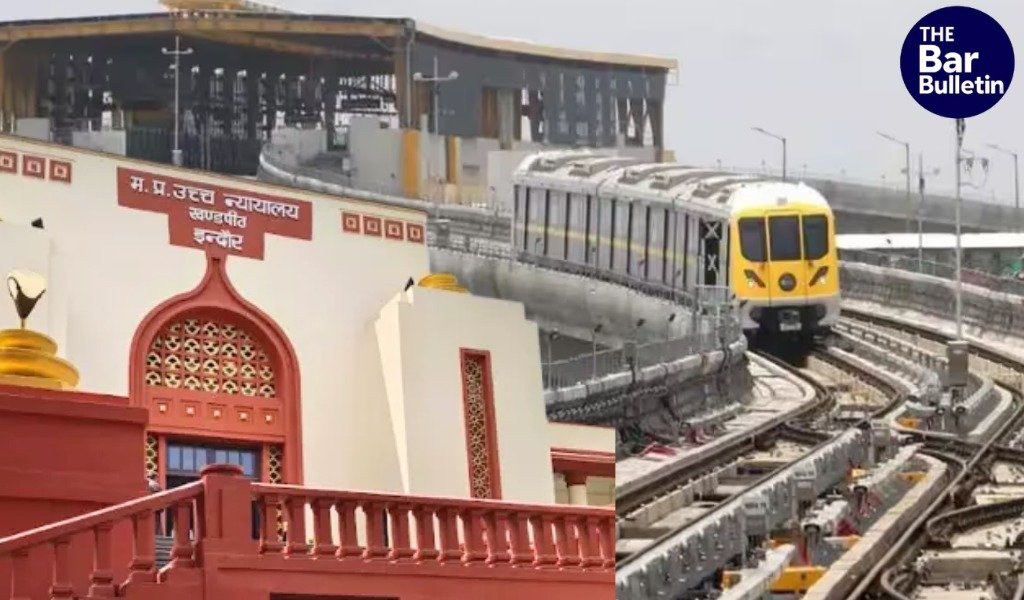

In a Public Interest Litigation filed before the Madhya Pradesh High Court seeking directions upon respondents 1 to 9 to not cut any trees from the subject land, to pass a prohibition order against M.P. Metro Rail Corporation Limited (respondent 6) while directing it to obey the Wild Life (Protection) Act, 1972, and to frame policy and guidelines regarding the transplantation policy of trees, a Division Bench of Justice Subodh Abhyankar and Justice Jai Kumar Pillai dismissed the petition since the metro alignment had already been upheld in an earlier petition, but issued directions to safeguard the birds.
The petitioner was aggrieved of the proposed construction of the underground metro station at Rani Sarai land, which would require the felling of more than 150 trees on which nests of 1000 birds would be destroyed. The Nature Volunteers’ Society also joined the petitioner as an intervener, who submitted that alternative lands were available for construction of the underground metro stations.
M.P. Metro Rail Corporation Limited submitted that the alignment had already been sanctioned and that all the due permissions from the forest department had been taken. It contended that the metro station had been squeezed to 150 meters, could not be relocated, and that the other alternative sites were not suitable. It was also mentioned that a High Level Centrally Empowered Committee had resolved to plant trees as compensatory plantation towards the 182 trees to be cut down, and that the respondents had undertaken to plant 2500 trees.
Referring to Raj Lakshmi Foundation v. State of Madhya Pradesh & Ors. (W.P. No. 10909 of 2024) which had attained finality and was binding on the Court, it was said that this Court had already taken into consideration the route that had been sanctioned for the metro rail project. Saying what cannot be done directly can also not be done indirectly, the Court found that it was the respondent’s duty to apprise the Court of the decision in Raj Lakshmi (supra), as it would have saved the Court’s valuable time and saved the parties from nurturing a false hope as considering the said decision, the petitioners had lost the petition even before it was filed.
The Court visited the site on 29-09-2026 along with the parties and saw thousands of birds, the majority of which were parrots, flocking on the trees, but found that most of the birds came there only to roost in the evening and only few had nested. It held that no case for interference was made out, and that it was unable to interfere on the principle of Stare Decisis, though it did not want the birds to lose their place to rest.
Being conscious of the plight of the birds, the Court directed that the respondents not cut all the trees at once or in any random manner. They were to proceed only under the supervision and consultation of at least two ornithologist/bird experts, in a phased manner over a period of time. The bird experts were to take into account the birds’ nest, eggs or baby birds, and a wild life rescue team was to be present on the site with nets and medical kits. Further, the respondents were directed to plant the same type of trees in the nearby area if the space was available to comply with the undertaking of planting 2500 trees, and to submit a report within one year. They were also to take care of the planted trees and file a report with Google images in the Registry every year in the month of April.
The Court allowed the intervener, a renowned environmentalist and recipient of Padma Shri award, to suggest the names of bird experts who could advise the respondents about the method of pruning the branches. The Court stated that it would be a painful process, but that this was the best that it could think of under the circumstances and directed the respondents to pay Rs.10,000/- each to the bird experts. Thus, the petition was dismissed and disposed of.
