

“
“Technology can improve justice but it can also undermine it. If poorly designed, an ODR system must never come as a result of a fast lane for unfair outcome.”
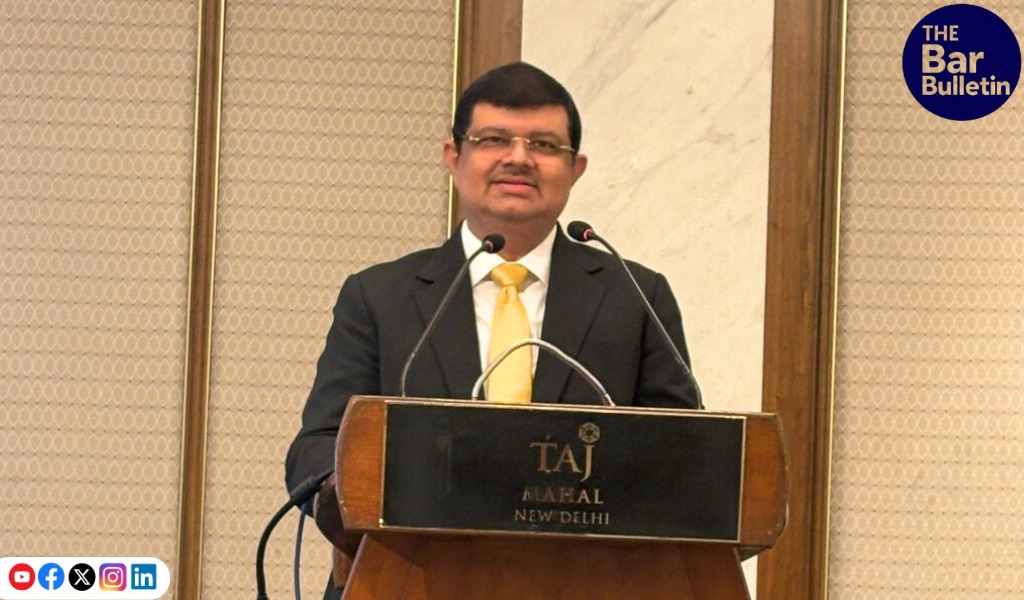
Justice Tejas Karia at the 1st DNLU ‘JUSTECH’ National Conclave.
Delivering his address at the 1st DNLU ‘JUSTECH’ National Conclave, Justice Tejas Karia dissected the persistent justice gap and the barriers that prevent individuals from accessing their rights. Advocating for Online Dispute Resolution as a formidable tool to bridge this divide, he cautioned that technology must be designed with robust safeguards and that the human element of learning and adjudication must remain paramount.
The entire session can be viewed at: https://www.youtube.com/watch?v=Jfy3qNQd7hA
The Anatomy of the Justice Gap
Justice Karia began by defining the justice gap as the disparity between a person seeking justice and their ability to actually access it. Noting that more than two thirds of humanity is unable to access justice in a meaningful way, he identified five primary barriers. The first is the cost barrier, where the expenses of court fees, lawyers, and other ancillary costs make justice unaffordable even for the deserving. The second is the accessibility barrier, encompassing distance, travel, and a lack of awareness regarding the enforcement of rights.
The third is the complexity barrier, where legal jargon and intricate procedures prevent individuals from understanding the system. The fourth is the time barrier, underscoring the adage that justice delayed is justice denied. He illustrated this with a recent anecdote:
“
“Yesterday only I was hearing a case of 2010 which I could finish in 10 minutes. But it had to wait for 16 years to get those 10 minutes from the court.”
Finally, he noted a lack of trust, where litigants hesitate to approach the judicial system or alternative dispute resolution mechanisms.
Online Dispute Resolution as a Bridge
Addressing how to bridge this gap, Justice Karia highlighted Online Dispute Resolution (ODR) as a highly effective tool. He clarified that ODR does not mean replacing judges with computers or removing the human aspect of justice rather, it provides a platform for document exchange, video conferencing, negotiations, and expert determination.
ODR improves access by allowing individuals who cannot travel hundreds of kilometers to access justice from the comfort of their homes, thereby reducing costs. It has been emphasized that ODR should be simple, fast, and efficient, without imposing disproportionate costs or delays. Furthermore, it saves time and allows litigants to multitask, attending to their daily wages while participating in proceedings. Justice Karia also noted that ODR creates valuable data which, if properly anonymized, can help identify recurring disputes and reduce the burden on courts by grouping similar cases.
Safeguards and Limitations
While advocating for ODR, Justice Karia stressed that it is not suitable for all cases, particularly criminal trials and significant constitutional matters. For consumer, family, and tenancy disputes, however, it is highly effective. He outlined essential safeguards for ODR systems ensuring equal access for all stakeholders, maintaining impartiality of the decision maker, guaranteeing privacy and cybersecurity, and obtaining informed consent.
He further emphasized the need for human oversight and the recognition of the digital divide.
“
“What we need to do is ensure that the ODR is hybrid by design. It is inclusive,” he stated, emphasizing the need to reach the last mile.
“
“Use ADR as a bridge. On one side there is a litigant who is seeking justice and the other side is a justice delivery system.”
A Message for the Future Generation
Directing his attention to the students in the audience, Justice Karia warned against the excessive reliance on artificial intelligence for research and drafting. He recalled that while traditional research involved reading numerous books and coming across irrelevant cases before finding the relevant ones, modern researchers often rely on AI searches that yield incomplete or nonexistent results.
“
“The real case which is there also doesn’t exist,”
he remarked, touching upon the issue of hallucination.
He emphasized the enduring importance of reading books and acquiring personal knowledge.
“
“Imagine you want to join a law firm and a partner is asking a question to you in an interview. Will you say to the partner that let me do research on artificial intelligence and then I will answer this question? You will have to know,”
he said, adding that a client requires immediate answers. He affirmed that lawyers who study on their own and use technology merely as a tool will be the ones who successfully bridge the justice gap.
Concluding his address, Justice Karia set a visionary goal for the legal profession.
“
“Our challenge is not simply to build digital courtrooms. It is to build a justice system in which a person’s rights do not depend on financial capacity, geographical location, language, gender, disability or digital literacy. Let us build online dispute resolution not as a substitute for justice but as a bridge to it. Let us make justice something that reaches people where they live, in a language they understand and at a cost they can afford and at the time when they need it most.”
***
“Master It and Use It as an Assistance, Not as a Driving Force”: Justice Sanjeev S. Kalgaonkar on Judicial Technology and Access to Justice
“
“We should master it and use it as an assistance, not as a guiding or driving force.”
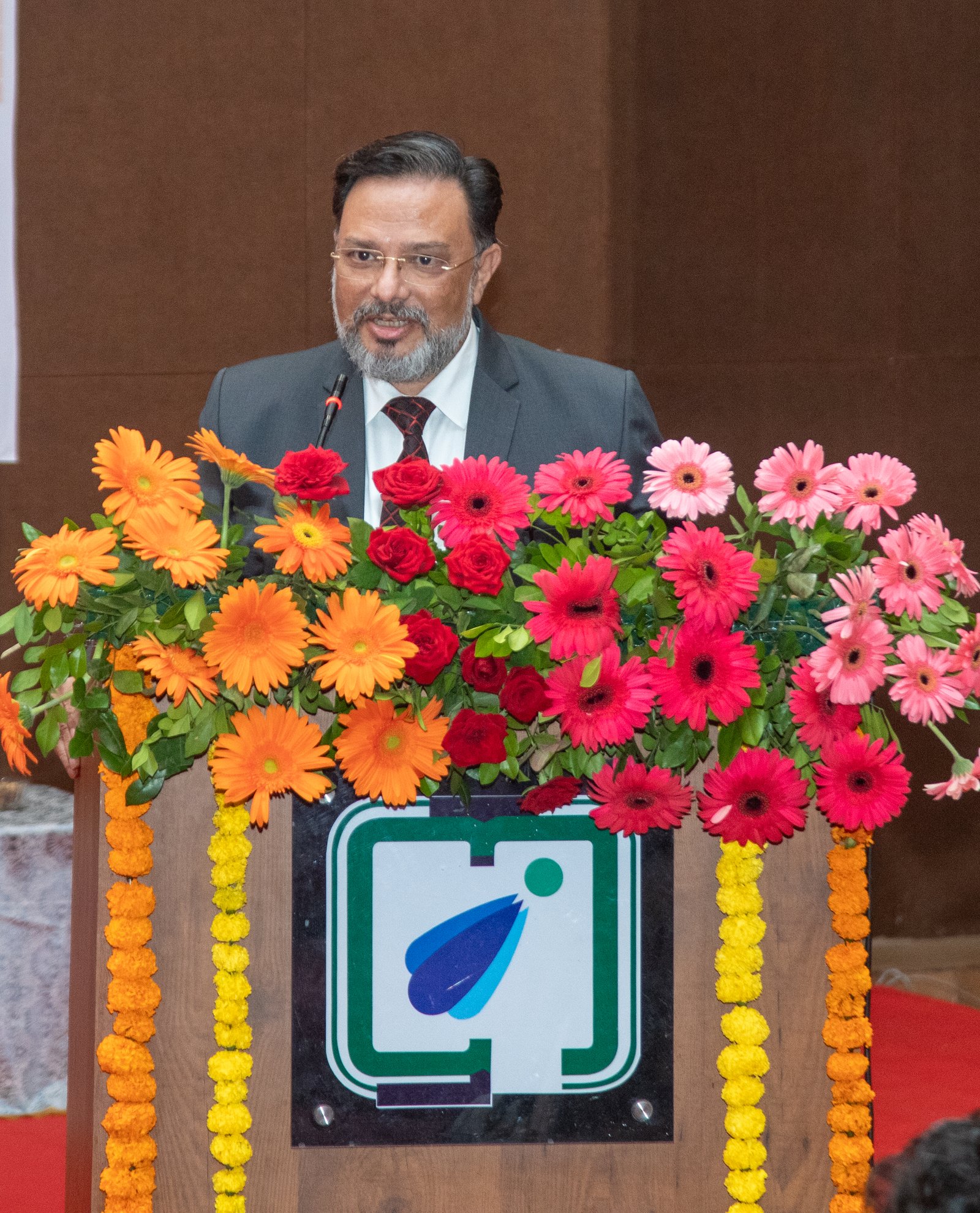
Justice Sanjeev S. Kalgaonkar at the 1st DNLU ‘JUSTECH’ National Conclave.
Speaking in the session on bridging the justice gap and democratising the legal system through judicial technology, Justice Sanjeev S. Kalgaonkar drew on his experience of three decades in the Indian judiciary, including 25 years of working on judicial technology. He described the many ways in which technology is already widening access to justice, from national platforms to simple tools introduced in Madhya Pradesh. After greeting the dignitaries on the dais, he said he could speak on his favourite subject for an entire day, but would confine himself to a few minutes.
Information, Knowledge and Wisdom
Since the main theme of the conclave was artificial intelligence, he opened with a light remark:
“
“We are living in an era where the intelligence is artificial and stupidity is natural.”
He then asked the students how they would distinguish between information, knowledge and wisdom (soochna, gyaan aur vidwatta), and offered his own answer.
Facts and data collected from books or screens are information. When critical thinking, logic and reasoning are applied to information, it becomes knowledge. When “years of lived experience refine that knowledge,” it becomes wisdom.
He recalled that a learned advocate was once admired for having the entire body of case law at his fingertips. Today, he said,
“
“the entire case law is on the tip of your thumb,”
Since a mobile phone search is enough. Whether the results are right or wrong, and the problem of hallucination, he would leave for later, but this was a vast resource. Still, what a phone gives is information. AI has now reached the stage where it can connect the dots and turn information into knowledge, but “AI has yet to reach the stage of wisdom.” Wisdom, he said, is what the judges and advocates on the dais possess, having applied critical thought to knowledge and information over the years.
FASTER: Orders Delivered in Minutes
Referring to the point made earlier by Mr. Ritin Rai, Justice Kalgaonkar recalled the Chief Justice of India’s remark from the bench during the Agra prisoners case:
“
“In this era of technology, we are still looking at the sky for pigeons to deliver our orders.”
Within 15 days, he said, the FASTER system was in place for the fast and secure communication of electronic records. Once a judge approves an order, it can reach any prison or court in the country within 15 minutes. He called it a wonderful system that directly serves the citizens of the country.
SUPACE, SUVAS and Early AI Planning
He also spoke about SUPACE (Supreme Court Portal for Assistance in Court Efficiency) and SUVAS, the Supreme Court’s translation software. Both, he pointed out, were planned around 2018 and 2019, when the term artificial intelligence was still new. He said anyone could check the tender archive of the Supreme Court’s website, where an expression of interest was issued on 24 December 2020 inviting eligible vendors to create AI-assisted case filing and case scrutiny for the Court.
The Pandemic and India’s Pioneering Role
Turning to the pandemic, he noted that a lockdown was imposed on 23 March 2020. Yet the Supreme Court ensured that
“
“the wheels of justice will not stop.”
On 25 March 2020 it began hearing matters through video conferencing. Within a week, five benches were functioning, and by 6 April 2020, a date he said he was mentioning deliberately, all courts in India were working through video conferencing and hearing urgent matters. At that time, he said, other jurisdictions were still only planning to use telecommunication.
“India pioneered in that,” he said, adding that he felt proud that the Indian judiciary led the way in the toughest period in human history.
Madhya Pradesh: E-Summons and E-Forensics
Justice Kalgaonkar then described two initiatives from Madhya Pradesh. E-summons. All courts in the State now send summons in criminal and civil cases electronically to the concerned police stations. More than 12 crore (120 million) summons have already reached police stations without paper. Considering the environmental impact, he said,
“
“1,20,000,000 summons means 2,40,000,000 papers Saved.”
E-forensics. Earlier, forensic reports often failed to reach the courts hearing bail applications. When explanations were sought after 11 or 12 months, the answer was that the report had been sent to the police station, which had not produced it in court. The e-forensic platform now delivers the report in digital form to the court on the day the scientific officer signs it. Such tools, he said, help deliver justice early.
Conclusion: AI as an Assistant
Concluding, Justice Kalgaonkar called AI a wonderful tool and said
“
“whether we like it or not, it is going to stay.”
It was therefore better to adopt it, master it, and use it only as an aid and never as the guiding or driving force. He thanked the organisers for the opportunity and said he felt privileged to share the dais with the dignitaries.
***