
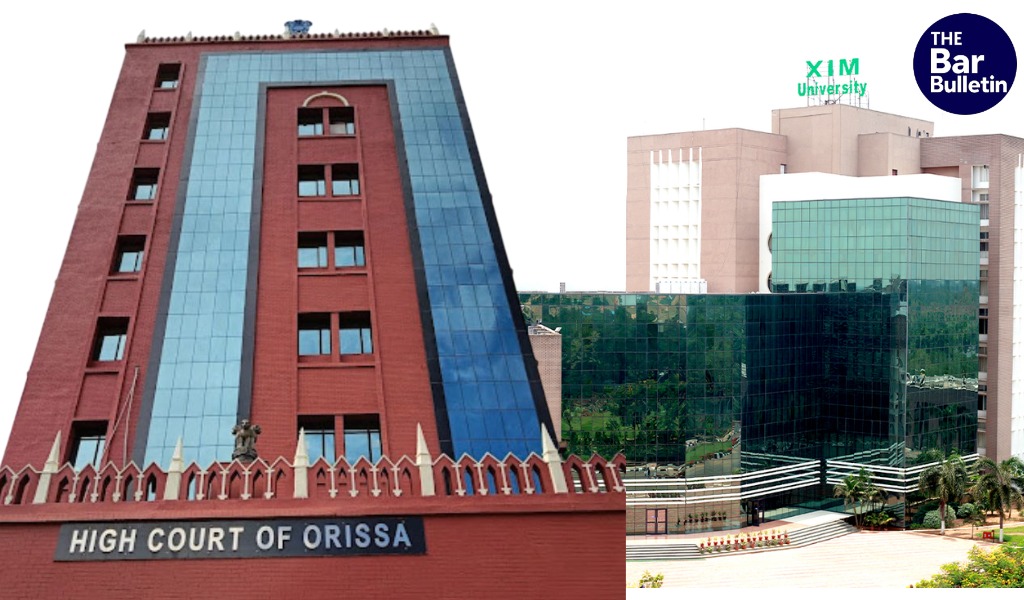

The High Court of Orissa at Cuttack Bench has held that where a student’s absence is on genuine medical grounds, is duly intimated to the University, and is acknowledged in the attendance record, the student cannot be debarred by mechanically applying the attendance rule as though it were a case of unauthorized absence. In such circumstances, the University must read its attendance, leave and examination provisions harmoniously, and where it has already extended the facility of make-up examination to undergraduate programmes, the benefit of such facility can be granted in an appropriate case.
Accordingly, the High Court held that the debarment order dated April 07, 2026 was contrary to the provisions of the Student Manual of Policies 2025-2026 and otherwise unjustified. The impugned debarment order was quashed, and the University was directed to conduct a make-up examination for the petitioner in the subject “Introduction to OB and HR” as early as possible, preferably within two weeks, without insisting that he appear in the forthcoming supplementary examination.
The Division Bench comprising Justice B. P. Routray and Justice Sashikanta Mishra found that the petitioner’s absence on 9 class dates on medical grounds was not disputed by the University, and the attendance record itself carried the endorsement “Absent Medical.” The Bench therefore accepted that the petitioner had sought leave of absence by duly intimating the authorities, and held that if those 9 classes were condoned, his attendance would become 47 out of 59 classes, i.e., 79%, instead of 64.41%.
On a conjoint reading of Clauses 10.5, 12.1 and 12.3 of the Student Manual, the Bench observed that exemption from attending classes is permissible for personal physical illness, grave personal tragedy and similar reasons up to 25%, and that leave of absence may be granted by the Dean on application with documentary evidence. Since the petitioner had applied for medical leave and the attendance record reflected the same, the Bench held that this was not a case of absence without prior permission or intimation. Therefore, the basis for debarment under Clause 10.4 was not made out.
The Bench further observed that although the Manual specifically provided make-up examination only for postgraduate courses under Clause 4.8.1, the Controller of Examinations had, by email dated March 16, 2026 approved by the Vice Chancellor, extended the facility of make-up examination to all undergraduate programmes as well. The Bench rejected the University’s contention that this order had not been acted upon, noting that the Manual itself contained a disclaimer reserving to the University the sole right to make changes in and additions to the policies. Having issued such an order, the University could not subsequently deny its effect.
The Bench also observed that where attendance shortage is not deliberate or in conscious disregard of institutional norms, the discretion to condone attendance should ordinarily be exercised in favour of the student, considering the severe consequences that may follow from refusal.
Also Read Supreme Court Declines Urgent Hearing on Plea Seeking SIT Probe into Ram Mandir Trust Donations
Briefly, the petitioner, a first-year BBM (Hons.) student of XIM University, Bhubaneswar, was debarred from appearing in the End-Semester Examination-II in the subject “Introduction to OB & HR” by notice dated April 07, 2026 on the ground that his attendance in that subject was 64.41%. He contended that during the second semester he suffered a back injury after an accidental fall and later acute respiratory tract infection with high fever, because of which he applied for medical leave with supporting documents. His absence for the relevant dates was marked by the University as “Absent Medical.” He argued that if the medically justified absence in 9 classes was taken into account, his attendance would cross the required threshold, and that instead of debarring him, the University ought to have permitted him to take a make-up examination.
The University defended the debarment by relying on the Student Manual of Policies, stating that a student must maintain minimum 75% attendance in each individual course, failing which he cannot be allowed to appear in the End-Semester Examination. According to the University, there was no provision for a make-up examination for an undergraduate student debarred for shortage of attendance in one subject; at best, such a student could take the supplementary examination in accordance with the Manual, and if debarred, would have to take it with the junior batch in the next year. The University also argued that several other students were similarly placed and had agreed to appear in the supplementary examination.
