
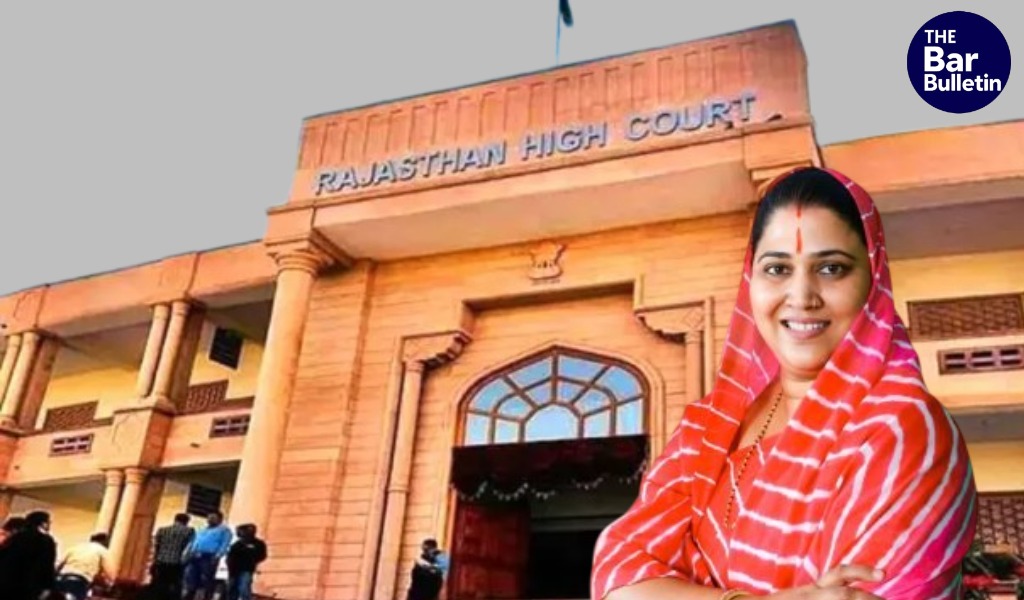

The Rajasthan High Court has dismissed an election petition challenging the election of MLA Ritu Banawat from the Bayana (076) Assembly Constituency, holding that the petitioner failed to establish any material concealment in her election affidavit or any corrupt practice warranting the setting aside of her election. However, the Court imposed costs of ₹1 lakh on the MLA for deliberately evading service of summons for nearly ten months during the pendency of the election petition.
Justice Sudesh Bansal was hearing an election petition filed by unsuccessful candidate Purushottam Lal, who had secured 689 votes in the 2023 Rajasthan Assembly elections. The respondent secured 1,05,749 votes and was declared elected. The petitioner alleged that the respondent had failed to make complete disclosures in Form-26, including details relating to social media accounts, bank accounts, assets and liabilities, and contended that such omissions amounted to corrupt practices rendering her nomination liable to rejection under Sections 100 and 123 of the Representation of the People Act, 1951.
Before examining the allegations, the Court undertook an extensive survey of the law governing candidate disclosures. It referred to Union of India v. Association for Democratic Reforms, (2002) 5 SCC 294, and People’s Union for Civil Liberties (PUCL) v. Union of India, (2003) 4 SCC 399, which recognised the voters’ fundamental right under Article 19(1)(a) to know material information about electoral candidates, resulting in mandatory disclosures through Form 26. The Court further relied on Resurgence India v. Election Commission of India, (2014) 14 SCC 189, Krishnamoorthy v. Sivakumar, (2015) 3 SCC 467, and Public Interest Foundation v. Union of India, (2019) 3 SCC 224, which emphasise that while Returning Officers may reject nomination papers containing material blanks, every omission does not automatically invalidate an election.
The Court also considered the Supreme Court’s decisions in Lok Prahari v. Union of India, (2018) 4 SCC 699, S. Rukmani Madegowda v. State Election Commission, (2022) 18 SCC 1, and Karikho Kri v. Nuney Tayang, (2024) 15 SCC 112, which clarify that non-disclosure of assets may amount to a corrupt practice only where the omission is material and substantial, and not where it is merely technical or insignificant. The High Court ultimately placed principal reliance on the recent decision in Ajmera Shyam v. Smt. Kova Laxmi & Ors., (2026) 3 SCC 373, wherein the Supreme Court held that courts must determine whether there has been substantial compliance with disclosure requirements before interfering with an election, and that insignificant or procedural defects should not defeat the popular mandate.
Applying these principles, the High Court examined each allegation individually.
● Non-disclosure of social media accounts: The Court held that although Facebook and Twitter accounts were not specifically mentioned, the candidate had disclosed her mobile number and email address through which the accounts were easily traceable. The omission neither concealed any material information nor affected the election.
● Non-disclosure of an SBI bank account: The Court found that the account was practically non-operative, contained only a nominal balance and had already been reflected in the income tax returns. The omission was held to be trivial and not deliberate.
● Non-disclosure of separate bank accounts and alleged undervaluation of the husband’s vehicles: The Court held that the total movable assets had been disclosed, the petitioner failed to establish suppression of assets beyond the declared value, and there was no evidence proving intentional undervaluation of the vehicles, particularly considering depreciation and resale value.
● Incorrect particulars regarding agricultural land and other immovable properties: Allegations relating to incorrect measurements, omission of khasra numbers, an agreement to sell one property, and alleged concealment of commercial or residential properties were rejected for want of evidence. The Court found either satisfactory explanations or complete absence of proof that the properties had been concealed.
● Concealment of source of income: The petitioner alleged that the candidate had disclosed only agricultural income despite earlier declaring transportation business and later showing wholesale and retail trade in income tax returns. The Court held that changes in sources of income over different years did not establish concealment and did not amount to a substantial defect.
● Blank or incomplete columns in Form 26: The Court rejected objections regarding certain unfilled columns, including apartment details and government accommodation, holding that the information furnished substantially complied with the disclosure requirements and the alleged omissions were neither misleading nor material.
Applying these principles, the Court concluded that none of the alleged defects constituted corrupt practice, improper acceptance of nomination, or non-compliance of such a substantial nature as would justify invalidating the election. The Court observed:
“
“This Court does not find any force therein to hold that respondent No.1 is guilty of adopting corrupt practice, or that her nomination was improperly accepted by the Returning Officer or her nomination suffers from a serious defect of substantive character which either violates the mandate of law or materially affected her election.”
Having upheld the respondent’s election, the Court nevertheless strongly criticised her conduct during the proceedings. It recorded that despite repeated attempts through court process servers, registered post, WhatsApp, email, and even an enquiry by the District Judge, the respondent avoided service of summons and ultimately appeared only after service was effected through the Secretary of the Rajasthan Legislative Assembly. Condemning the conduct, the Court observed:
“
“Respondent No.1 should not have adopted such modus operandi to delay and deter the proceedings of election petition… this Court strongly deprecates the conduct and practice followed by respondent No.1 to avoid her presence in this election petition for a long period of about 10 months.”
Accordingly, while dismissing the election petition, the Court directed Banawat to pay ₹1 lakh as costs to the election petitioner within thirty days for following “a wrong precedent” by deliberately delaying the proceedings through evasion of court summons.
